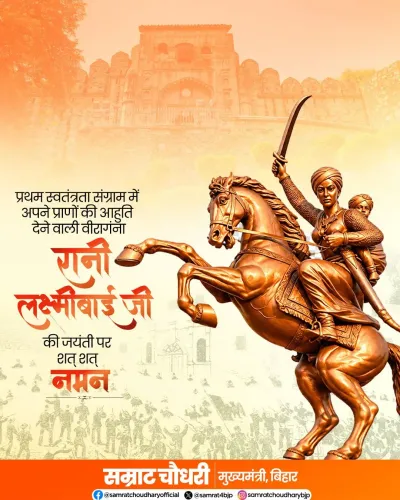
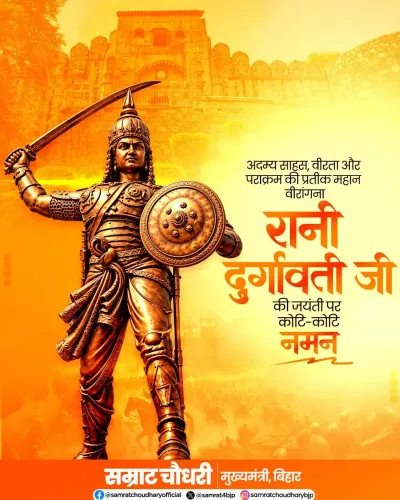
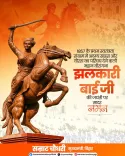
CM Samrat Choudhary pays tribute to Jhalkari Bai on her birth anniversary
Synopsis
Bihar Chief Minister Samrat Choudhary paid tribute to Dalit warrior Jhalkari Bai on her birth anniversary, honouring her courage during the 1857 First War of Independence and calling her sacrifice an eternal national inspiration.
Key Takeaways
Bihar CM Samrat Choudhary posted a tribute to Jhalkari Bai on her birth anniversary on 22 November 2026 .
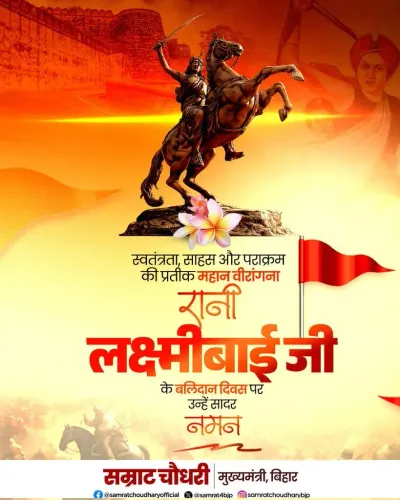
Jhalkari Bai was a Dalit woman warrior who fought alongside Rani Lakshmibai during the 1857 First War of Independence .
She is credited with a rearguard action at Jhansi Fort that helped the Rani escape British encirclement.
She holds deep cultural significance for Dalit communities as a symbol of marginalised courage in India's freedom struggle.
The tribute is part of a broader pattern of BJP leaders marking anniversaries of 1857 figures, emphasising women and lower-caste contributions.
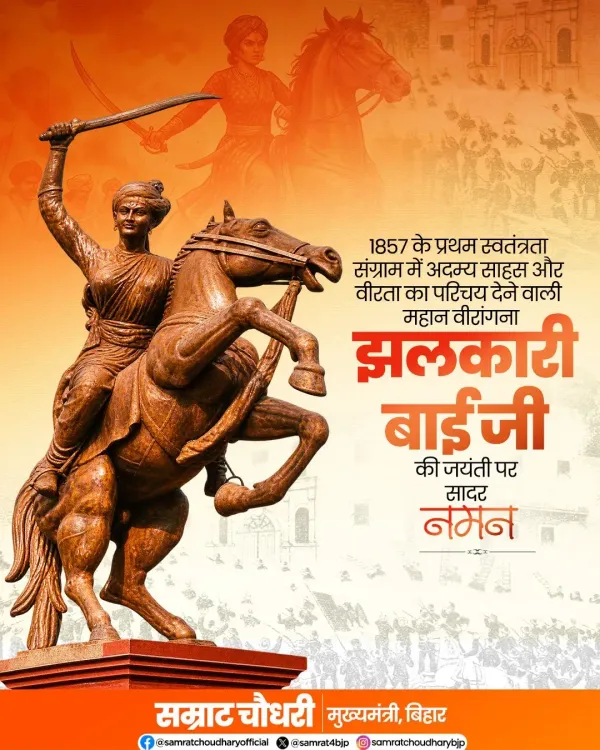
A Dalit woman who stood shoulder to shoulder with Rani Lakshmibai during India's first organised uprising against British rule was remembered on Sunday, 22 November 2026 — as Bihar Chief Minister Samrat Choudhary offered his homage to warrior Jhalkari Bai on her birth anniversary.
Posting in Hindi on X, CM Choudhary wrote: '1857 के प्रथम स्वतंत्रता संग्राम में अदम्य साहस और शौर्य का परिचय देने वाली वीरांगना झलकारी बाई जी की जयंती पर कोटि-कोटि नमन।' — 'Countless salutations to the brave Jhalkari Bai, who displayed indomitable courage and valour in the First War of Independence of 1857. Her sacrifice, dedication and bravery towards the nation will always inspire us.'Who was Jhalkari Bai — and why she still matters
Jhalkari Bai was a Dalit warrior from the Jhansi region of central India who rose to prominence during the 1857 revolt — widely recognised as the first major organised resistance to British colonial rule across northern and central India. Serving in the women's military wing of Rani Lakshmibai's forces, she was noted for her battlefield courage and her role in the defence of Jhansi Fort. Historical accounts credit her with a daring rearguard action that helped the Rani escape encirclement by British forces — an act of sacrifice that passed largely unsung for generations. Her story carries particular resonance for Dalit communities, who claim her as a symbol of marginalised courage that mainstream historical narratives long overlooked.Tributes, memory, and the politics of inclusive nationalism
CM Choudhary's post is part of a well-established pattern among Indian political leaders — including those from the BJP — of marking birth anniversaries of 1857 participants on social media, with deliberate attention to women and lower-caste figures. These commemorations serve a dual purpose: honouring genuine historical contributions and actively reshaping public memory around a more inclusive idea of the independence struggle. For Bihar — a state where caste identity remains a live electoral force — paying tribute to a Dalit woman warrior is as much a signal of political outreach as it is an act of historical recognition. The 1857 uprising involved not just princes and sepoys, but artisans, farmers, and women from communities whose roles history textbooks have only recently begun to acknowledge. The legacy of Jhalkari Bai endures in statues, folk songs, and local commemorations across Uttar Pradesh and Madhya Pradesh — and each anniversary reignites the conversation about which stories a nation chooses to tell about itself.Point of View
Such commemorations function simultaneously as cultural outreach and electoral messaging. The pattern across the party suggests a coordinated historical-memory project, not merely individual sentiment. As more unsung figures of the independence era receive institutional recognition, the question of which stories get memorialised — and by whom — remains a contested but consequential political terrain.
NationPress
22 Nov 2026
Frequently Asked Questions
Who was Jhalkari Bai?
Jhalkari Bai was a Dalit woman warrior from the Jhansi region who served in the women's military wing of Rani Lakshmibai's forces during the 1857 First War of Independence. She is celebrated for her courage at Jhansi Fort and her role in helping the Rani evade British capture.
What is Jhalkari Bai's connection to Rani Lakshmibai?
Jhalkari Bai served as a soldier in Rani Lakshmibai's army in Jhansi. Historical accounts describe her as a close aide who reportedly disguised herself as the Rani during the 1857 battle, drawing British attention and allowing Lakshmibai to escape — an act of extraordinary personal sacrifice.
Why is Jhalkari Bai significant for Dalit communities?
Jhalkari Bai is claimed as a hero by Dalit communities across India because she was from a marginalised caste yet played a pivotal role in the 1857 revolt. Her story challenges the dominant narrative that the freedom struggle was led solely by upper-caste or royal figures.
Why did Bihar CM Samrat Choudhary post a tribute to Jhalkari Bai?
CM Choudhary posted the tribute on the occasion of Jhalkari Bai's birth anniversary, honouring her sacrifice during the 1857 First War of Independence. The gesture also reflects the BJP's broader effort to highlight the contributions of Dalit and women warriors in India's independence struggle.
What was the 1857 First War of Independence?
The 1857 First War of Independence was a major uprising against British colonial rule involving sepoys, rulers, and civilians across northern and central India. It is widely regarded as the first large-scale organised resistance to British authority on the subcontinent.