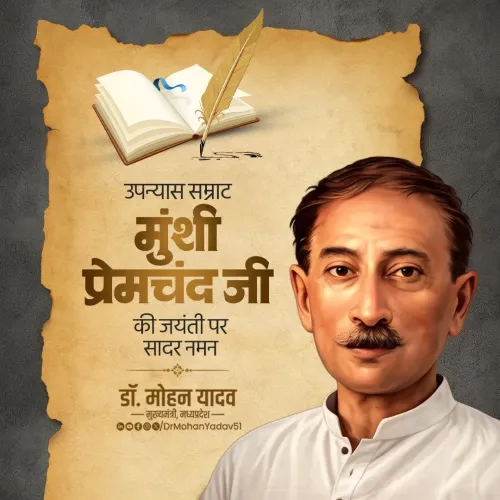
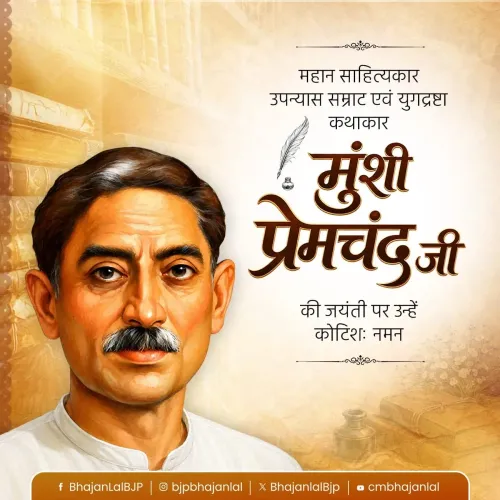
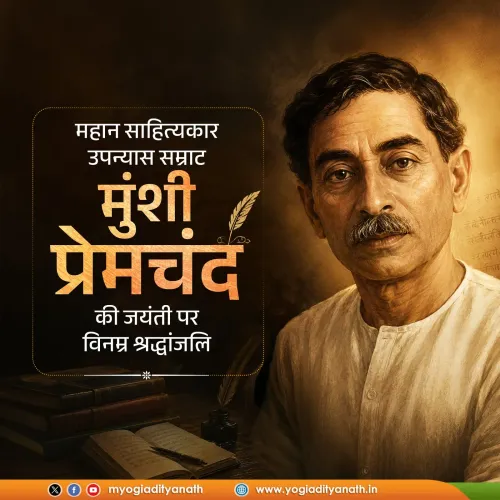
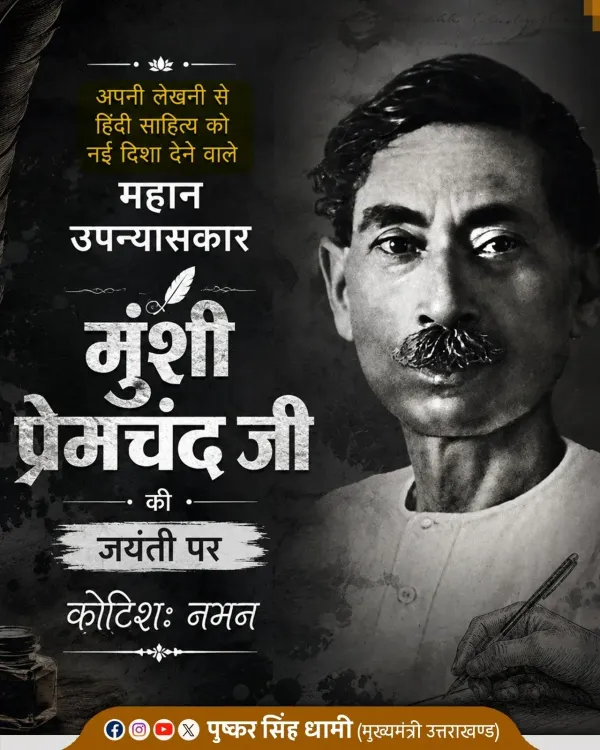
CM Dhami pays tribute to Munshi Premchand on Jayanti
Synopsis
Uttarakhand Chief Minister Pushkar Singh Dhami honoured Munshi Premchand on his birth anniversary on 31 July 2026, calling him the 'emperor of the novel' and praising his timeless message of truth, equality, and human values.
Key Takeaways
CM Pushkar Singh Dhami posted a tribute to Munshi Premchand on 31 July 2026 , his birth anniversary.
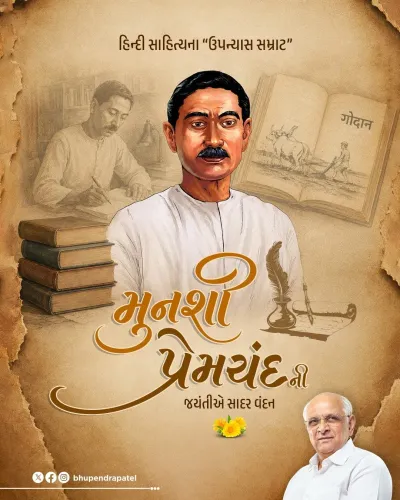
Dhami described Premchand as 'upanyas samrat' (emperor of the novel) and an unparalleled storyteller.
Munshi Premchand (1880–1936) is celebrated for realist Hindi-Urdu fiction addressing rural poverty, caste, and human dignity.
His landmark works include Godan and Gaban , still central to the Hindi literary canon.
Premchand Jayanti on 31 July draws tributes from political leaders across party lines every year.
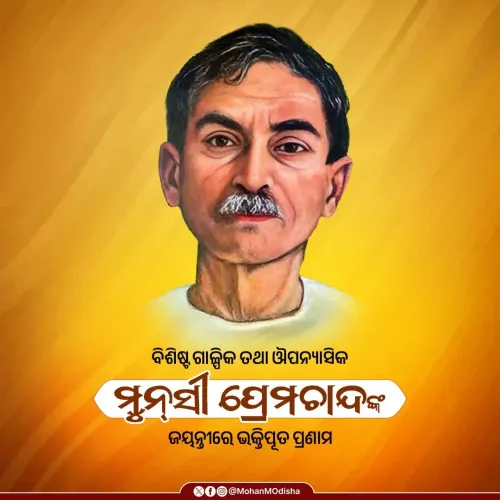
On the birth anniversary of one of Hindi literature's most enduring voices, Uttarakhand Chief Minister Pushkar Singh Dhami on Friday, 31 July 2026 paid homage to Munshi Premchand, saluting the writer's legacy of realism, sensitivity, and social conscience.
In his post, CM Dhami described Premchand as 'upanyas samrat' — the emperor of the novel — and a storyteller without equal, writing: 'Your timeless works will continue to deliver the message of truth, sensitivity, equality, and human values to society.'
Who was Munshi Premchand — and why he still matters
Munshi Premchand (1880–1936) transformed Hindi-Urdu fiction by turning the lens on rural poverty, caste discrimination, and the quiet dignity of ordinary lives. Works such as Godan and Gaban remain cornerstones of the modern Hindi literary canon, studied in schools and universities across the country more than eight decades after his death.
His writing was not merely aesthetic — it was a social mirror. At a time when Indian literature was dominated by mythological and romantic themes, Premchand insisted on the village, the farmer, the widow, and the indebted labourer as worthy subjects of serious fiction. That insistence changed the course of Hindi letters permanently.
Premchand Jayanti and the annual chorus of commemoration
Every 31 July, political leaders across the spectrum — from the ruling dispensation to the opposition — mark Premchand Jayanti with public tributes. The observance has become a fixture in India's cultural calendar, reflecting a broad, cross-party consensus on Premchand's place in the national imagination.
For a hill state like Uttarakhand, where Hindi is the primary language of public life, the anniversary carries particular resonance. Premchand's themes of agrarian struggle and rural dignity speak directly to communities whose lives have long revolved around the land.
Premchand's birth anniversary is not just a literary date on the calendar — it is a recurring national reminder that the questions he posed about inequality and human worth remain unanswered. Leaders who invoke his name inherit the obligation to take those questions seriously.
Point of View
Cutting across ideological lines — a signal of how deeply his social realism is woven into the national cultural fabric. For the BJP, invoking Premchand serves a dual purpose: it aligns the party with mainstream Hindi cultural identity while sidestepping the more contentious aspects of his progressive, often anti-establishment worldview. CM Dhami's tribute, framed around 'truth, equality, and human values,' stays safely within the celebratory register without engaging the harder policy questions Premchand's work implicitly raises. The real test of such commemorations lies not in the posts they generate, but in whether the agrarian and social inequalities Premchand chronicled see any meaningful redress.
NationPress
14 Sept 2026
Frequently Asked Questions
When is Munshi Premchand's birth anniversary?
Munshi Premchand was born on 31 July 1880 , and his birth anniversary — known as Premchand Jayanti — is observed every year on that date across India.
Why is Munshi Premchand called 'Upanyas Samrat'?
Premchand earned the title 'Upanyas Samrat' (emperor of the novel) for his prolific and pioneering contribution to Hindi-Urdu fiction, particularly his realist portrayals of rural life, poverty, and social inequality in works like Godan and Gaban .
What did CM Dhami say about Munshi Premchand?
Uttarakhand Chief Minister Pushkar Singh Dhami described Premchand as a great literary figure who gave Hindi literature new direction in realism, sensitivity, and social consciousness, adding that his timeless works would continue to spread the message of truth, equality, and human values.
What are Munshi Premchand's most famous works?
Premchand's most celebrated works include the novels Godan and Gaban , along with hundreds of short stories. His fiction is a staple of Hindi and Urdu literary education across India.
Why do Indian politicians tribute Premchand every year?
Premchand is regarded as the father of modern Hindi-Urdu realist fiction and holds a central place in India's cultural heritage. Premchand Jayanti on 31 July has become a fixture in the national calendar, drawing tributes from leaders across all major political parties.