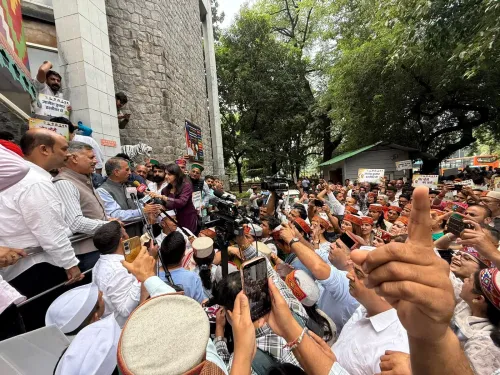
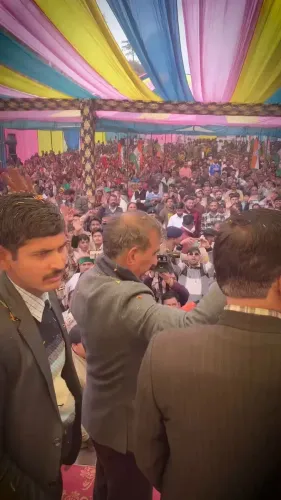
CM Sukhu Raises Alarm Over Electoral Roll Process Ahead of 2027 Polls
Synopsis
HP Chief Minister Sukhvinder Singh Sukhu warns that deleting even 2,000-3,000 votes per seat through the SIR electoral roll process can upend election results, vowing to mobilise public awareness against what he calls vote theft ahead of the 2027 state polls.
Key Takeaways
CM Sukhvinder Singh Sukhu posted on 18 October 2026 calling out the electoral roll revision process referred to as SIR .
He argued that a loss of two to three thousand votes per constituency is enough to change the outcome of an entire election.
Sukhu framed his party's opposition as a duty — directed against 'those who capture power by stealing votes.' The post explicitly mentions a goal of public awareness , signalling a grassroots mobilisation strategy.
Himachal Pradesh is due to hold its next assembly elections in 2027 , making voter-roll accuracy a high-stakes concern.
The Election Commission of India has not yet responded publicly to the Chief Minister's remarks.
A swing of two to three thousand votes in a single constituency can flip an entire election — and that, Himachal Pradesh Chief Minister Sukhvinder Singh Sukhu argued on Sunday, 18 October 2026, is precisely why his party is demanding accountability over the ongoing electoral roll revision process known as SIR.
Posting in Hindi on X, Sukhu framed the issue in stark democratic terms: 'अगर एक विधानसभा क्षेत्र से दो-तीन हज़ार वोट भी कट जाएँ, तो चुनाव का पूरा समीकरण बदल सकता है।' ('If even two to three thousand votes are cut from a single assembly constituency, the entire electoral equation can change.') His conclusion was pointed — speaking out against SIR is not just a political choice, it is, he said, an obligation.Votes 'Stolen Through the Back Door'
Sukhu's post draws a clear distinction between electoral competition and what he characterises as the manipulation of voter rolls. 'Our opposition,' he wrote, 'is against those who capture power by stealing votes, and our purpose is to make the public aware.' The framing is deliberate: this is not a complaint about losing at the ballot box, but an allegation that the ballot box itself may be tampered with before polling day even begins.
Electoral roll revisions — conducted periodically by the Election Commission of India as Special Summary Revisions — involve adding newly eligible voters and removing duplicate or ineligible entries. When done accurately, the process strengthens electoral integrity. Critics, however, have historically argued that poorly supervised revision exercises can result in the wrongful deletion of genuine voters, disproportionately affecting specific communities or constituencies.
Why 2027 Makes Every Deleted Name Count
Himachal Pradesh heads back to the polls in 2027. The state's assembly elections have historically been decided on wafer-thin margins — the kind of margins where, as Sukhu notes, a few thousand missing votes in a handful of seats can determine which party governs Simla. The Indian National Congress won power in 2022 and will be defending its majority with no room for statistical surprises on the rolls.
Across India, debates over electoral rolls sharpen predictably as election season approaches. Parties of every stripe have at various points alleged errors or irregularities in voter lists — the issue cuts across ideological lines. What makes Sukhu's intervention notable is its timing and its explicit call to 'make the public aware,' signalling that the Congress in Himachal Pradesh intends to turn voter-roll transparency into a grassroots mobilisation issue rather than merely a legal one.
The Election Commission of India has not yet publicly responded to the Chief Minister's remarks. Any formal challenge or representation from the state government to the Commission is likely to draw sharp attention in the months ahead.
With 2027 on the horizon, every name on the voter list — and every name that disappears from it — is now political.
Point of View
Transforming a technical administrative process — electoral roll revision — into a narrative of democratic threat that the Congress can take to every booth worker and village meeting in Himachal Pradesh. By attaching an emotive charge ('vote theft,' 'stolen power') to a process the average voter rarely notices, the party is attempting to build vigilance at the grassroots level well before the 2027 campaign formally begins. The move also puts the Election Commission on notice that any anomalies in the rolls will face public and political scrutiny. Historically, whichever party controls the dominant narrative around electoral credibility often holds a structural advantage in close contests.
NationPress
18 Oct 2026
Frequently Asked Questions
What is SIR in the context of elections in Himachal Pradesh?
SIR stands for Special Summary Revision, a periodic process conducted by the Election Commission of India to update electoral rolls by adding eligible new voters and removing ineligible or duplicate entries. CM Sukhu has raised concerns that this process could be misused to wrongfully delete genuine voters.
Why is Sukhvinder Singh Sukhu speaking against SIR now?
Himachal Pradesh is scheduled to hold assembly elections in 2027, and Sukhu argues that even small-scale deletions of legitimate votes — as few as 2,000 to 3,000 per constituency — can shift election outcomes. He says raising public awareness now is a democratic obligation.
When are the next Himachal Pradesh assembly elections?
The next Himachal Pradesh assembly elections are due in 2027. The Indian National Congress, led in the state by Chief Minister Sukhu, is seeking to defend the majority it won in the 2022 elections.
Has the Election Commission of India responded to CM Sukhu's remarks?
As of 18 October 2026, there is no public response from the Election Commission of India to Chief Minister Sukhu's post criticising the SIR electoral roll process.
Is concern about electoral roll revisions unique to Himachal Pradesh?
No. Across India, political parties of various ideological leanings have periodically raised objections to electoral roll revisions, citing risks of inaccuracies or selective deletions that could disadvantage certain voters. Such debates typically intensify ahead of state or national elections.