CM Sukhu reaffirms Himachal's rights fight from Oak Over

Synopsis
Chief Minister Sukhvinder Singh Sukhu, posting from Oak Over in Shimla on 7 November 2026, described an early-morning gathering of well-wishers and reaffirmed his government's commitment to pursuing Himachal Pradesh's rights and honour with full strength.
Key Takeaways
CM Thakur Sukhvinder Singh Sukhu posted from his official residence Oak Over, Shimla on 7 November 2026 .
Well-wishers arrived at Oak Over from early morning to offer congratulations, details of the specific occasion were not disclosed.
Sukhu described the public affection as giving him confidence and reaffirmed the government's resolve on Himachal Pradesh's rights.
The post used the phrase 'haq aur samman' (rights and honour) — language consistent with the Sukhu government's centre-state messaging since December 2022 .
Himachal Pradesh has ongoing claims related to power revenue, water sharing, and central fund allocations.
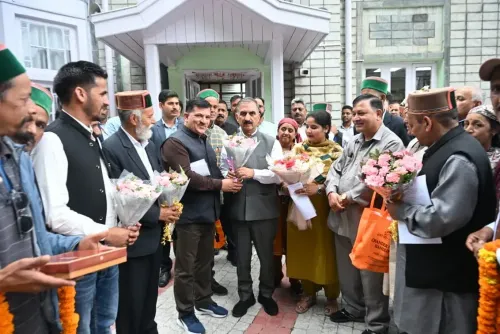
Well-wishers began arriving at Oak Over, Shimla from early morning — and Chief Minister Thakur Sukhvinder Singh Sukhu did not miss the moment. On Saturday, 7 November 2026, the Chief Minister's Office of Himachal Pradesh shared Sukhu's personal note on the outpouring of public affection and renewed his pledge to keep pressing for the hill state's rights and dignity.
Posting from his official residence, Sukhu wrote in Hindi: 'unka sneh aur vishwas dekhkar achha laga' — 'seeing their affection and trust felt good.' He added that on matters tied to the 'rights and honour of Himachal Pradesh', the government would continue to put its case forward 'with full strength'.A morning of congratulations at Oak Over
The Chief Minister's note describes a scene of spontaneous public warmth — people converging on Oak Over, the official CM residence in Shimla, from the morning hours to offer felicitations. Sukhu framed their presence not as a personal tribute but as an expression of trust in the government's broader stance. The specific occasion prompting the congratulations was not detailed in the post.
Sukhu's standing pledge on state rights
Since taking charge in December 2022, the Sukhu government has consistently flagged Himachal Pradesh's pending claims — on power revenue, water-sharing arrangements, and central fund allocations. The language in this post — 'rights and honour' (haq aur samman) — mirrors the framing the CM has used repeatedly when addressing centre-state friction. It is a signal aimed as much at New Delhi as at a domestic audience.
Himachal Pradesh, a small hill state heavily reliant on hydropower earnings and central transfers, has an outsized stake in how federal resource-sharing formulas are drawn. State governments across the political spectrum have periodically made similar reassertions; Sukhu's Congress administration has made it a consistent thread in its public communication.
What this moment tells us about state politics
The image Sukhu paints — of residents arriving unbidden, of a government absorbing popular goodwill and translating it into resolve — is a recognisable grammar of Indian state politics. Chief ministers routinely anchor policy messaging in visible local support; it simultaneously validates past decisions and sets up future demands on the Centre as expressions of democratic mandate rather than factional interest. The pattern is common across parties, but the timing and visibility of such moments still carry political weight.
Any concrete follow-up — a delegation to New Delhi, a formal memorandum on pending dues, or a statement on a specific demand — will tell us whether this is the opening note of a fresh push or a reaffirmation of existing positions.
Point of View
The CM keeps the message broad enough to cover multiple fronts — power revenue, water sharing, central transfers — without committing to a particular timeline. This is consistent with the Congress government's posture since taking power in late 2022, when it inherited a fiscal position that made federal resource claims politically necessary. The broader pattern across Indian states suggests such reaffirmations often precede formal delegation visits or budget-season demands to New Delhi.
NationPress
7 Nov 2026
Frequently Asked Questions
What did CM Sukhu say at Oak Over on 7 November 2026?
Chief Minister Sukhvinder Singh Sukhu said well-wishers gathered at Oak Over, Shimla from early morning and that seeing their affection and trust felt good; he pledged to continue pressing for Himachal Pradesh's rights and honour with full strength.
What is Oak Over in Shimla?
Oak Over is the official residence of the Chief Minister of Himachal Pradesh, located in Shimla.
What rights is CM Sukhu referring to for Himachal Pradesh?
Since taking office in December 2022, the Sukhu government has pursued pending state claims including hydropower revenue, water-sharing arrangements, and allocations from central government funds.
When did Sukhvinder Singh Sukhu become Chief Minister of Himachal Pradesh?
Thakur Sukhvinder Singh Sukhu became Chief Minister of Himachal Pradesh in December 2022, after the Congress party won the state assembly elections.
Why does Himachal Pradesh frequently raise centre-state rights issues?
Himachal Pradesh is heavily dependent on hydropower earnings and central fiscal transfers, making federal resource-sharing formulas particularly consequential for the state's finances; successive governments have raised these claims with the Centre.