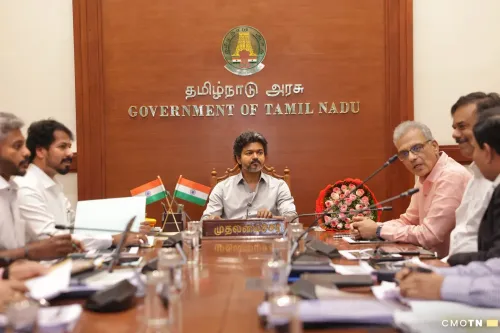
CM Vijay Chairs Review Meet on Crimes Against Women, Children
Synopsis
Chief Minister S. Joseph Vijay on 25 May 2026 chaired a Secretariat-level review with Tamil Nadu Police, the Social Welfare Department, and the Government Pleader to assess crimes against women and children, fast-track pending cases, and strengthen preventive and awareness measures.
Key Takeaways
Joseph Vijay chaired the review meeting on 25 May 2026 at the Tamil Nadu Secretariat, Chennai .
The meeting covered three areas: status of crimes against women and children, expediting case proceedings, and preventive and awareness measures.
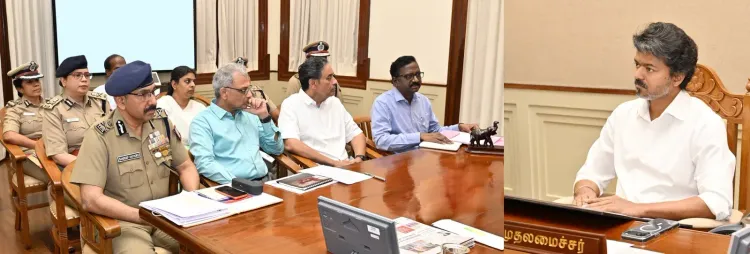
Participants included senior officials from Tamil Nadu Police , the Social Welfare Department , and the Government Pleader's office .
Tamil Nadu has operated all-women police stations since the 1990s and expanded fast-track courts after the 2012 Nirbhaya case .
The review signals a whole-of-government approach spanning investigation, prosecution, and social welfare.
The Chief Minister's Office of Tamil Nadu announced on Monday, 25 May 2026 that Chief Minister S. Joseph Vijay chaired a high-level review meeting at the Secretariat in Chennai to examine crimes against women and children, ways to expedite pending cases, and strategies for preventive action and public awareness.
The Tamil-language post from the official CMO account stated that the meeting — held under the Chief Minister's chairmanship — brought together senior officials from the Tamil Nadu Police, the Social Welfare Department, and the Government Pleader's office to conduct a comprehensive review. The agenda covered three broad pillars: the current status of crimes against women and children, measures to fast-track case proceedings, and precautionary and awareness-raising steps.
Context
Crimes against women and children remain a persistent governance challenge across Indian states. High-level executive reviews of this nature are typically convened to assess ground-level implementation gaps, align inter-departmental coordination, and signal political priority to enforcement agencies. The involvement of the Government Pleader alongside police and social welfare officials suggests the review extended to the prosecution stage, not merely investigation.
Policy Backdrop
Tamil Nadu has a long-standing institutional framework for addressing gender-based crimes. The state pioneered all-women police stations in the 1990s, a model later replicated across India. After the 2012 Nirbhaya case, the state expanded its network of fast-track courts specifically for sexual offence cases, in line with the 2013 Criminal Law Amendment that introduced stricter penalties and streamlined procedures.
The Social Welfare Department has historically complemented policing measures by running awareness campaigns in schools, colleges, and rural communities. Bringing all three arms — police, welfare, and legal — into a single review meeting reflects a whole-of-government approach that Tamil Nadu has pursued across successive administrations.
Stakeholders and Impact
The most direct beneficiaries of any outcomes from this review are women and children across Tamil Nadu, particularly survivors navigating the criminal justice system. Police personnel at the district and station level will be the primary implementers of any new directives on case tracking or investigation protocols.
Civil society organisations working on gender justice have long advocated for faster trial timelines and better coordination between first responders and legal aid services. A review at the Chief Minister's level carries the authority to unblock systemic delays that lower-level coordination meetings cannot resolve.
What's Next
Observers will watch for follow-up orders on digital case-tracking systems, expanded fast-track court benches, or new state-funded awareness drives. Any concrete directives emerging from this meeting could surface in the next Tamil Nadu Legislative Assembly session or be reflected in the state's social welfare budget allocations. The Chief Minister's direct involvement raises the likelihood that implementation will be monitored at the highest executive level.
Point of View
Social welfare apparatus, and the government's legal counsel in a single Chief Minister-chaired session is a deliberate signal that the Vijay administration intends to treat gender-based crime as a cross-departmental accountability issue rather than a policing matter alone. The move fits a broader pattern seen across Indian states of using high-visibility executive reviews to reset bureaucratic inertia on long-pending cases, particularly in the wake of public incidents that draw media and civil society scrutiny. For Tamil Nadu, which built its institutional reputation on all-women police stations and fast-track courts, this meeting is both a continuation of established policy lineage and a test of whether the new administration can translate review mandates into measurable outcomes. The inclusion of the Government Pleader is the most operationally significant detail — it suggests the bottleneck being addressed lies as much in prosecution timelines as in investigation quality.
NationPress
24 Sept 2026
Frequently Asked Questions
What was the review meeting chaired by CM Joseph Vijay about?
The meeting, held on 25 May 2026 at the Tamil Nadu Secretariat, focused on crimes against women and children, steps to fast-track pending cases, and measures for prevention and public awareness.
Who attended the review meeting at the Tamil Nadu Secretariat?
Senior officials from Tamil Nadu Police, the Social Welfare Department, and the Government Pleader's office attended the meeting chaired by Chief Minister S. Joseph Vijay.
Does Tamil Nadu have special courts for crimes against women?
Yes. Tamil Nadu expanded fast-track courts for sexual offence cases following the 2012 Nirbhaya case, building on an earlier tradition of all-women police stations established in the 1990s.
What follow-up actions can be expected after this review?
Possible outcomes include directives on digital case-tracking, expansion of fast-track court benches, and new state-funded awareness campaigns, which may be reflected in the next assembly session or budget.
Why is the Government Pleader's involvement significant?
The presence of the Government Pleader signals that the review addressed prosecution-stage delays, not just police investigation, indicating a comprehensive approach to the criminal justice pipeline.