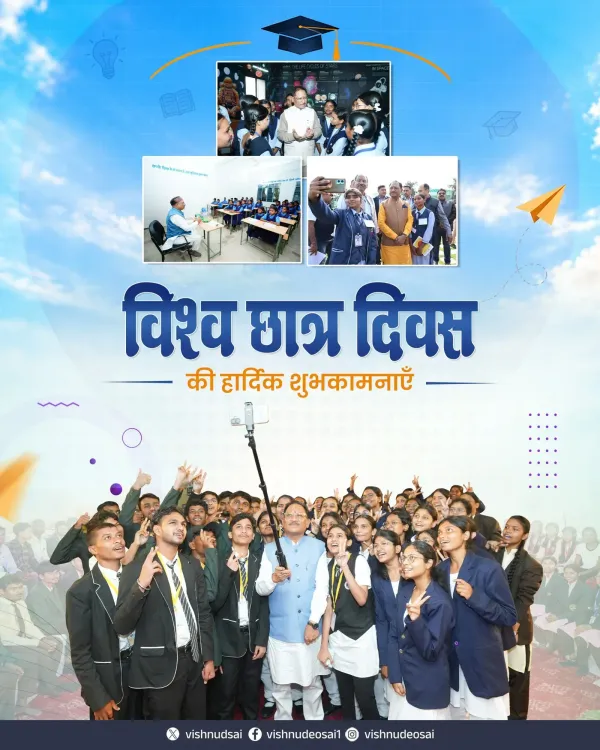
CM Vishnu Deo Sai Greets Chhattisgarh Students on World Students' Day
Synopsis
Chhattisgarh Chief Minister Vishnu Deo Sai greeted all students in the state on World Students' Day, observed on APJ Abdul Kalam's birth anniversary, urging them to contribute to the Viksit Bharat and Viksit Chhattisgarh vision through talent and hard work.
Key Takeaways
World Students' Day is observed on 15 October every year to mark the birth anniversary of former President Dr.
CM Vishnu Deo Sai wished all students of Chhattisgarh and linked their bright futures to the Viksit Bharat-Viksit Chhattisgarh resolve.
The Viksit Bharat @2047 vision, articulated by PM Narendra Modi in 2023 , positions youth education as central to India's development goals.
The National Education Policy 2020 forms the policy backbone, emphasising skills and holistic development across school and higher education.
Chhattisgarh has been governed by the BJP since December 2023 , consistently aligning state education messaging with the central government's development framework.
On the birth anniversary of Dr. APJ Abdul Kalam — a day the world marks as World Students' Day — Chhattisgarh Chief Minister Vishnu Deo Sai extended heartfelt wishes to every student in the state, tying their individual ambitions directly to the larger national vision of a developed India.
Posting on 15 October 2026, CM Sai wrote: 'आप सभी के उज्ज्वल भविष्य से ही विकसित भारत-विकसित छत्तीसगढ़ का संकल्प साकार होगा' — 'It is only through the bright futures of all of you that the resolve of a Developed India and a Developed Chhattisgarh will be realised.' He urged students to reach new heights of success through talent, hard work, and dedication, and to contribute to the progress of the country and the state through their knowledge and skills.
Kalam's legacy and the day's meaning
APJ Abdul Kalam, who served as India's President from 2002 to 2007, remains the country's most cited symbol of science, self-belief, and youth aspiration. World Students' Day is observed on his birthday, 15 October, each year as a reminder that education is the irreducible foundation of national ambition. For a BJP-governed state like Chhattisgarh, invoking Kalam is both an emotional and a political act — he bridges party lines and speaks directly to first-generation learners in a state still building its educational infrastructure.
Viksit Bharat as the governing framework for youth
CM Sai's message is anchored in the Viksit Bharat @2047 vision — the central government's long-arc development framework, publicly articulated by Prime Minister Narendra Modi in 2023, which positions the education and skilling of India's youth as the primary engine for reaching developed-nation status by 2047, the centenary of independence. Chhattisgarh, governed by the BJP since December 2023, has aligned its state education messaging consistently with this framework. The National Education Policy of 2020, which overhauled school and higher education with a sharp focus on skills and holistic development, forms the policy backbone behind such calls to students.
The message, while ceremonial in register, carries a deliberate signal: the state government expects its students not just to succeed personally, but to become active contributors to a measurable development target. Ambition, here, is framed as civic duty.
Point of View
Transforming a ceremonial wish into a political statement about human capital and governance targets. Invoking APJ Kalam is a particularly effective bridge — his legacy commands cross-party respect and resonates deeply with aspirational, first-generation learners in states like Chhattisgarh. The consistent alignment between state-level BJP messaging and the central government's development vision signals a coordinated communication strategy heading into the next phase of NEP rollout. Observers will watch whether such messaging translates into concrete state budget allocations for student welfare and skill development in Chhattisgarh.
NationPress
15 Oct 2026
Frequently Asked Questions
Why is World Students' Day celebrated on 15 October?
World Students' Day is celebrated on 15 October to mark the birth anniversary of former Indian President Dr. APJ Abdul Kalam , who was a passionate advocate for education and youth empowerment.
What did Chhattisgarh CM Vishnu Deo Sai say on World Students' Day 2026?
CM Vishnu Deo Sai extended greetings to all students in Chhattisgarh and said their bright futures alone would realise the resolve of a 'Developed India and Developed Chhattisgarh,' urging them to succeed through talent, hard work, and dedication.
What is the Viksit Bharat vision?
Viksit Bharat @2047 is the central government's vision for India to become a developed nation by 2047 , the centenary of independence, with youth education and skilling identified as core pillars.
When did Vishnu Deo Sai become Chief Minister of Chhattisgarh?
Vishnu Deo Sai became Chief Minister of Chhattisgarh in December 2023 after the BJP's victory in the state assembly elections.
What is the National Education Policy 2020?
The National Education Policy 2020 , approved in July 2020 , overhauled India's school and higher education systems with a focus on skills, holistic development, and preparing youth for future economic challenges.