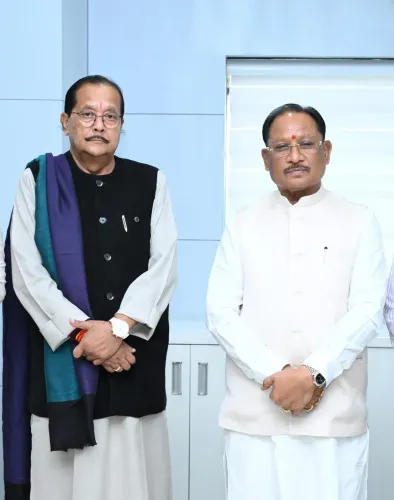
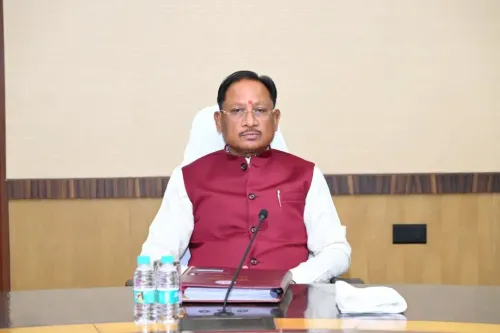
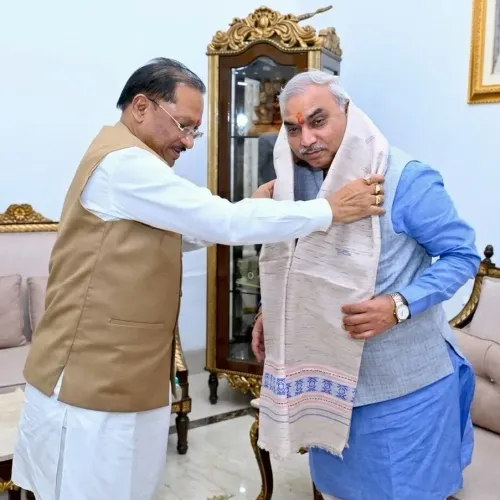
CM Vishnu Deo Sai meets BMS leaders on worker welfare
Synopsis
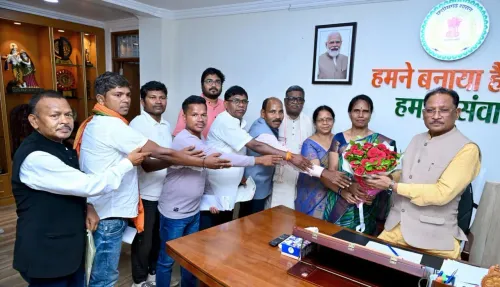
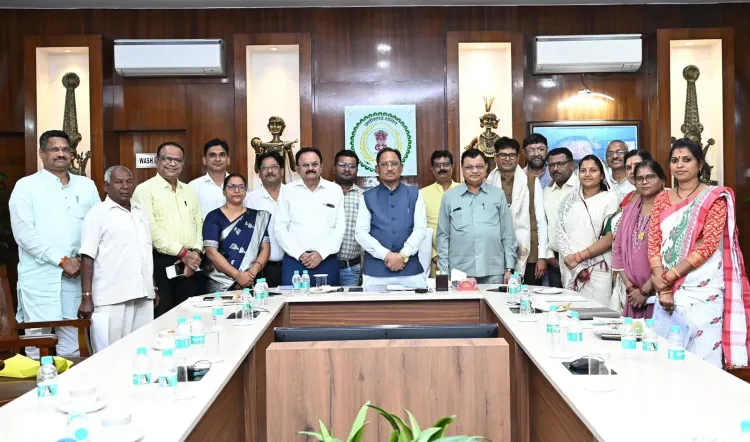
Chhattisgarh CM Vishnu Deo Sai held a courtesy meeting with Bharatiya Mazdoor Sangh officials on 25 September 2026, with Cabinet ministers Lakhan Lal Dewangan, O.P. Choudhary, and Laxmi Rajwade present, to discuss labour welfare and industrial development priorities.
Key Takeaways
Chhattisgarh Chief Minister Vishnu Deo Sai met senior Bharatiya Mazdoor Sangh (BMS) functionaries at his official residence on 25 September 2026 .
Discussions centred on worker welfare and the state's industrial development .
Cabinet ministers Lakhan Lal Dewangan , O.P.
Choudhary , and Laxmi Rajwade attended the meeting.
BMS regional organisation secretary V.
Rajesh led the union's delegation.
The BMS, founded in 1955 and RSS-affiliated, is India's largest trade union and a key interlocutor in BJP-governed states.
Chhattisgarh's steel, coal, and mining sectors make labour relations a critical policy lever for the state government.
Labour talks landed at the top of Chhattisgarh Chief Minister Vishnu Deo Sai's calendar on Friday, 25 September 2026, when senior functionaries of the Bharatiya Mazdoor Sangh (BMS) — India's largest trade union — called on him at his official residence in Raipur for a wide-ranging courtesy meeting on worker welfare and the state's industrial future.
CM Sai described the discussion as 'sarthak charcha' — 'meaningful dialogue' — covering 'shramik kalyan aur pradesh ke audyogik vikas se jude vibhinn vishay' (various subjects linked to labour welfare and the state's industrial development). Three of his cabinet colleagues were at the table: Lakhan Lal Dewangan, O.P. Choudhary, and Laxmi Rajwade. The BMS was represented by its regional organisation secretary V. Rajesh along with other senior office-bearers.
Why BMS and Chhattisgarh are a natural fit
Chhattisgarh sits on one of India's most valuable mineral belts — steel, coal, and mining operations form the backbone of its economy, making labour relations a live political and economic variable. The BMS, founded in 1955 and affiliated with the RSS, has for decades been the preferred interlocutor between BJP-led governments and organised labour, threading the needle between worker demands and the appetite for industrial expansion.
That dynamic is especially pointed in Chhattisgarh, where large public and private sector plants employ tens of thousands of workers whose interests the BMS claims to represent. Sai, who assumed office in December 2023, has made industrial investment a signature pitch, hosting investor summits and pushing infrastructure linkages to draw manufacturing to the state. Keeping a powerful affiliated union in the conversation is less courtesy than calculation.
The cabinet names in the room
O.P. Choudhary and Lakhan Lal Dewangan bring portfolios that touch both finance and social welfare, making their presence a signal that Friday's discussions were not purely ceremonial. Laxmi Rajwade's attendance added a further dimension to the government's stated emphasis on inclusive labour policy. The meeting's composition — three ministers plus the BMS regional secretary — suggests the dialogue was structured around specific asks, even if no formal announcements followed.
Watch for follow-up movement in Chhattisgarh's upcoming assembly session: BMS consultations of this seniority have historically preceded announcements on wage revisions, safety norms in mines, or social-security extensions for contract workers — precisely the segments where the union's ground presence is strongest.
Point of View
Not just symbolic inclusion. For Chhattisgarh, a mineral-rich state where contract and casual workers in steel and mining are a large but legally fragile workforce, such consultations can directly shape the terms of labour compliance in new investment zones. With three cabinet ministers present, the government appears to be treating BMS not as a protest-management tool but as a genuine policy stakeholder. Any subsequent assembly session announcements on wages or worker insurance will reveal how much of that goodwill translates into concrete benefit.
NationPress
25 Sept 2026
Frequently Asked Questions
Why did Chhattisgarh CM Vishnu Deo Sai meet Bharatiya Mazdoor Sangh leaders?
CM Sai met BMS officials on 25 September 2026 for a courtesy call at his official residence, where they held discussions on worker welfare and the industrial development of Chhattisgarh.
What is Bharatiya Mazdoor Sangh (BMS)?
The Bharatiya Mazdoor Sangh is India's largest trade union, founded in 1955 and affiliated with the RSS. It regularly engages with BJP-led state and central governments on labour welfare issues.
Which ministers attended the BMS meeting with CM Vishnu Deo Sai?
Cabinet ministers Lakhan Lal Dewangan, O.P. Choudhary, and Laxmi Rajwade attended the meeting alongside BMS regional organisation secretary V. Rajesh and other senior union office-bearers.
What labour issues are important to Chhattisgarh?
Chhattisgarh's economy is heavily dependent on steel, coal, and mining, making worker safety, wages, and social security for industrial and contract workers key policy priorities for the state government.
When did Vishnu Deo Sai become Chief Minister of Chhattisgarh?
Vishnu Deo Sai assumed office as Chief Minister of Chhattisgarh in December 2023, following the BJP's victory in the state assembly elections.