CM Sai Meets Jharkhand Finance Minister on Border Development
Synopsis
Chhattisgarh Chief Minister Vishnu Deo Sai and Jharkhand Finance Minister Radha Krishna Kishore held talks at Mahanadi Bhavan on 7 July 2026, discussing social ties, border-area development, and welfare scheme coordination between the two neighbouring tribal-belt states.
Key Takeaways
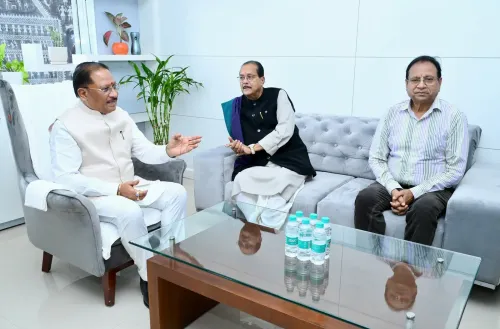
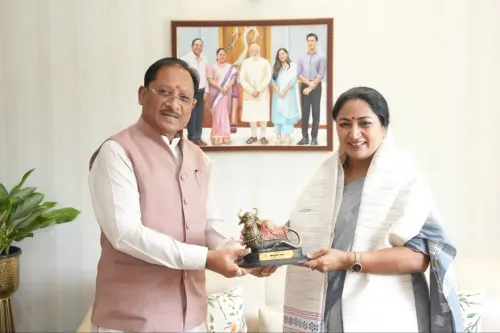
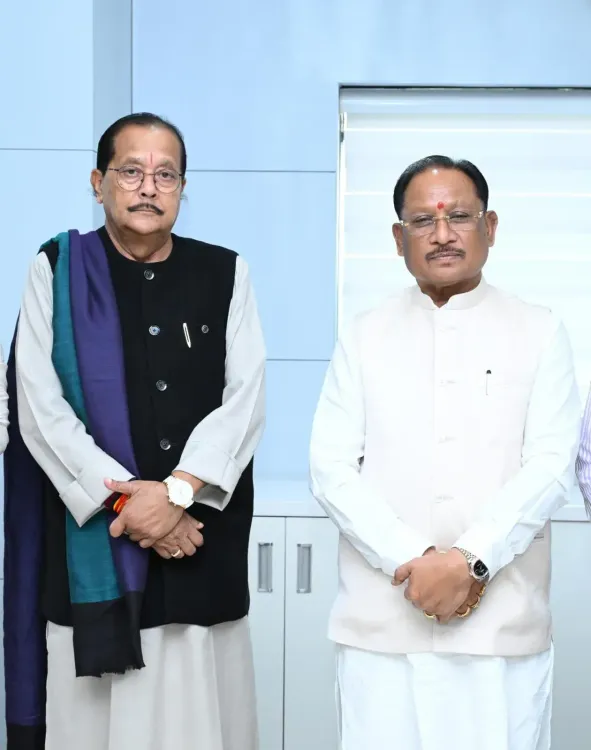
CM Vishnu Deo Sai hosted Jharkhand Finance Minister Radha Krishna Kishore at Mahanadi Bhavan , Raipur on 7 July 2026 .
Discussions covered social and cultural ties, border-region development, and effective implementation of public welfare schemes.
CM Sai expressed confidence that inter-state coordination would generate new development opportunities for border-area citizens.
Chhattisgarh and Jharkhand share a common border and were both formed in November 2000 with comparable tribal and mineral-belt profiles.
No formal agreements or joint declarations were announced; the meeting was characterised as a courtesy call with substantive dialogue.
The engagement reflects India's cooperative federalism approach, encouraging cross-state coordination on welfare delivery regardless of party affiliation.
Chief Minister Vishnu Deo Sai of Chhattisgarh received Jharkhand Finance Minister Radha Krishna Kishore for a courtesy call at Mahanadi Bhavan ministerial complex in Raipur on 7 July 2026, with both leaders holding substantive discussions on inter-state cooperation, border-area development, and the effective implementation of welfare schemes.
Context
The Chief Minister's Office of Chhattisgarh confirmed that the meeting covered 'saamajik evam saanskritik sambandh' (social and cultural ties) between the two states, development of border regions, and coordination on public welfare programmes. CM Sai expressed confidence that the coordination between the two states would 'create new opportunities for development' and that citizens in border areas would be direct beneficiaries.
The discussions were described as 'saarthak charcha' — meaningful dialogue — signalling a constructive tone rather than a routine protocol visit. No formal agreements or joint declarations were announced.
Policy Backdrop
Chhattisgarh and Jharkhand were both carved out as separate states in November 2000 — the former from Madhya Pradesh and the latter from Bihar — and have shared a common border, comparable tribal demographics, and overlapping mineral-belt challenges ever since. Their border districts are home to significant Scheduled Tribe populations who often straddle administrative boundaries for livelihoods, cultural practices, and access to government services.
India's cooperative federalism framework, which has been emphasised at the national level since 2014, encourages neighbouring states to align their welfare delivery mechanisms and border infrastructure regardless of the political parties in power. Inter-state ministerial meetings of this kind are a recognised instrument for reducing scheme duplication and improving last-mile delivery in remote districts.
Stakeholders and Impact
The communities most directly affected by any outcome of this dialogue are residents of the Chhattisgarh-Jharkhand border belt, particularly tribal populations in districts such as those adjoining Surguja on the Chhattisgarh side and Garhwa and Latehar on the Jharkhand side. These areas have historically faced gaps in infrastructure, healthcare access, and agricultural support.
State administrations on both sides stand to benefit from converging their flagship welfare schemes — including housing, food security, and livelihood programmes — to avoid coverage gaps for residents who move across the border seasonally. The meeting also carries symbolic weight as an example of cross-party, cross-state engagement: CM Sai leads a BJP-governed Chhattisgarh while Jharkhand is governed by a different political formation.
What's Next
No specific follow-up timeline or joint committee was publicly announced following the meeting. Observers of state-level governance will watch for references to any agreed cooperation in upcoming state budget documents, assembly sessions, or official orders from either government.
If the dialogue translates into institutional mechanisms — such as a border coordination committee or convergence of specific centrally-sponsored schemes — it could serve as a model for other contiguous central-Indian states facing similar socio-economic profiles. CM Sai's emphasis on 'new opportunities for development' through coordination suggests the Chhattisgarh government views such inter-state engagement as a governance priority in the near term.
Point of View
Who took office in December 2023, such high-profile bilateral engagements help establish a governance identity centred on cooperative federalism. The focus on border-area citizens — a constituency that often falls between administrative stools — aligns with a broader national push to close last-mile welfare gaps in tribal belts. Whether the courtesy call produces institutional follow-through will be the real test of its significance.
NationPress
6 Oct 2026
Frequently Asked Questions
Why did Jharkhand Finance Minister meet Chhattisgarh CM Vishnu Deo Sai?
Jharkhand Finance Minister Radha Krishna Kishore paid a courtesy call on Chhattisgarh CM Vishnu Deo Sai on 7 July 2026 to discuss social and cultural ties, border-area development, and coordination on welfare schemes between the two neighbouring states.
What issues were discussed between Chhattisgarh and Jharkhand at the July 2026 meeting?
The two leaders discussed the social and cultural relationship between Chhattisgarh and Jharkhand, development of border regions, effective implementation of public welfare schemes, and avenues for mutual cooperation.
Do Chhattisgarh and Jharkhand share a border?
Yes, Chhattisgarh and Jharkhand share a common border. Both states were created in November 2000 and have overlapping tribal demographics and mineral-rich districts along their shared boundary.
Who is the Chief Minister of Chhattisgarh in 2026?
Vishnu Deo Sai is the Chief Minister of Chhattisgarh. He is a BJP leader who assumed office in December 2023.
What is cooperative federalism in India?
Cooperative federalism refers to the framework that encourages Indian states to coordinate with each other and with the central government on policy delivery. It has been emphasised at the national level since 2014 and promotes inter-state meetings on welfare, infrastructure, and border development.