US Senate rejects Iran war-powers resolution 48-51 in first post-midterm vote
Synopsis
The US Senate has rejected — for the 15th time — a War Powers Resolution to end Trump's Iran conflict, this time falling short 48-51. With Democrats set to control Congress in January and a government funding deadline on 11 December, the Iran war question is about to collide head-on with the federal budget.
Key Takeaways
The US Senate rejected H.Con.Res.
93 by 48-51 on 21 November — its first Iran war-powers vote since the 3 November midterms .
Three Republicans — Susan Collins , Lisa Murkowski , and Rand Paul — voted with Democrats; Democrat John Fetterman voted against.
The war has reportedly cost US taxpayers at least $47 billion and claimed 23 American lives , according to Senator Baldwin's floor statement.
This was the Senate's 15th vote invoking the War Powers Resolution against the Iran conflict; the only measure that previously passed the Senate was adopted 50-48 on 23 June .
Democrats vowed to revive the push in the new Congress in January ; the Iran funding question is now linked to the federal funding deadline of 11 December .
The US Senate on Thursday, 21 November voted 48-51 to reject H.Con.Res. 93, a House-passed resolution that would have directed President Donald Trump to withdraw American forces from hostilities with Iran. The defeat marks the Senate's first war-powers vote since the 3 November midterm elections — and the 15th such vote overall since the conflict began.
How the Vote Broke Down
Three Republicans crossed the aisle to support the resolution: Senator Susan Collins of Maine, Senator Lisa Murkowski of Alaska, and Senator Rand Paul of Kentucky. On the Democratic side, Senator John Fetterman of Pennsylvania voted against the measure, while Senator Chris Murphy of Connecticut was declared 'necessarily absent' and did not vote.
Notably, Republican Senator Thom Tillis of North Carolina — who had backed a similar resolution (H.Con.Res. 89) in September — voted against this one. That earlier measure had failed 49-50 on 24 September.
Key Arguments on the Senate Floor
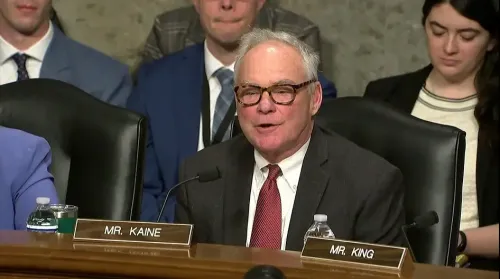
Democratic Senator Tim Kaine of Virginia urged colleagues to 'do what the Constitution demands, what our public demands, and that is to end this illegal war.' Kaine added, 'The American public is tired of it. But we here in the Senate, we have the capacity to fix it, and voting again that this war is illegal is an important step on the road to doing just that.'
Democratic Senator Tammy Baldwin of Wisconsin stated on the floor that the war 'has cost taxpayers at least $47 billion' and that '23 Americans have lost their lives.'
On the opposing side, Republican Senator Tim Sheehy of Montana urged a no vote, arguing: 'Iran is not a war of choice; it is a war of necessity. We should finish the job, protect this Nation, and protect our allies.' Sheehy warned that if Iran seized control of the Strait of Hormuz and other key sea lanes, it would 'constrict half the world's energy supply.'
Background and Legislative History
The resolution was introduced by Democratic Representative Seth Moulton of Massachusetts on 28 April. The House passed it by 220-204 on 15 September. As a concurrent resolution, it invoked Section 5(c) of the 1973 War Powers Resolution and, by design, would not have required the President's signature — meaning Trump could not have vetoed it.
According to the office of Senator Adam Schiff, the Senate has now cast 15 votes aimed at forcing an end to the conflict through the War Powers Resolution framework. The only measure to pass the Senate was H.Con.Res. 86, which the chamber adopted 50-48 on 23 June.
Democrats Signal Next Steps
Following the vote, Democrats signalled a renewed push once they assume congressional control in January. 'While we had bipartisan support in today's vote, it was not enough. In the new Congress, we will change that,' Schiff said in a statement.
Kaine said he and colleagues 'in the new Democratic majority Congress will be exploring every possible additional tool to force an end to the war.' Democratic Senator Jacky Rosen of Nevada said voters had 'resoundingly rejected Donald Trump's unconstitutional war with Iran that has made everything more expensive.'
The vote came a day after Indian American Congressman Ro Khanna and Democratic Representative Yassamin Ansari announced they would oppose any government funding package that did not explicitly prohibit spending on offensive operations in Iran. With current federal funding set to expire on 11 December, the Iran war question is now entangled with the broader government shutdown standoff.
Point of View
However, may be 11 December: by tying the war-powers debate to the government funding deadline, Khanna and Ansari have weaponised the fiscal calendar in a way that floor resolutions alone never could. Democrats' confidence about January is real, but war-powers resolutions, even when passed by Congress, lack enforcement teeth against a determined executive — the only binding levers are the budget and treaty law, neither of which is straightforward. The $47 billion cost figure, if it enters the appropriations debate, could move persuadable Republicans in ways that floor speeches have not.
NationPress
21 Nov 2026
Frequently Asked Questions
What was H.Con.Res. 93 and why did the Senate vote on it?
H.Con.Res. 93 was a concurrent resolution invoking Section 5(c) of the 1973 War Powers Resolution, directing President Donald Trump to remove US forces from hostilities with Iran. The Senate voted on it on 21 November 2026 as part of ongoing congressional efforts to reassert war-making authority; it failed 48-51.
Which senators crossed party lines in the Iran war-powers vote?
Three Republicans — Susan Collins of Maine, Lisa Murkowski of Alaska, and Rand Paul of Kentucky — voted with Democrats in favour of the resolution. On the other side, Democrat John Fetterman of Pennsylvania voted against it, while Democrat Chris Murphy of Connecticut did not vote.
How much has the Iran war cost the United States?
According to Democratic Senator Tammy Baldwin's floor statement, the conflict has cost US taxpayers at least $47 billion and resulted in the deaths of 23 Americans. These figures were cited during Senate debate but were not independently verified in the session.
What happens next after the Senate rejected the resolution?
The defeat ends H.Con.Res. 93 in the Senate. Democrats have signalled they will revive the effort when they take control of Congress in January 2027. Additionally, some lawmakers have threatened to block any government funding bill that does not bar spending on offensive Iran operations, with current federal funding expiring on 11 December.
How does this vote compare to earlier war-powers votes on Iran?
This was the Senate's 15th vote invoking the War Powers Resolution on the Iran conflict. The closest earlier attempt, H.Con.Res. 89, failed 49-50 on 24 September. The only measure to pass the Senate was H.Con.Res. 86, adopted 50-48 on 23 June, though it did not result in an end to hostilities.