CM Dhami pays tribute to C.V. Raman on death anniversary
Synopsis
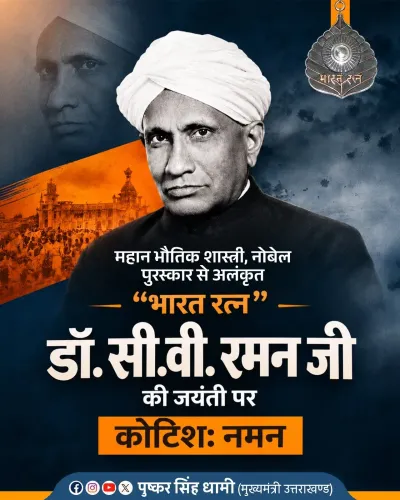
Uttarakhand Chief Minister Pushkar Singh Dhami marked the death anniversary of Nobel laureate C.V. Raman on 21 November 2026, saluting the discoverer of the Raman Effect and urging India's youth to draw inspiration from his scientific legacy.
Key Takeaways
CM Pushkar Singh Dhami paid tribute to physicist C.V.
Raman on his death anniversary on 21 November 2026 .
Raman discovered the Raman Effect in 1928 , revolutionising the field of light scattering and spectroscopy.
Raman was awarded the Nobel Prize in Physics in 1930 , becoming the first Asian to win a Nobel in a science discipline.
He received India's highest civilian honour, the Bharat Ratna , in 1954 .
Dhami called on the younger generation to set new benchmarks in research and innovation , invoking Raman's curiosity and scientific temperament.
28 February , the date of the Raman Effect discovery, is observed annually as National Science Day across India.
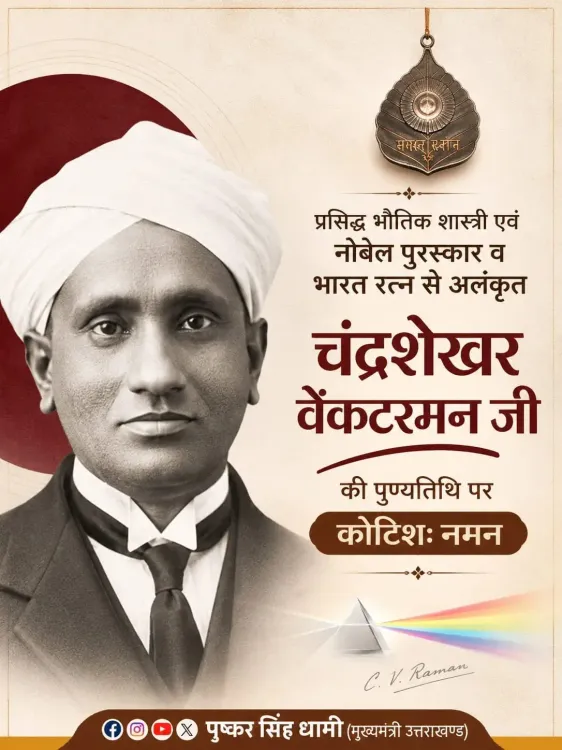
A towering figure in the history of science, Sir Chandrasekhara Venkata Raman — the man who proved that light itself could be made to tell secrets — is remembered today on his death anniversary. Uttarakhand Chief Minister Pushkar Singh Dhami paid his respects on Saturday, 21 November 2026, honouring the physicist's enduring legacy through a heartfelt message on X.
In his post, CM Dhami wrote: 'Kotishaः naman' — a salute repeated a million times over — to the celebrated physicist and discoverer of the Raman Effect, adorned with both the Nobel Prize and the Bharat Ratna. He expressed that Raman's 'unparalleled achievements in science, his curiosity for knowledge, and his scientific temperament will forever inspire the younger generation to set new benchmarks in research and innovation.'
The discovery that changed how the world sees light
C.V. Raman made his landmark discovery — the Raman Effect — in 1928, demonstrating that when light passes through a transparent material, a portion of the scattered light changes wavelength. It was a finding that upended established physics and opened an entirely new field of spectroscopy. The Nobel Committee recognised the breakthrough swiftly: Raman received the Nobel Prize in Physics in 1930, becoming the first Asian and first non-white scientist to win a Nobel Prize in a science category.
India later conferred its highest civilian honour, the Bharat Ratna, on him in 1954 — a recognition of a career that had grown almost entirely on Indian soil, without the institutional advantages of Europe's great research universities. That fact alone made Raman a potent symbol: proof that world-class science could be done from Kolkata as credibly as from Cambridge.
Why political leaders keep invoking Raman's name
Tributes like CM Dhami's are not mere ritual. Indian political leaders across the spectrum regularly mark the death anniversaries of scientists such as Raman, APJ Abdul Kalam, and Homi Bhabha as a way of anchoring contemporary calls for research and innovation in a proud national lineage. The message is consistent: India produced genius before, it can do so again.
For a state like Uttarakhand, which hosts institutions including IIT Roorkee — one of India's oldest technical universities — invoking Raman carries particular resonance. It connects the state's academic ecosystem to a national scientific identity built over nearly a century.
Raman's legacy is also institutionally alive: 28 February, the date of his 1928 discovery, is observed every year as National Science Day across India, a tradition that keeps his name in classrooms from Kohima to Kochi.
Point of View
The message also resonates locally — Uttarakhand's academic institutions give the tribute practical grounding beyond symbolism. Across parties, the consistent invocation of Raman, Kalam, and Bhabha signals a bipartisan consensus that science nationalism is an effective and uncontroversial register of public communication. The real test, analysts note, is whether such commemorations translate into measurable state-level policy support for young researchers.
NationPress
21 Nov 2026
Frequently Asked Questions
When did C.V. Raman die?
C.V. Raman passed away on 21 November 1970 in Bengaluru, at the age of 82.
What is the Raman Effect?
The Raman Effect, discovered in 1928 , is the phenomenon by which light scattered through a transparent material undergoes a change in wavelength. It became the foundation of Raman spectroscopy, widely used in chemistry, physics, and materials science.
What awards did C.V. Raman receive?
C.V. Raman received the Nobel Prize in Physics in 1930 and India's highest civilian honour, the Bharat Ratna , in 1954 .
Why is 28 February celebrated as National Science Day in India?
National Science Day is observed on 28 February every year to mark the date in 1928 on which C.V. Raman announced his discovery of the Raman Effect.
Who is Pushkar Singh Dhami?
Pushkar Singh Dhami is the Chief Minister of Uttarakhand and a senior leader of the Bharatiya Janata Party (BJP) .