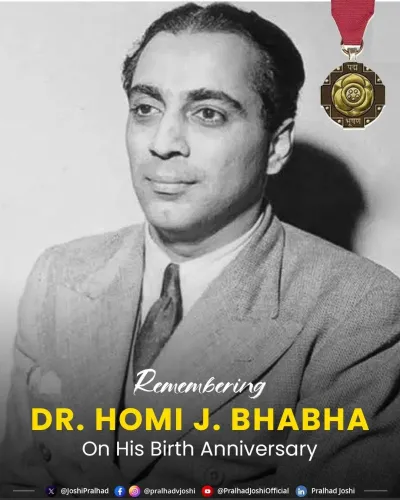
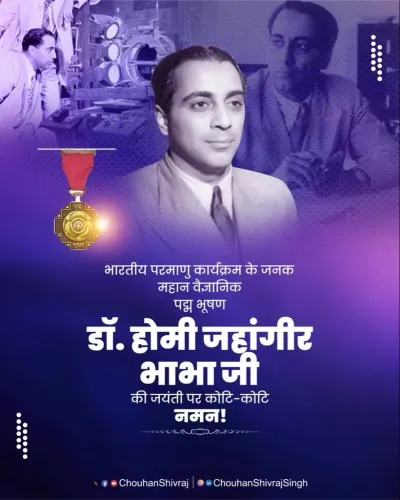
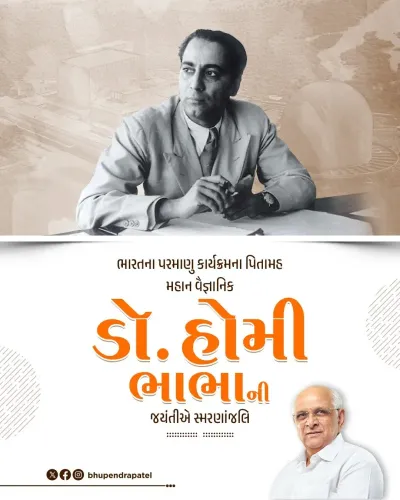
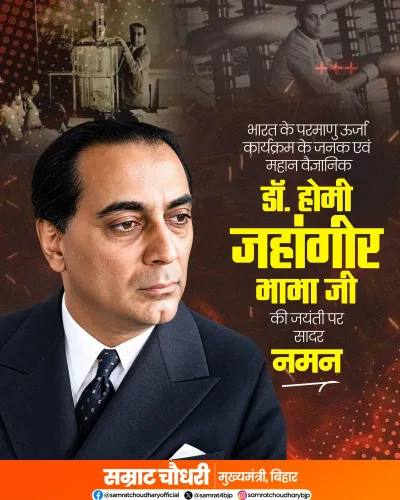
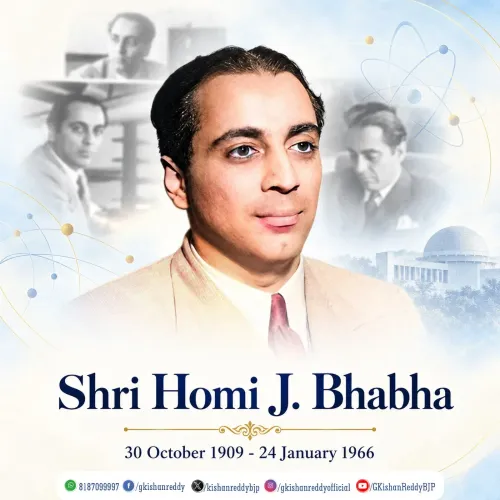
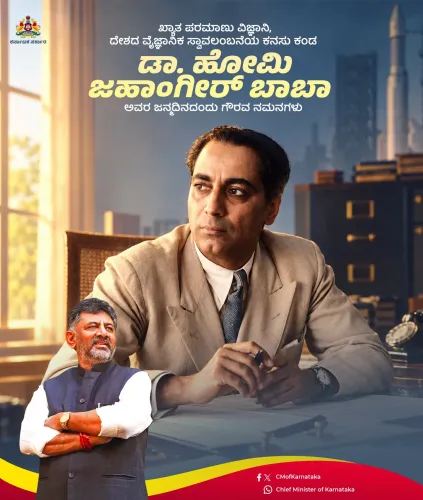
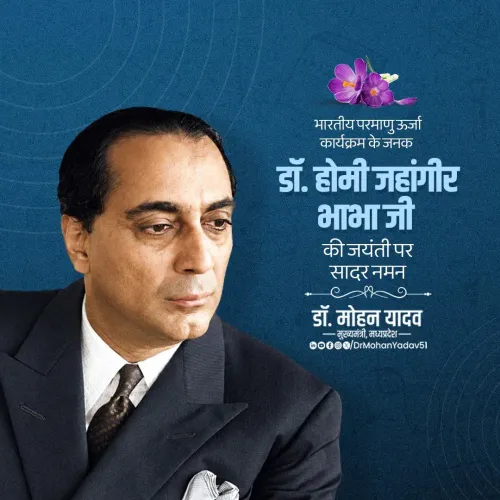
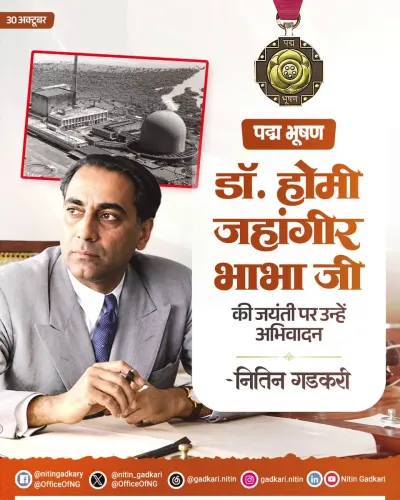
CM Dhami Pays Tribute to Dr. Homi Bhabha on Birth Anniversary
Synopsis
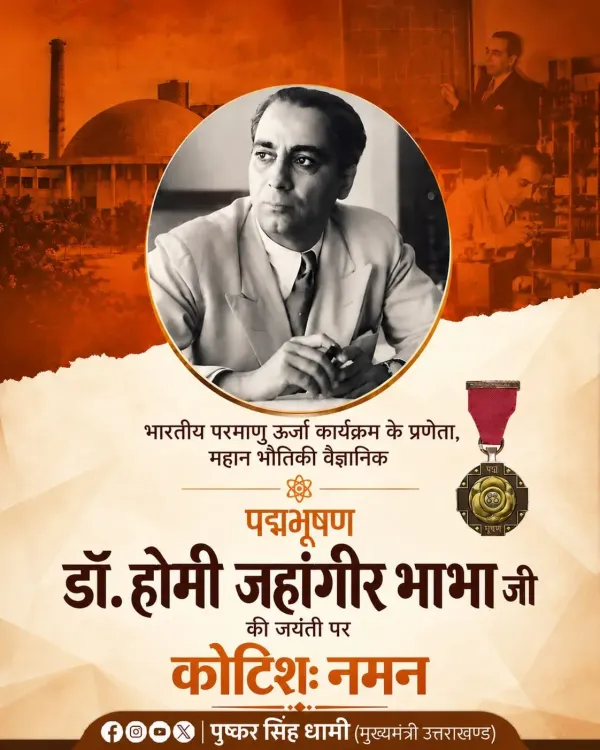
On Dr. Homi Jehangir Bhabha's birth anniversary, Uttarakhand CM Pushkar Singh Dhami paid tribute to the nuclear physicist who founded TIFR, chaired India's Atomic Energy Commission, and designed the three-stage nuclear programme that still guides India's energy policy.
Key Takeaways
CM Pushkar Singh Dhami posted a Hindi tribute to Dr.
Homi Jehangir Bhabha on 30 October 2026 , the physicist's birth anniversary.
Bhabha was born on 30 October 1909 and founded the Tata Institute of Fundamental Research in 1945 .
He served as the first Chairman of India's Atomic Energy Commission and designed the country's three-stage nuclear power programme.
The Bhabha Atomic Research Centre (BARC) in Trombay was renamed in his honour after his death in a plane crash on 24 January 1966 .
His institutional blueprint — leveraging India's thorium reserves — remains the strategic basis for India's civilian nuclear energy roadmap today.
The man who gave India its nuclear spine was born on this day, and Uttarakhand Chief Minister Pushkar Singh Dhami marked the occasion with a heartfelt tribute to Dr. Homi Jehangir Bhabha on Friday, 30 October 2026 — honouring the physicist whose vision shaped a nation's scientific destiny.
Posting on X in Hindi, CM Dhami wrote: 'Heartfelt salutations on the birth anniversary of the great scientist, eminent nuclear physicist and pioneer of India's atomic energy programme, Dr. Homi Jehangir Bhabha. Your foresight played a vital role in giving India a new identity in the field of science and technology. Your life is an inspiring example of scientific vision, innovation, foresight and dedication to nation-building — it will continue to inspire us always in the service of the nation.'
The Architect of India's Atomic Age
Dr. Homi Jehangir Bhabha was born on 30 October 1909 in Bombay into a prominent Parsi family. A Cambridge-trained physicist who had studied under Paul Dirac and worked alongside Europe's finest scientific minds, he returned to India during the Second World War and never looked back. In 1945, he founded the Tata Institute of Fundamental Research (TIFR) in Bombay — India's first world-class basic-sciences institution — and followed it with the establishment of the Atomic Energy Establishment at Trombay, later renamed the Bhabha Atomic Research Centre (BARC) in his honour. As the first Chairman of India's Atomic Energy Commission, he built the institutional scaffolding of an entire scientific enterprise almost from scratch. He championed the idea that a newly independent, resource-constrained nation could compete at the frontier of physics — and proved it.A Legacy That Still Powers the Grid
Bhabha's three-stage nuclear power programme — designed to leverage India's abundant thorium reserves — remains the strategic blueprint for India's civilian nuclear energy roadmap to this day. The Department of Atomic Energy, the network of nuclear power plants under Nuclear Power Corporation of India Limited (NPCIL), and the ongoing development of advanced heavy-water reactors all trace their institutional DNA back to the framework he laid in the 1940s and 1950s. He was also a gifted painter and architect who designed TIFR's striking Colaba campus in Bombay — a reminder that his foresight crossed disciplinary lines. Bhabha died in a plane crash on 24 January 1966, when Air India Flight 101 struck Mont Blanc. He was 56. The loss truncated a career still in full stride, yet the institutions he built have long outlasted him. Every year, Indian leaders from across the political spectrum pay tribute on his birth anniversary — a bipartisan recognition that scientific institution-building is one of independent India's most durable achievements. CM Dhami's post joins a long line of such commemorations, invoking Bhabha not merely as a historical figure but as a living standard for 'scientific vision, innovation and dedication to nation-building.'Point of View
Invoking Bhabha's 'foresight and innovation' at a moment when India's civilian nuclear expansion is back on the policy agenda. The emphasis on 'nation-building' and 'service to the nation' also reflects a BJP rhetorical register that frames scientific patriotism as civic duty. Such commemorations rarely shift policy, but they do signal which historical figures a political establishment wishes to claim as its own.
NationPress
30 Oct 2026
Frequently Asked Questions
When is Dr. Homi Bhabha's birth anniversary?
Dr. Homi Jehangir Bhabha was born on 30 October 1909 , so his birth anniversary falls on 30 October every year.
What did Dr. Homi Bhabha contribute to India?
Dr. Bhabha founded the Tata Institute of Fundamental Research (TIFR) in 1945, served as the first chairman of India's Atomic Energy Commission , and designed the three-stage nuclear power programme that remains India's civilian nuclear roadmap.
What is BARC and how is it connected to Homi Bhabha?
BARC — Bhabha Atomic Research Centre — is India's premier nuclear research facility located in Trombay, Mumbai. It was originally called the Atomic Energy Establishment, Trombay, and was renamed BARC in honour of Dr. Bhabha after his death in 1966.
How did Dr. Homi Bhabha die?
Dr. Bhabha died on 24 January 1966 when Air India Flight 101 crashed into Mont Blanc in the Alps. He was 56 years old.
Why did CM Dhami pay tribute to Homi Bhabha?
Uttarakhand CM Pushkar Singh Dhami posted the tribute on 30 October 2026 to mark Dr. Bhabha's birth anniversary, honouring his foundational role in establishing India's scientific and nuclear energy institutions.