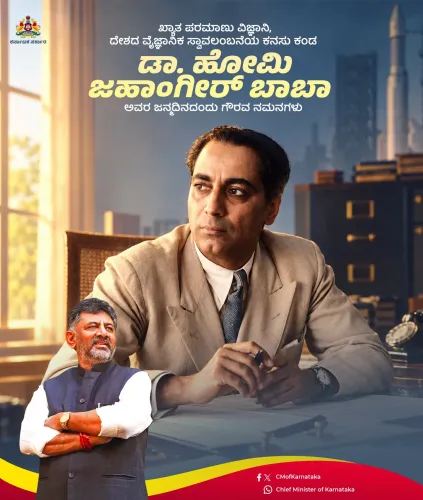
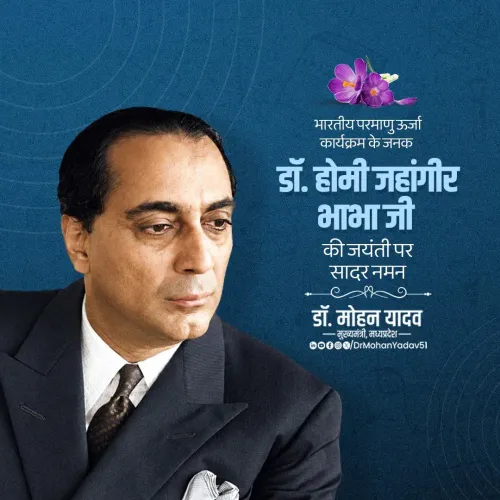
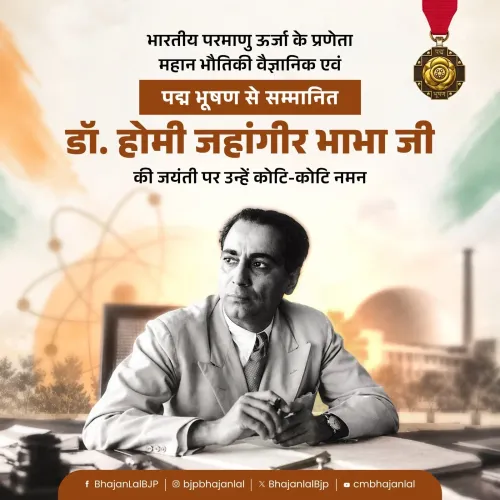
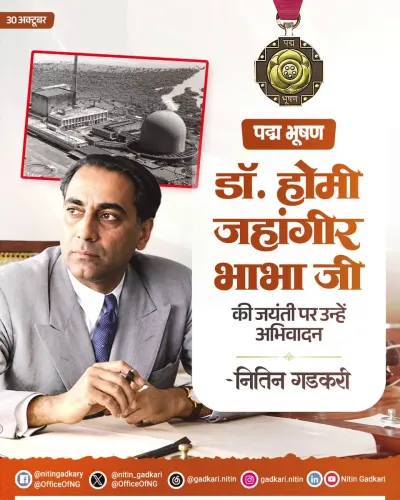
CM Bhupendra Patel Pays Tribute to Dr. Homi Bhabha on Birth Anniversary
Synopsis
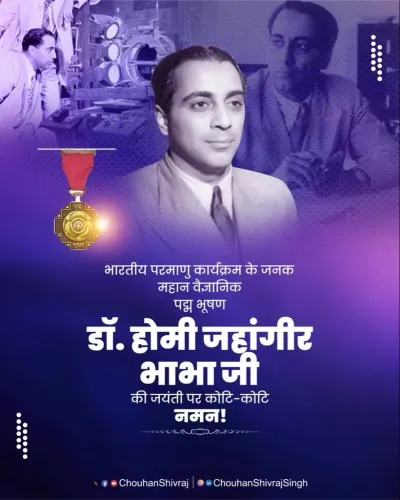
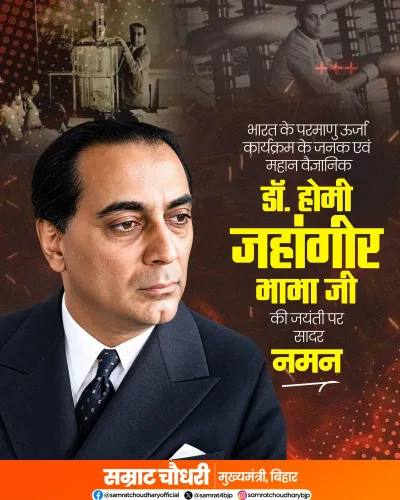
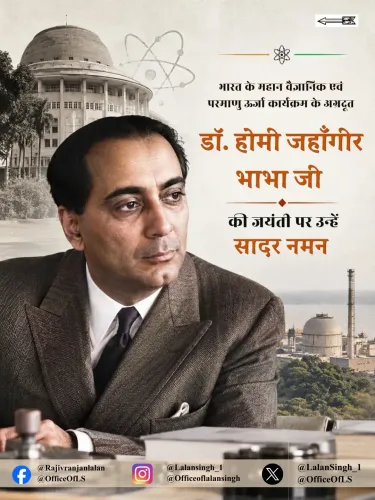
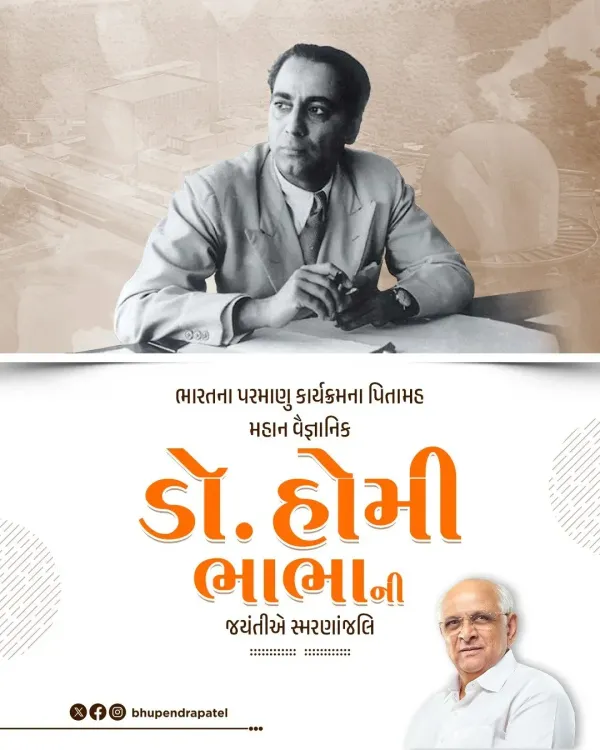
Gujarat Chief Minister Bhupendra Patel honoured Dr. Homi Jehangir Bhabha on his birth anniversary, calling the founder of India's atomic energy programme a world-renowned physicist whose contributions to modern science remain unforgettable.
Key Takeaways
Gujarat CM Bhupendra Patel posted a tribute to Dr.
Homi Jehangir Bhabha on his birth anniversary, 30 October 2026 .
Bhabha is recognised as the father of India's nuclear energy programme and a world-renowned physicist.
He founded the Tata Institute of Fundamental Research in 1945 and chaired the Atomic Energy Commission of India from 1948 .
CM Patel called Bhabha's contribution to placing India among global leaders in modern science 'unforgettable.' The tribute aligns with a broader Indian political tradition of honouring founding scientists to underscore indigenous capability in strategic technologies.
On the birth anniversary of the man who gave India its nuclear soul, Gujarat Chief Minister Bhupendra Patel paid a heartfelt tribute to Dr. Homi Jehangir Bhabha on Friday, 30 October 2026 — honouring the physicist whose vision planted the seeds of a modern scientific India.
Posting in Gujarati, CM Patel wrote: 'Bharatiya paramaanu oorja karyakramna janak, vishvavikhy at bhautikashashtri ane vaigyanik Dr. Homi Jahangir Bhabha ni jayantie smarananjali.' — 'Homage on the birth anniversary of Dr. Homi Jehangir Bhabha, the father of India's atomic energy programme, a world-renowned physicist and scientist.' He added that Bhabha's contribution to placing India among the world's leading nations in modern science 'will remain unforgettable.'The Architect Who Built India's Nuclear Foundation
Dr. Homi Jehangir Bhabha stands as one of independent India's most consequential scientific figures. In 1945, he founded the Tata Institute of Fundamental Research (TIFR), creating the country's first world-class research institution. Three years later, in 1948, he was appointed the founding chairman of the Atomic Energy Commission of India — the body that set India on the path to nuclear self-reliance. Bhabha's guiding philosophy was clear and urgent: India could not afford to be a passive recipient of scientific progress. He channelled that conviction into building institutions and training generations of physicists at a time when the country had barely found its feet as an independent nation. The result was a homegrown nuclear infrastructure that still underpins India's strategic and energy ambitions today.Why State Leaders Mark This Day
CM Patel's tribute is part of a wider tradition in Indian public life — state and national leaders regularly mark the anniversaries of founding scientists to reinforce the narrative of indigenous capability in strategic technologies. For Gujarat, the connection is also personal: Bhabha's legacy lives on in institutions and atomic energy facilities that have shaped the broader scientific landscape of western India. India's nuclear energy programme continues to expand, with the government targeting a significant increase in atomic power capacity over the coming decades. Tributes like today's serve as both remembrance and a quiet statement of political continuity — that the ambitions Bhabha seeded in 1948 remain alive and official. Bhabha never saw the full flowering of what he built — he died in a plane crash in 1966. But the institutions he created have outlasted him by six decades and counting. That, as CM Patel's tribute implies, is a legacy beyond measure.Point of View
BJP-led state governments continue to align themselves with India's scientific-nationalist narrative — one that frames nuclear self-reliance as a foundational achievement of the post-independence project. The timing, on Bhabha's birth anniversary, is deliberate; it connects present-day nuclear energy expansion ambitions to a revered founding figure, lending historical depth to current policy. For a party that has made technological sovereignty a recurring theme, honouring Bhabha is as much forward-looking messaging as it is backward-looking remembrance.
NationPress
30 Oct 2026
Frequently Asked Questions
Who was Dr. Homi Jehangir Bhabha?
Dr. Homi Jehangir Bhabha was a world-renowned Indian physicist widely regarded as the father of India's nuclear energy programme. He founded the Tata Institute of Fundamental Research in 1945 and served as the first chairman of the Atomic Energy Commission of India from 1948.
When is Homi Bhabha's birth anniversary?
Homi Bhabha's birth anniversary is observed on 30 October each year.
What did Gujarat CM Bhupendra Patel say about Homi Bhabha?
CM Patel paid homage to Bhabha, calling him the father of India's atomic energy programme and a world-renowned physicist and scientist, and said his contribution to placing India among the leading nations in modern science 'will remain unforgettable.'
What is the Atomic Energy Commission of India?
The Atomic Energy Commission of India was established in 1948 under Dr. Homi Bhabha's chairmanship to pursue peaceful nuclear research and build India's self-reliance in atomic energy — a foundation that continues to shape the country's nuclear policy.
Why do Indian politicians pay tribute to scientists like Homi Bhabha?
State and national leaders in India regularly mark the birth anniversaries of founding scientists to reinforce the narrative of indigenous scientific capability, particularly in strategic sectors like nuclear energy, and to align current policy ambitions with historic achievements.