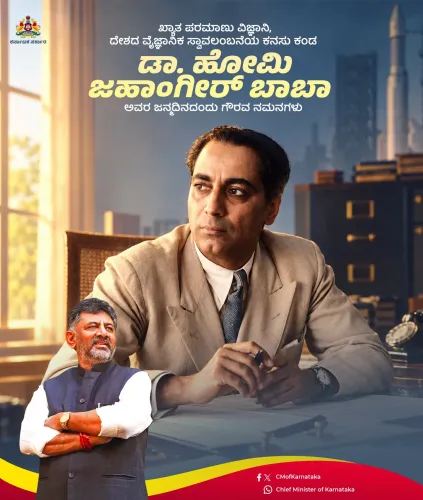
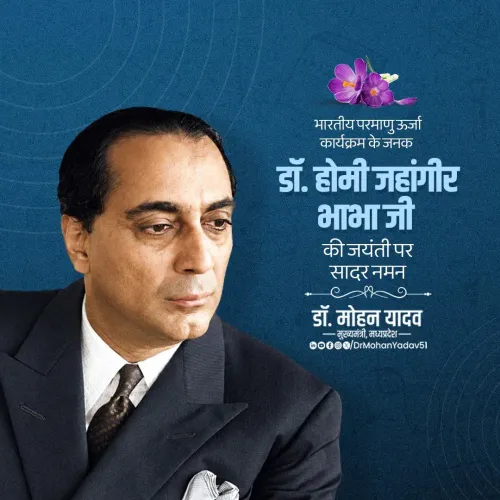
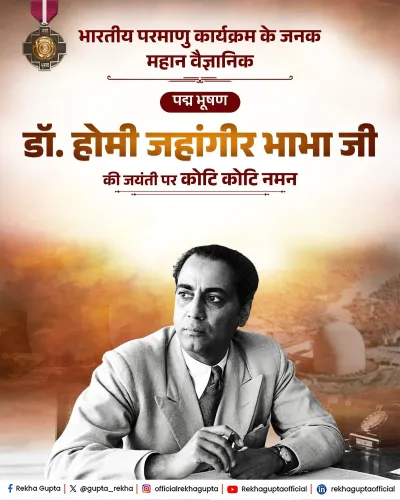
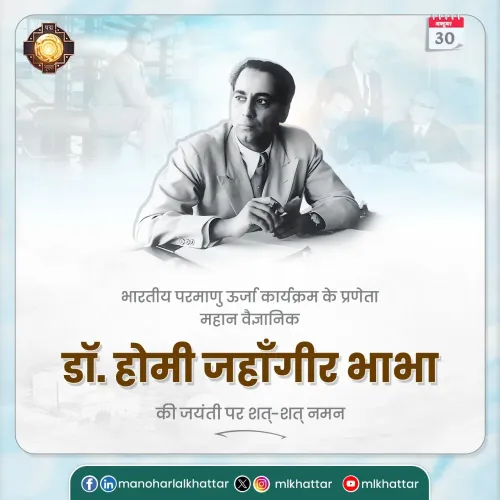
CM Bhajanlal Sharma Pays Tribute to Dr. Homi Bhabha on Birth Anniversary
Synopsis
Rajasthan CM Bhajan Lal Sharma marked the birth anniversary of Dr. Homi J. Bhabha on October 30, honouring the Padma Bhushan physicist who founded TIFR in 1945 and chaired India's Atomic Energy Commission, calling his contribution to national self-reliance in nuclear science unforgettable.
Key Takeaways
Rajasthan CM Bhajan Lal Sharma paid tribute to Dr.
Bhabha on his birth anniversary, October 30, 2026 .
Bhabha is recognised as the father of India's nuclear programme and was honoured with the Padma Bhushan .
He founded the Tata Institute of Fundamental Research in 1945 and served as the first chairman of the Atomic Energy Commission established in 1948 .
He also established what became the Bhabha Atomic Research Centre (BARC) , India's premier nuclear research facility.
CM Sharma emphasised Bhabha's role in making India aatmanirbhar (self-reliant) in science and nuclear energy — a theme central to both Bhabha's original vision and current national policy.
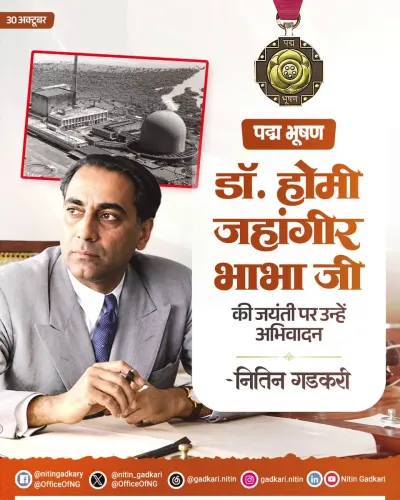
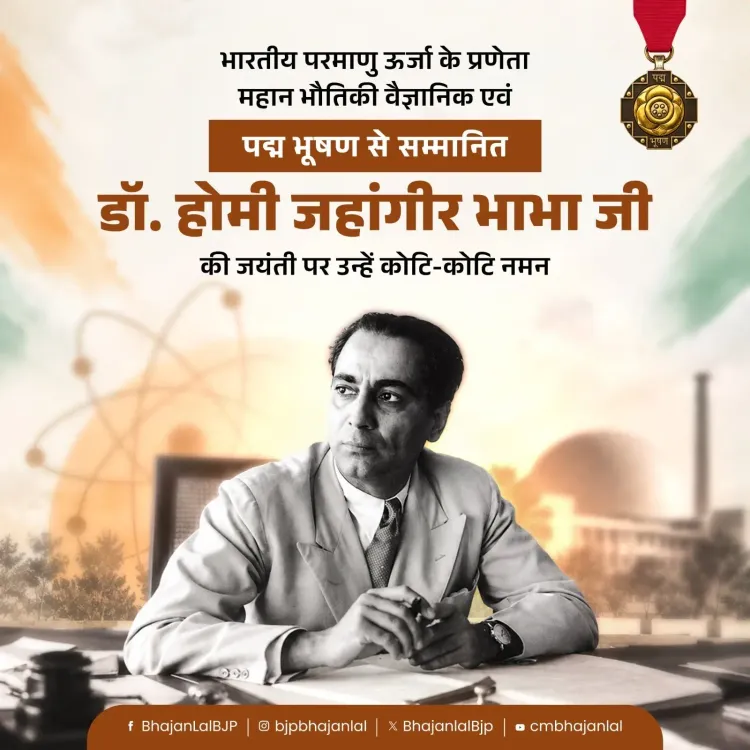
On the birth anniversary of the man who gave India its nuclear spine, Rajasthan Chief Minister Bhajan Lal Sharma on Friday, October 30 offered heartfelt homage to Dr. Homi Jahangir Bhabha, saluting the physicist's unparalleled contribution to making the nation self-reliant in science and atomic energy.
In his post, CM Sharma wrote: 'Bhartiya parmaanu karyakram ke janak... Dr. Homi Jahangir Bhabha ji ki jayanti par unhe koti-koti naman!' ('On the birth anniversary of the father of India's nuclear programme... I offer a million salutes to Dr. Homi Jahangir Bhabha!'). He added that Bhabha's extraordinary contribution to making the nation self-reliant and empowered in the fields of science and nuclear energy 'will remain unforgettable forever.'
The architect behind India's nuclear foundations
Dr. Homi Jahangir Bhabha is celebrated as the father of India's nuclear programme — a distinction rooted in concrete institutional action, not just honorary tradition. In 1945, he founded the Tata Institute of Fundamental Research (TIFR), creating India's first serious home for advanced scientific inquiry. When India gained independence, he was appointed the first chairman of the Atomic Energy Commission, established in 1948, to build indigenous nuclear capabilities from the ground up.
He also established what would become the Bhabha Atomic Research Centre (BARC) — today the nerve centre of India's civilian nuclear research. For his services to science and the nation, he was awarded the Padma Bhushan, one of India's highest civilian honours.
A birth anniversary that echoes through national policy
Indian leaders across administrations have consistently marked October 30 — Bhabha's birth anniversary — to reinforce the country's commitment to self-reliance in nuclear science. The tribute is rarely just ceremonial: it arrives against a backdrop of successive atomic energy policies since independence, each building on the three-stage nuclear programme Bhabha himself envisioned. The word CM Sharma used — 'aatmanirbhar' (self-reliant) — consciously echoes both Bhabha's original vision and the current national emphasis on indigenous capability-building.
For Rajasthan, the resonance is not merely philosophical. The state is home to the Rawatbhata nuclear power plant, one of India's oldest operating atomic energy facilities, making Bhabha's legacy a lived, functional reality within the state CM Sharma governs.
Point of View
Lending ideological continuity to a legacy that predates the party by decades. It also serves as a subtle reminder that India's nuclear capability is an indigenous achievement — significant in the context of ongoing global debates around civil nuclear cooperation and energy security. For Rajasthan, home to the Rawatbhata nuclear plant, the tribute carries additional local resonance.
NationPress
30 Oct 2026
Frequently Asked Questions
Who is Dr. Homi J. Bhabha?
Dr. Homi Jahangir Bhabha was an Indian physicist regarded as the father of India's nuclear programme. He founded the Tata Institute of Fundamental Research in 1945, chaired the Atomic Energy Commission from 1948, and established the institution now known as the Bhabha Atomic Research Centre. He was awarded the Padma Bhushan.
When is Homi Bhabha's birth anniversary?
Dr. Homi J. Bhabha was born on October 30, and his birth anniversary is observed annually on that date across India.
What did Bhajan Lal Sharma say about Homi Bhabha?
Rajasthan CM Bhajan Lal Sharma posted a tribute calling Bhabha the father of India's nuclear programme and a great physicist honoured with the Padma Bhushan, saying his contribution to making India self-reliant in science and nuclear energy 'will remain unforgettable forever.'
What is the Bhabha Atomic Research Centre?
The Bhabha Atomic Research Centre (BARC), located in Mumbai, is India's premier nuclear research facility. It was established by Dr. Homi J. Bhabha and remains the cornerstone of India's civilian nuclear research and development.
When was India's Atomic Energy Commission established?
India's Atomic Energy Commission was established in 1948, with Dr. Homi J. Bhabha as its first chairman, to develop the country's indigenous nuclear capabilities after independence.