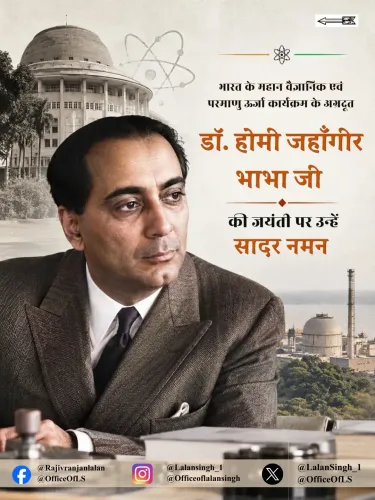
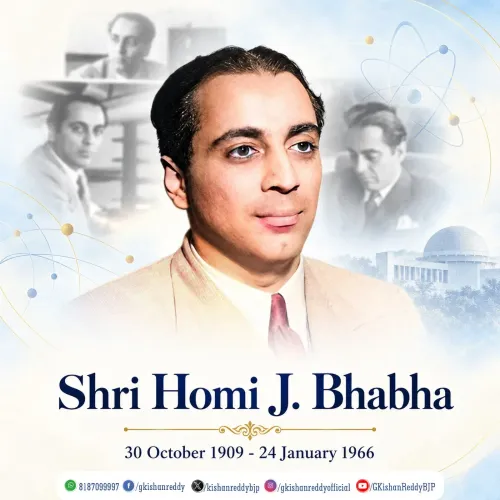
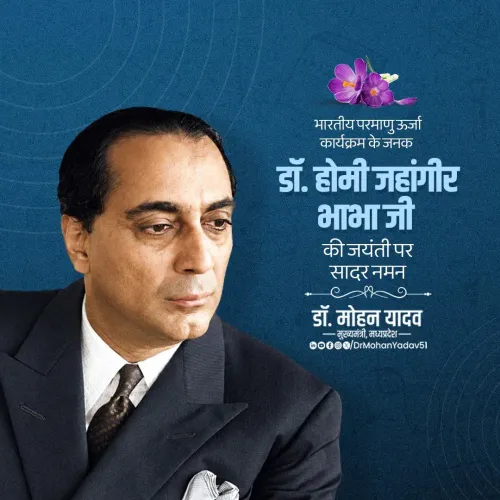
Khattar pays tribute to Homi Bhabha on birth anniversary
Synopsis
Union Power Minister Manohar Lal Khattar marked the birth anniversary of Dr. Homi Jahangir Bhabha on 30 October 2026, saluting the Padma Bhushan physicist who founded the Atomic Energy Commission in 1948 and built the bedrock of India's nuclear self-reliance.
Key Takeaways
Union Power Minister Manohar Lal Khattar posted a tribute to Dr.
Homi Jahangir Bhabha on his birth anniversary on 30 October 2026 .
Khattar hailed Bhabha's 'unparalleled talent, scientific vision, and indomitable resolve' for establishing India as a nuclear-capable, self-reliant nation.
Bhabha founded the Tata Institute of Fundamental Research (TIFR) in 1945 and became the first chairman of the Atomic Energy Commission of India in 1948 .
He was awarded the Padma Bhushan , India's third-highest civilian honour.
Khattar described Bhabha as a permanent source of inspiration and guidance for India's youth.
The tribute aligns with a broader government pattern of invoking Bhabha's legacy to underline India's commitment to indigenous nuclear energy development.
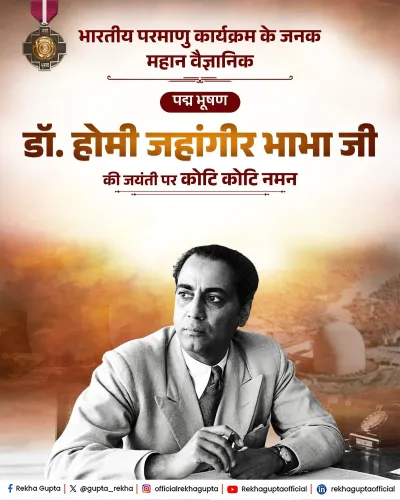
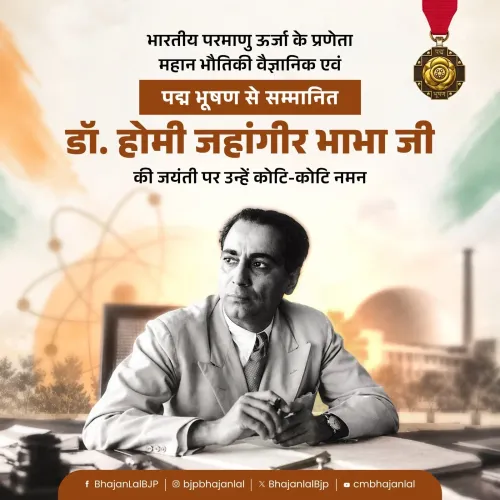
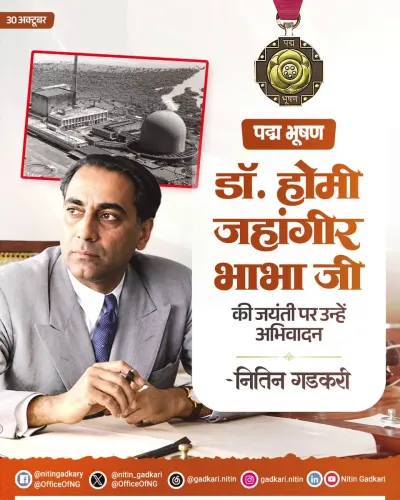
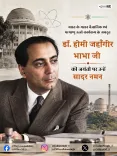
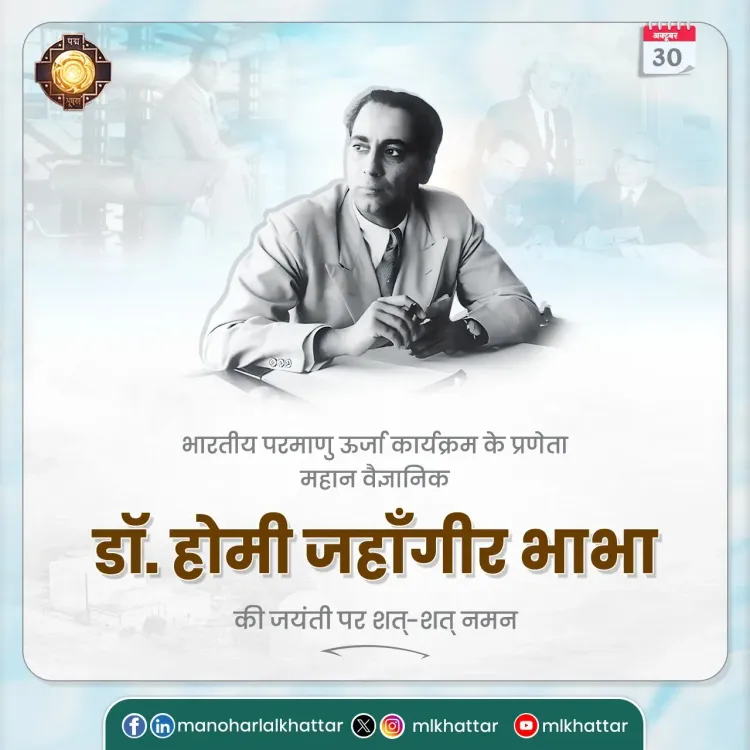
On the birth anniversary of Dr. Homi Jahangir Bhabha, the architect of India's nuclear programme, Union Power Minister Manohar Lal Khattar offered a heartfelt tribute on Friday, 30 October 2026, honouring the physicist whose vision transformed India into a nuclear-capable, self-reliant nation.
Posting in Hindi, Khattar wrote: 'भारतीय परमाणु ऊर्जा कार्यक्रम के जनक व दूरदर्शी वैज्ञानिक 'पद्मभूषण' डॉ. होमी जहाँगीर भाभा की जयंती पर उन्हें भावपूर्ण नमन!' — 'Heartfelt salutations to Padma Bhushan Dr. Homi Jahangir Bhabha, the father of India's atomic energy programme and a visionary scientist, on his birth anniversary!' He credited Bhabha's 'unparalleled talent, scientific vision, and indomitable resolve' with establishing India as a self-reliant, nuclear-powered nation, adding that 'sons of the soil like you, who served the nation through science, will always remain a source of inspiration and guidance for the youth.'
The man who gave India its nuclear foundation
Dr. Homi Jahangir Bhabha was a Cambridge-trained theoretical physicist who returned to India and built its scientific infrastructure almost from scratch. In 1945, he established the Tata Institute of Fundamental Research (TIFR) in Bombay, giving Indian scientists a world-class research home for the first time. Three years later, in 1948, he became the founding chairman of the Atomic Energy Commission of India, the institution that would anchor the country's entire nuclear ambition for decades to come.
Bhabha's guiding principle — that India must master the full nuclear fuel cycle indigenously — became the philosophical bedrock of a programme that now encompasses civilian power generation, research reactors, and strategic capability. Awarded the Padma Bhushan, India's third-highest civilian honour, he remains a rare figure whose legacy sits equally comfortably in a physics lecture and a national security briefing.
Why ministers mark this day
Khattar's tribute fits a deliberate pattern in Indian public life: senior ministers use key scientists' anniversaries to reaffirm the government's commitment to self-reliant technology — a message that resonates directly with the Aatmanirbhar Bharat (self-reliant India) framework. For a Power Minister specifically, invoking Bhabha carries extra weight: nuclear energy is a growing pillar of India's baseload electricity strategy, and any signal of political will on that front is watched closely by the scientific and energy-planning communities.
With India's nuclear power capacity targets under active discussion and new plant projects in various stages of clearance, reminding the country of the man who made all of it possible is more than ceremonial — it is a restatement of intent.
Point of View
Even as it reframes that legacy within the contemporary 'Aatmanirbhar Bharat' vocabulary. For a Power Minister, the symbolism is particularly pointed: nuclear energy sits at the centre of India's long-term electricity security debate, and invoking Bhabha keeps political attention on the technology. These anniversary posts also serve as low-cost, high-reach signals to India's scientific community that their foundational figures retain state-level recognition. Cumulatively, such tributes reinforce the narrative that India's technological sovereignty has deep roots — and present leadership as its rightful steward.
NationPress
30 Oct 2026
Frequently Asked Questions
Who was Homi Jahangir Bhabha?
Dr. Homi Jahangir Bhabha was a Cambridge-trained Indian theoretical physicist widely regarded as the father of India's nuclear programme. He founded the Tata Institute of Fundamental Research in 1945 and served as the first chairman of the Atomic Energy Commission of India from 1948. He was awarded the Padma Bhushan for his contributions to science and national development.
When is Homi Bhabha's birth anniversary?
Homi Jahangir Bhabha's birth anniversary falls on 30 October , and it is marked each year by tributes from Indian scientists, institutions, and government officials.
What did Manohar Lal Khattar say about Homi Bhabha?
Union Power Minister Manohar Lal Khattar called Bhabha the 'father of India's atomic energy programme and a visionary scientist,' crediting his 'unparalleled talent, scientific vision, and indomitable resolve' with establishing India as a self-reliant, nuclear-powered nation, and describing him as a lasting inspiration for the country's youth.
What is the Atomic Energy Commission of India?
The Atomic Energy Commission of India was established in 1948 under the chairmanship of Dr. Homi Bhabha to direct India's indigenous research and development in nuclear science and energy. It remains the apex policy body overseeing India's civilian and strategic nuclear activities.
Why does India's nuclear programme matter today?
India's nuclear power capacity is seen as a critical component of its long-term baseload electricity strategy, reducing dependence on coal and imported fuels. The programme, whose foundations Bhabha laid in the 1940s and 1950s, continues to expand with new reactor projects aimed at increasing the share of clean, indigenous nuclear energy in India's power mix.