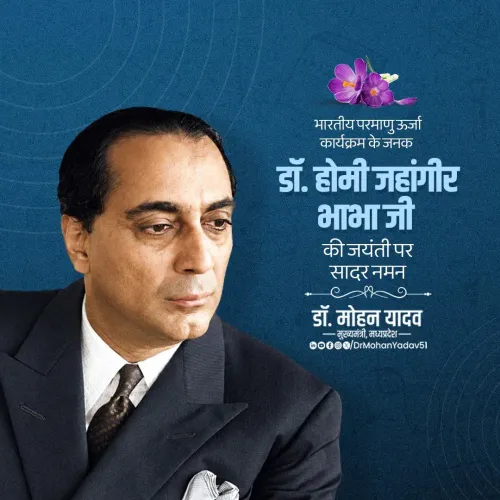
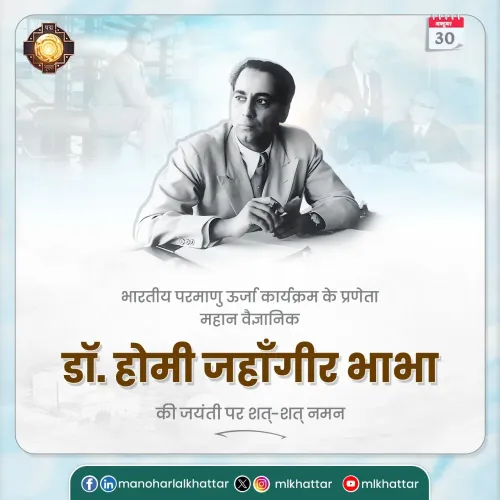
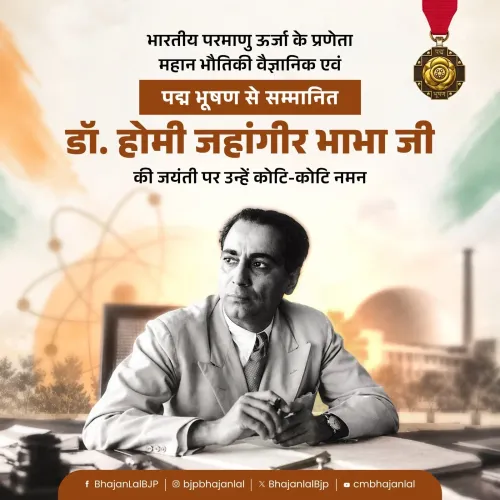
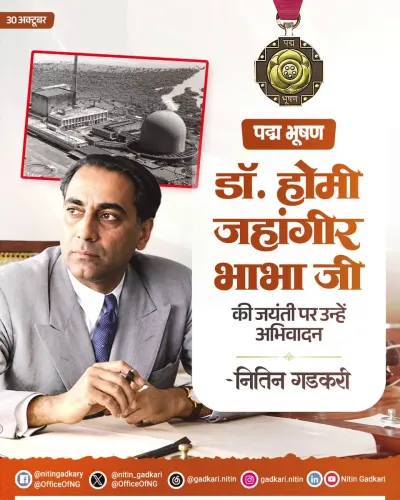
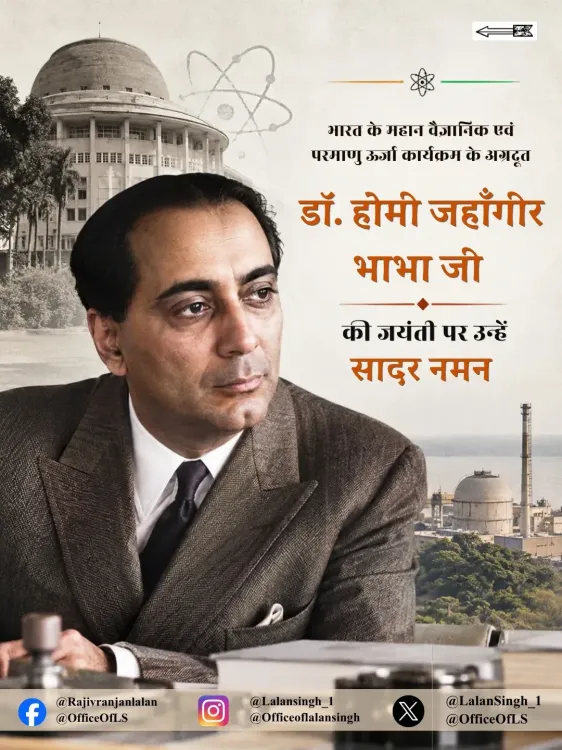
Lalan Singh pays tribute to Dr. Homi Bhabha on birth anniversary
Synopsis
Union Minister Rajiv Ranjan Singh (Lalan Singh) paid tribute to Dr. Homi J. Bhabha on his birth anniversary, honouring the nuclear pioneer's vision of a self-reliant India and his foundational role in building the country's atomic energy programme.
Key Takeaways
Union Minister Lalan Singh paid tribute to Dr.
Bhabha on his birth anniversary on 30 October 2026 .
Bhabha founded the Tata Institute of Fundamental Research in 1945 and was the first chairman of the Atomic Energy Commission set up in 1948 .
The Department of Atomic Energy was established in 1954 under his stewardship.
The minister highlighted Bhabha's 'incomparable contribution to science' and his dream of building a self-reliant India .
Bhabha's legacy includes designing India's three-stage nuclear programme intended to eventually use the country's vast thorium reserves .
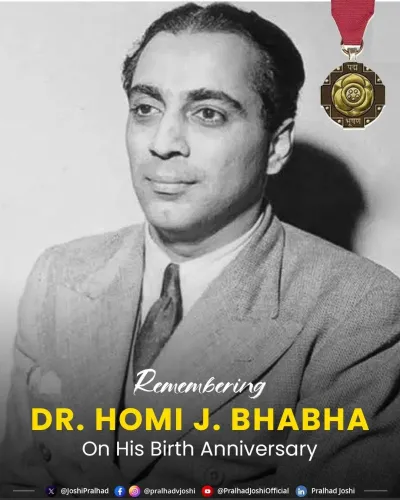
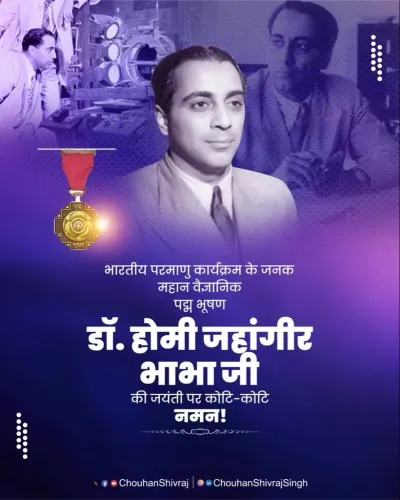
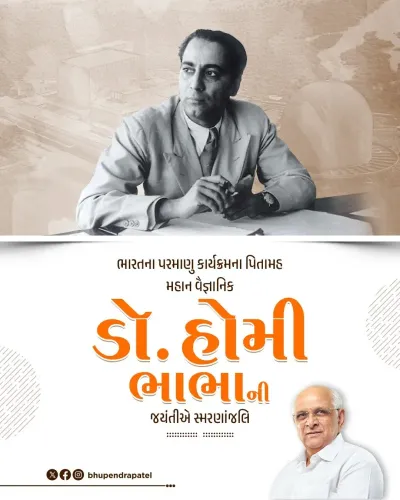
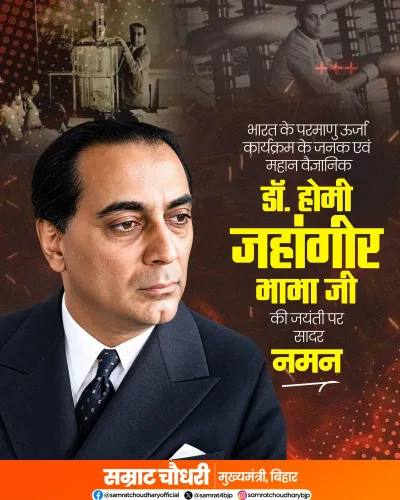
On the birth anniversary of the architect of India's atomic age, Union Panchayati Raj and Fisheries Minister Rajiv Ranjan Singh — popularly known as Lalan Singh — paid solemn tribute on Friday, 30 October 2026 to Dr. Homi Jahangir Bhabha, saluting his foundational role in shaping the country's nuclear destiny.
Posting in Hindi, the minister wrote: 'महान वैज्ञानिक एवं परमाणु ऊर्जा कार्यक्रम के अग्रदूत डॉ. होमी जहाँगीर भाभा जी की जयंती पर उन्हें सादर नमन' — 'Respectful homage to the great scientist and pioneer of the nuclear energy programme, Dr. Homi Jahangir Bhabha, on his birth anniversary.' He added that Bhabha's 'incomparable contribution to science and his dream of building a self-reliant India will continue to inspire the country's scientific progress and future generations.'The man who lit India's nuclear flame
Dr. Homi J. Bhabha stands as perhaps the single most consequential figure in post-independence Indian science. In 1945, he founded the Tata Institute of Fundamental Research (TIFR), giving India its first world-class basic-science institution. When Prime Minister Jawaharlal Nehru established the Atomic Energy Commission in 1948, Bhabha became its first chairman — a role that let him draw the entire blueprint of an indigenous nuclear programme from scratch. The Department of Atomic Energy, set up in 1954, became the institutional engine that drove that vision forward. Today, the landmark research complex at Trombay, Mumbai — renamed the Bhabha Atomic Research Centre (BARC) in his honour — remains the nerve-centre of India's civil nuclear science.Self-reliance, then and now
Lalan Singh's invocation of Bhabha's 'dream of a self-reliant India' carries deliberate resonance. The phrase mirrors the current government's Aatmanirbhar Bharat framework — and Bhabha, who insisted on building indigenous capacity rather than depending on foreign technology, is a natural historical anchor for that argument. Indian leaders across party lines have long drawn a straight line from Bhabha's laboratories to the country's present strategic and energy ambitions. The minister's tribute fits a consistent pattern: birth anniversaries of scientists tied to strategic programmes are marked publicly, keeping the narrative of indigenous development alive in public memory. Bhabha's legacy is not merely ceremonial. India's three-stage nuclear power programme — designed to eventually harness thorium, of which the country holds vast reserves — was his original conception, and it continues to guide nuclear energy planning decades after his death.Point of View
Invoking Bhabha is also a reminder that strategic self-reliance transcends any single party's legacy. With nuclear energy capacity expansion back on the policy agenda, such anniversary tributes subtly keep public attention on atomic power as a pillar of India's long-term energy security calculus.
NationPress
30 Oct 2026
Frequently Asked Questions
When is Homi Bhabha's birth anniversary?
Dr. Homi Jahangir Bhabha was born on 30 October 1909 , and his birth anniversary is observed on that date every year.
What did Homi Bhabha contribute to India?
Dr. Bhabha founded the Tata Institute of Fundamental Research in 1945 , became the first chairman of India's Atomic Energy Commission in 1948 , and designed the country's three-stage nuclear power programme. The Bhabha Atomic Research Centre (BARC) in Mumbai is named in his honour.
What is the Bhabha Atomic Research Centre?
The Bhabha Atomic Research Centre (BARC) is India's premier nuclear research facility located in Trombay, Mumbai . It was established in 1954 as the Atomic Energy Establishment and renamed after Dr. Bhabha following his death.
What was India's three-stage nuclear programme?
Conceived by Dr. Homi Bhabha , India's three-stage nuclear programme aims to eventually use the country's abundant thorium reserves for energy, moving through natural uranium reactors, fast breeder reactors, and finally thorium-based reactors.