Pralhad Joshi Remembers Nuclear Pioneer Dr. Homi Bhabha
Synopsis
Union Minister Pralhad Joshi remembered Padma Bhushan Dr. Homi J. Bhabha on his birth anniversary, saluting the physicist who founded TIFR in 1945, established the Atomic Energy Establishment Trombay in 1954, and chaired India's Atomic Energy Commission — building the institutional scaffolding for India's nuclear programme.
Key Takeaways
Union Minister Pralhad Joshi paid tribute to Dr.
Bhabha on his birth anniversary on 30 October 2026 .
Bhabha was a Padma Bhushan recipient and the founding Chairman of India's Atomic Energy Commission , constituted in 1948 .
He established the Tata Institute of Fundamental Research (TIFR) in 1945 as India's first serious physics research body.
He set up the Atomic Energy Establishment, Trombay in 1954 , later renamed Bhabha Atomic Research Centre (BARC) .
India's first research reactor, Apsara , went critical in 1956 under the programme Bhabha designed.
Tributes to Bhabha underscore the continuity between India's 1940s–1960s nuclear foundations and present-day atomic energy goals.
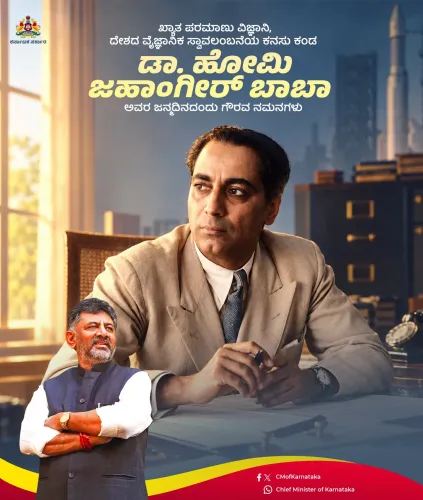
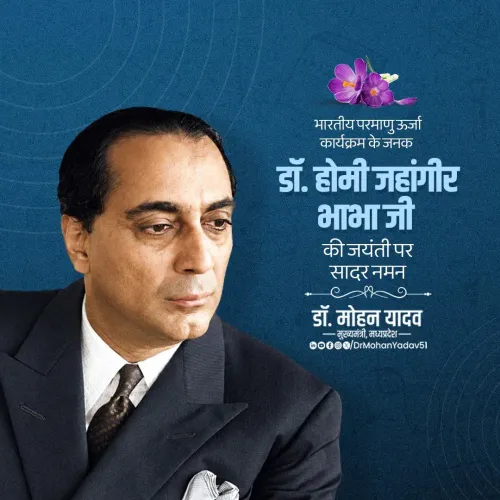
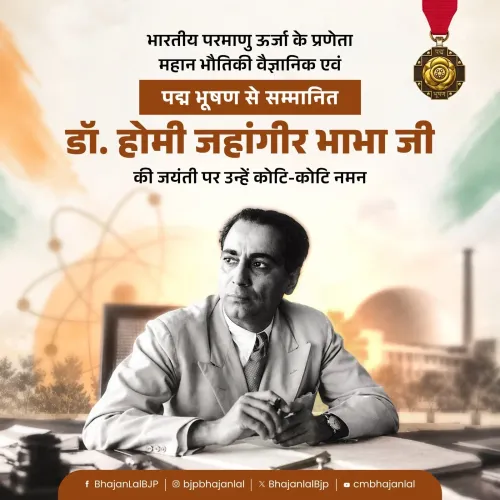
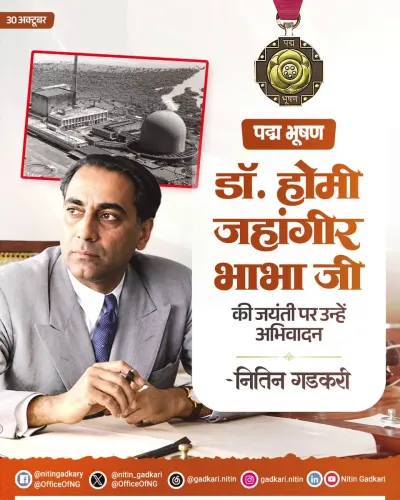
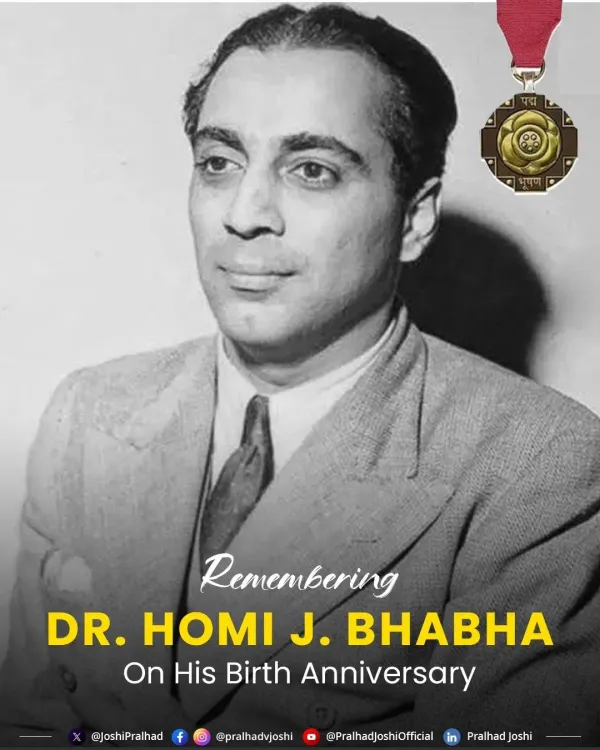
The architect of India's atomic ambitions was born on this day, and Union Consumer Affairs Minister Pralhad Joshi marked the occasion on Friday, 30 October 2026, with a tribute to Padma Bhushan Dr. Homi Jehangir Bhabha — the physicist who turned post-independence India's nuclear dream into brick, mortar, and chain reaction.
Joshi wrote: 'Remembering Padma Bhushan Dr. Homi J. Bhabha ji on his birth anniversary. His pioneering work in nuclear science laid the foundation for India's nuclear programme and continues to inspire generations of scientists.'
The man who built India's atomic scaffolding
Bhabha was not merely a scientist — he was an institution-builder at a moment when India had almost none. In 1945, he established the Tata Institute of Fundamental Research (TIFR), seeding the country's first serious environment for theoretical and experimental physics. Nine years later, in 1954, he set up the Atomic Energy Establishment, Trombay — later renamed the Bhabha Atomic Research Centre (BARC) in his honour — as the operational engine of the national nuclear effort.
In 1948, the government constituted the Atomic Energy Commission and placed Bhabha at its helm as Chairman, giving his vision the sovereign mandate it needed. The programme moved swiftly: by 1956, India's first research reactor, Apsara, went critical at Trombay — proof that the blueprint Bhabha had drawn was not theoretical ambition but live engineering capability.
A tributary tradition with a strategic undertone
Indian ministers routinely mark the birth anniversaries of the nation's foundational scientists, and tributes to Bhabha carry particular resonance. They serve as implicit reaffirmations of the post-independence conviction that strategic self-reliance begins in the laboratory. Each such commemoration threads the present back to the 1940s–1960s institutional foundations that still underpin the Department of Atomic Energy's research and energy programmes today.
For a minister whose portfolio spans energy policy — including New and Renewable Energy — acknowledging Bhabha is also a reminder that India's energy ambitions have always demanded the courage to build from scratch.
Generations of scientists trained at BARC and TIFR have since extended that legacy into reactors, space propulsion, and medical isotopes. Bhabha lit the fuse. The chain reaction is still running.
Point of View
Anchoring present-day nuclear and energy policy in a lineage of indigenous institution-building. For Pralhad Joshi, whose portfolio explicitly includes New and Renewable Energy, invoking Bhabha is a reminder that India's energy transitions have always required building capability from first principles. Such commemorations also reinforce the Department of Atomic Energy's cultural self-image at a time when nuclear power is being reconsidered globally as a low-carbon baseload option. The tribute is brief, but the policy subtext it carries is substantial.
NationPress
30 Oct 2026
Frequently Asked Questions
Who was Dr. Homi J. Bhabha?
Dr. Homi Jehangir Bhabha was India's pioneering nuclear physicist and institution-builder. He founded the Tata Institute of Fundamental Research in 1945, established the Atomic Energy Establishment Trombay (now BARC) in 1954, and served as the first Chairman of India's Atomic Energy Commission from 1948.
What did Homi Bhabha contribute to India's nuclear programme?
Bhabha laid the entire institutional foundation of India's nuclear programme — from creating premier research bodies like TIFR and BARC to overseeing the commissioning of India's first research reactor, Apsara, in 1956.
What is BARC and who founded it?
The Bhabha Atomic Research Centre (BARC) in Trombay, Mumbai, is India's premier nuclear research facility. It was originally set up in 1954 by Homi Bhabha as the Atomic Energy Establishment, Trombay, and was renamed BARC in his memory.
Why did Pralhad Joshi remember Homi Bhabha?
Union Minister Pralhad Joshi posted a tribute on X on 30 October 2026 to mark Homi Bhabha's birth anniversary, honouring his foundational role in India's nuclear science and his legacy of inspiring generations of scientists.
What was India's first nuclear reactor?
Apsara was India's first research reactor. It went critical in 1956 at the Atomic Energy Establishment, Trombay, as part of the nuclear programme planned and led by Dr. Homi J. Bhabha.