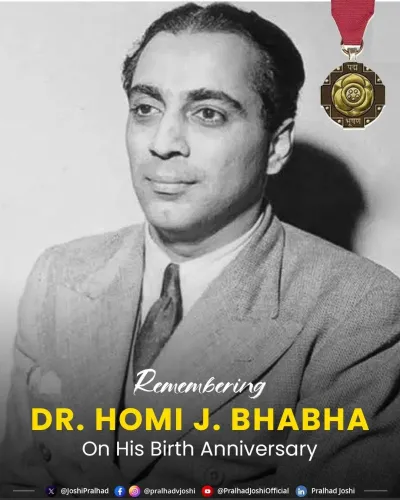
Kishan Reddy Remembers Homi Bhabha on Birth Anniversary
Synopsis
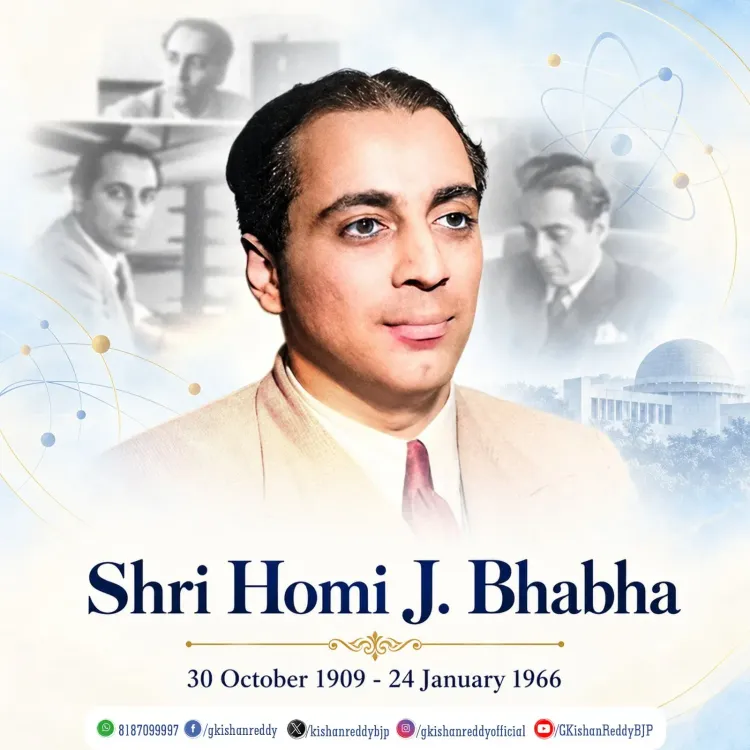
Union Minister G. Kishan Reddy marked the birth anniversary of Dr. Homi Jehangir Bhabha, the nuclear physicist who founded TIFR, chaired India's Atomic Energy Commission, and built the institutional backbone of the country's nuclear programme after independence.
Key Takeaways
Union Coal and Mines Minister G.
Kishan Reddy paid tribute to Dr.
Homi Jehangir Bhabha on his birth anniversary on 30 October 2026 .
Bhabha founded the Tata Institute of Fundamental Research in 1945 and chaired the Atomic Energy Commission from its creation in 1948 .
The Department of Atomic Energy and the Atomic Energy Establishment Trombay (later renamed BARC ) were both established in 1954 under his leadership.
India's first research reactor, Apsara , achieved criticality at Trombay in 1956 — the operational start of the national nuclear programme.
Bhabha's three-stage nuclear power programme, designed around India's thorium reserves, continues to guide the country's long-term nuclear energy strategy.
On the birth anniversary of the man who gave India its nuclear ambition, Union Coal and Mines Minister G. Kishan Reddy paid tribute on Friday, 30 October 2026 to nuclear physicist Dr. Homi Jehangir Bhabha, calling him 'a pioneering architect of India's nuclear programme.'
The physicist who built India's nuclear foundation
Dr. Homi Jehangir Bhabha was not merely a scientist — he was an institution-builder in the most literal sense. He founded the Tata Institute of Fundamental Research in 1945, and when India became independent, he was the natural choice to chair the newly constituted Atomic Energy Commission in 1948. The commission was placed directly under the Prime Minister's charge — a signal of how strategically vital nuclear research was deemed from day one.
Under Bhabha's leadership, the Department of Atomic Energy was established in 1954, the same year the Atomic Energy Establishment Trombay came into being at Trombay, Mumbai — the facility that would later be renamed the Bhabha Atomic Research Centre (BARC) in his honour. Two years later, in 1956, India's first research reactor, Apsara, achieved criticality at Trombay, marking the operational birth of the national nuclear programme.
A three-stage vision that still drives India's nuclear pursuit
What made Bhabha's legacy truly durable was not any single reactor or institution, but a strategic framework: the three-stage nuclear power programme designed to leverage India's vast thorium reserves and move toward energy self-reliance across generations. Successive governments — irrespective of political colour — have maintained that architecture, a rare continuity in Indian policy.
Kishan Reddy's tribute underscores this continuity. His post noted that Bhabha's contributions 'continue to inspire India's pursuit of scientific excellence and self-reliance' — a phrase that echoes the Atmanirbhar Bharat (self-reliant India) framework his own government has championed across strategic sectors, from defence to space to energy.
India's nuclear establishment — spanning BARC, the Nuclear Power Corporation of India, and research facilities across the country — stands today as a direct institutional descendant of the structures Bhabha designed in those post-independence decades. The scientist who once lobbied Jawaharlal Nehru for a dedicated nuclear agency built something that outlasted every political cycle since.
Point of View
Making tributes to him a low-friction but symbolically charged act for any sitting government. The emphasis on institutional legacy — BARC, DAE, the three-stage programme — subtly reinforces the argument that India's strategic autonomy in nuclear matters is a long-built inheritance, not a recent political achievement. For a minister who oversees coal and mines, the nuclear self-reliance framing also gestures toward the energy security dimension that links all extractive and generative sectors of India's economy.
NationPress
30 Oct 2026
Frequently Asked Questions
When is Homi Jehangir Bhabha's birth anniversary?
Dr. Homi Jehangir Bhabha was born on 30 October 1909 , and his birth anniversary is observed on 30 October each year.
What did Homi Bhabha contribute to India's nuclear programme?
Bhabha founded the Tata Institute of Fundamental Research in 1945 , chaired the Atomic Energy Commission from 1948 , established the Department of Atomic Energy in 1954 , and oversaw the commissioning of India's first research reactor, Apsara , in 1956 . He also designed the three-stage nuclear power programme that still guides India's nuclear strategy.
What is BARC and how is it connected to Homi Bhabha?
The Bhabha Atomic Research Centre (BARC) in Trombay, Mumbai was originally established in 1954 as the Atomic Energy Establishment Trombay and was later renamed in honour of Dr. Homi Jehangir Bhabha , who built it into India's primary nuclear research facility.
Who is G. Kishan Reddy?
G. Kishan Reddy is the Union Minister of Coal and Mines in the Government of India and also serves as the BJP's Telangana state president . He represents the Secunderabad constituency in the Lok Sabha.
What is India's three-stage nuclear power programme?
The three-stage nuclear power programme was conceived by Dr. Homi Bhabha to leverage India's large thorium reserves . It progresses from pressurised heavy-water reactors using natural uranium, to fast-breeder reactors using plutonium, and finally to reactors running on thorium — a long-term roadmap for nuclear energy self-reliance that successive governments have continued to pursue.