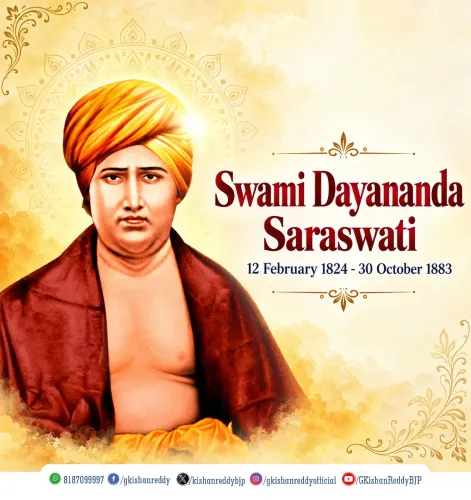
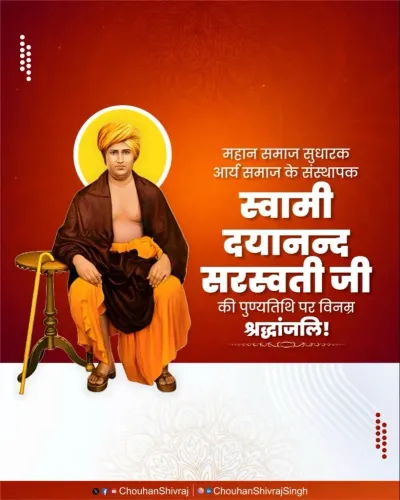
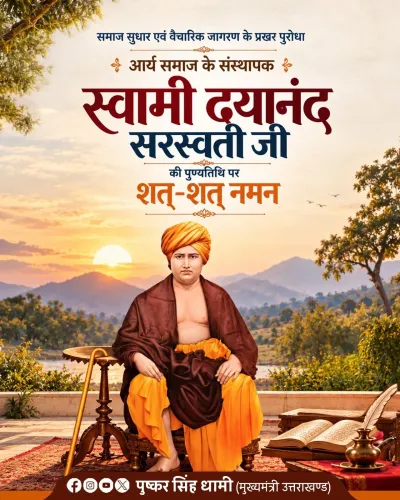
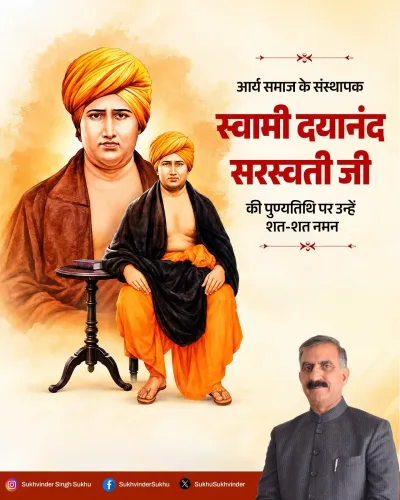
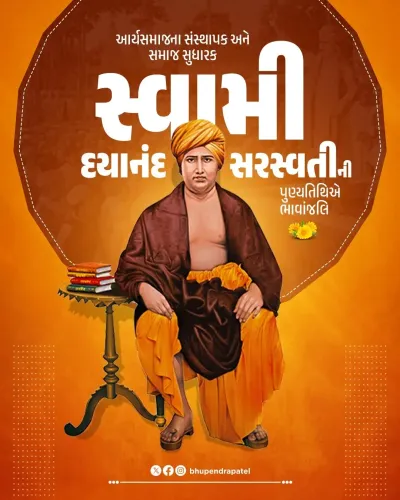
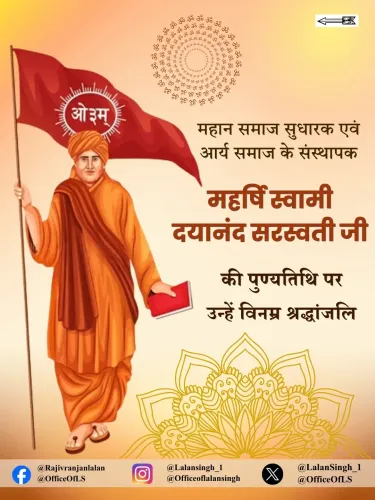
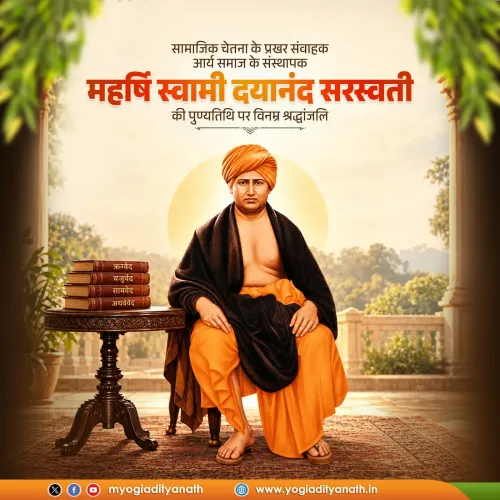
Shekhawat pays tribute to Swami Dayanand Saraswati on Punyatithi
Synopsis
Union Culture Minister Gajendra Singh Shekhawat paid a heartfelt tribute to Arya Samaj founder Swami Dayanand Saraswati on his 143rd death anniversary, honouring the 19th-century reformer's Vedic revival and social reform legacy.
Key Takeaways
Union Culture and Tourism Minister Gajendra Singh Shekhawat posted a tribute to Swami Dayanand Saraswati on his death anniversary on 30 October 2026 .
Swami Dayanand Saraswati died on 30 October 1883 , making this his 143rd punyatithi .
He founded the Arya Samaj in 1875 , a reform organisation promoting Vedic monotheism, women's education, and opposition to caste discrimination.
Shekhawat's tribute described Saraswati as a 'great social reformer, founder of the Arya Samaj, and visionary saint.' The tribute follows a longstanding tradition of BJP leaders publicly commemorating 19th-century reformers on their death anniversaries.
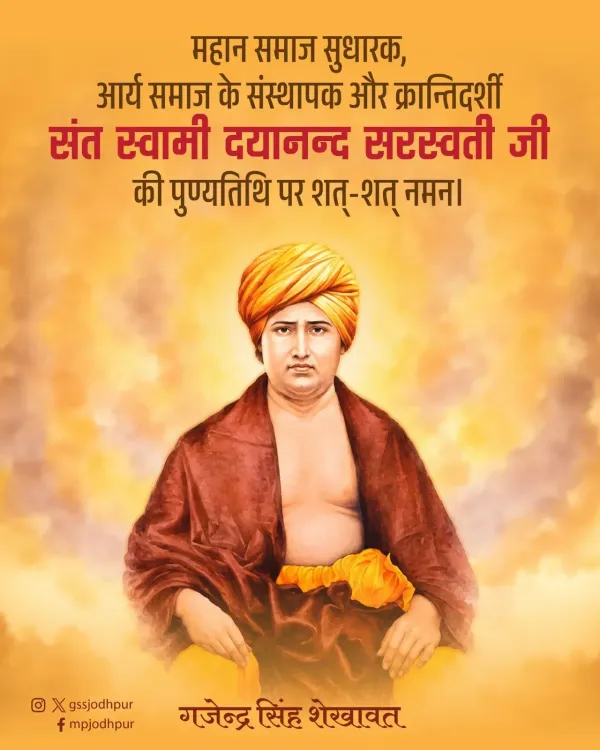
On the 143rd death anniversary of one of India's most consequential social reformers, Union Culture and Tourism Minister Gajendra Singh Shekhawat offered a respectful tribute to Swami Dayanand Saraswati — the visionary saint who shook 19th-century Hindu society to its foundations and built an institution that still endures.
Posting on Friday, 30 October 2026, Shekhawat wrote: 'Mahan samaj sudharak, Arya Samaj ke sansthapak aur krantidharshi sant Swami Dayanand Saraswati ji ki punyatithi par shat-shat naman' — offering a hundredfold salutation to the great social reformer, founder of the Arya Samaj, and visionary saint on his death anniversary.
The reformer who challenged an age
Born in 1824 in Gujarat, Swami Dayanand Saraswati spent decades dismantling the religious orthodoxies of his time — opposing idol worship, rejecting the rigid hierarchies of caste, and insisting on a return to the pure monotheism of the Vedas. His intellectual courage made him enemies in powerful quarters. He died on 30 October 1883, and his passing anniversary is observed each year as his punyatithi.
In 1875, he founded the Arya Samaj in Bombay — a Hindu reform organisation built on Vedic principles, championing education for women, opposing child marriage, and insisting that merit, not birth, defined a person's worth. The organisation seeded schools, colleges, and social movements across the subcontinent and became a quiet engine of the broader Indian reform and independence era.
A tradition of public memory on Punyatithi
Shekhawat's tribute follows a pattern that has become a fixture of Indian political culture: senior leaders publicly acknowledge the death anniversaries of 19th-century reformers, threading their own party's cultural vision to the legacy of figures who reshaped Indian society. For the BJP, invoking Swami Dayanand Saraswati carries particular resonance — the Arya Samaj's emphasis on Vedic heritage, national self-respect, and social reform aligns closely with the cultural agenda the party has long promoted.
As Union Minister of Culture, Shekhawat's role puts him at the centre of how the Indian state curates and commemorates its reformist past. A tribute like this is both personal and institutional — a signal of which legacies the government chooses to amplify.
Swami Dayanand Saraswati's challenge to his own era remains vivid: a lone monk who picked a fight with entrenched power and, in the end, outlasted it. That the Indian state still pauses to mark his passing, 143 years later, is itself a measure of how deep that impact runs.
Point of View
His role is precisely to curate which historical figures occupy official memory, and Arya Samaj's reformist-nationalist lineage makes Dayanand Saraswati a particularly resonant choice. The annual repetition of such tributes by senior ministers is less about individual sentiment and more about state-level signalling of cultural priorities. The pattern reflects a sustained effort to connect contemporary governance to a 19th-century reform tradition that the party claims as intellectual heritage.
NationPress
30 Oct 2026
Frequently Asked Questions
When did Swami Dayanand Saraswati die?
Swami Dayanand Saraswati died on 30 October 1883 . His death anniversary, known as his punyatithi , is observed annually across India by Arya Samaj institutions and political leaders.
Who founded the Arya Samaj?
The Arya Samaj was founded by Swami Dayanand Saraswati in 1875 in Bombay. It is a Hindu reform organisation based on Vedic principles, monotheism, and social reform.
What did Swami Dayanand Saraswati stand for?
Swami Dayanand Saraswati advocated a return to Vedic monotheism, opposed idol worship and caste discrimination, supported women's education, and rejected child marriage — making him one of the most influential social reformers of 19th-century India.
Why did Gajendra Singh Shekhawat post about Swami Dayanand Saraswati?
Union Culture and Tourism Minister Gajendra Singh Shekhawat posted a tribute on 30 October 2026 — the 143rd death anniversary of Swami Dayanand Saraswati — as part of a longstanding tradition of senior leaders commemorating reformers on their punyatithi.
What is the significance of Arya Samaj in India today?
The Arya Samaj , founded in 1875 , continues to operate schools, colleges, and social institutions across India. It remains influential in promoting Vedic education and social reform, and its legacy is widely acknowledged in Indian cultural and political discourse.