Dr Jitendra Singh Pays Tribute to Homi Bhabha on Birth Anniversary
Synopsis
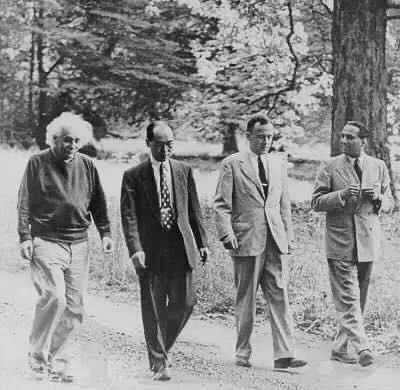
Union Science Minister Dr. Jitendra Singh marked the birth anniversary of Dr. Homi J. Bhabha on October 30, sharing a rare archival photograph of the physicist who founded India's nuclear institutions and whose legacy continues to shape the country's science and energy policy.
Key Takeaways
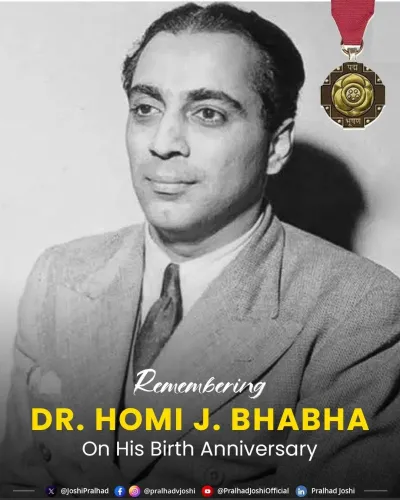
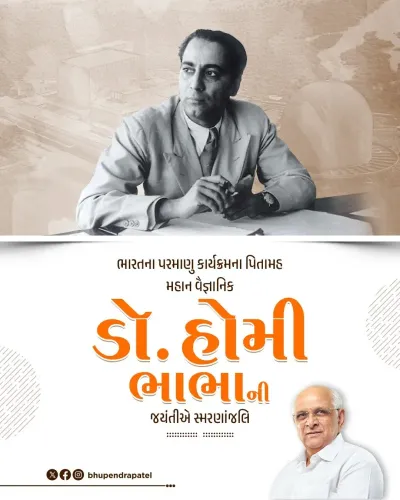
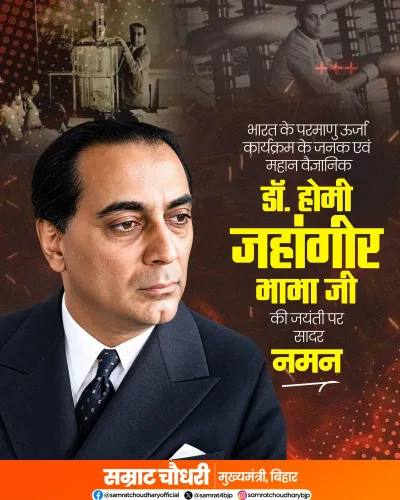
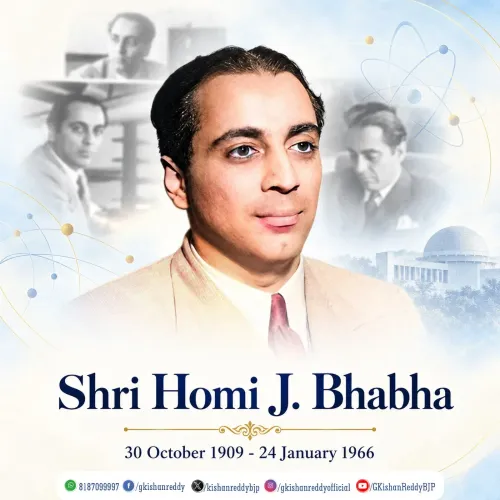
Bhabha was born on October 30, 1909 and is revered as the Father of India's Nuclear Programme.
Bhabha founded the Tata Institute of Fundamental Research in 1945 and chaired the Atomic Energy Commission from 1948 .
Jitendra Singh shared a rare archival photograph showing Bhabha alongside leading scientists of his era.
The Bhabha Atomic Research Centre (BARC) in Mumbai is named in his honour and remains central to India's nuclear programme.
India's three-stage nuclear power programme traces its conceptual roots to Bhabha's foundational policy vision.
A rare photograph, a towering legacy — Union Science and Technology Minister Dr. Jitendra Singh marked the birth anniversary of Dr. Homi J. Bhabha on Friday, October 30, 2026, sharing an archival image of the physicist alongside some of the foremost scientific minds of his era, calling him 'the Father of India's Nuclear Programme' whose contributions 'laid the foundation for India's nuclear science.'
The man who built India's nuclear foundations
Born on October 30, 1909, Dr. Homi Jehangir Bhabha shaped the trajectory of Indian science at a moment when the country was still finding its sovereign footing. In 1945, he founded the Tata Institute of Fundamental Research — India's first dedicated research institution in the fundamental sciences — and in 1948 became the founding chairman of the Atomic Energy Commission of India, giving the nascent republic both the institutional architecture and the intellectual ambition to pursue nuclear science independently.
His vision was never narrowly military. Bhabha argued, famously and persistently, that mastery of nuclear science was inseparable from India's broader industrial and technological development — a conviction that continues to underpin India's three-stage nuclear power programme to this day.
Why the photograph matters
Dr. Singh identified Bhabha as the figure standing at the 'extreme right' in the shared image, framing the photograph as a window into a remarkable intellectual gathering. The image, described as 'rare,' places Bhabha in the company of leading scientific contemporaries — a visual reminder that transformative science is rarely solitary and that India's nuclear story was built in collaboration with some of the sharpest minds of the mid-20th century.
The minister's post reflects a broader practice within Indian government communications: anchoring contemporary policy identity to the founding scientists of strategic fields. For a ministry that oversees everything from space applications to nuclear research programmes, invoking Bhabha is not merely ceremonial — it is a statement of institutional lineage.
A legacy still shaping Indian science policy
The Department of Atomic Energy, the Bhabha Atomic Research Centre (BARC) in Mumbai — named in his honour — and India's expanding civilian nuclear infrastructure all trace their intellectual DNA directly to Bhabha's foundational choices. He remains the rare scientist-administrator whose institutional decisions outlived him by more than six decades and still govern how India thinks about energy sovereignty.
On a day when India pauses to remember one of its most consequential scientists, the archival photograph shared by the Science Minister is less a social media post and more a quiet, confident assertion: the foundations Bhabha poured are still bearing weight.
Point of View
Invoking Bhabha on his birth anniversary reinforces the narrative that India's current ambitions in nuclear energy, space, and deep science are not new departures but the maturation of a vision set in motion decades ago. It is soft power directed inward — at the scientific community and the public — reminding both that strategic self-reliance has deep roots. As India expands its civilian nuclear capacity and negotiates its place in global technology governance, Bhabha's legacy functions as both inspiration and political shorthand.
NationPress
30 Oct 2026
Frequently Asked Questions
When was Dr. Homi J. Bhabha born?
Dr. Homi J. Bhabha was born on October 30, 1909 , in Bombay (present-day Mumbai), India.
Why is Homi Bhabha called the Father of India's Nuclear Programme?
Bhabha is called the Father of India's Nuclear Programme because he founded the Tata Institute of Fundamental Research in 1945 and chaired the Atomic Energy Commission of India from 1948, building the entire institutional and scientific infrastructure for India's nuclear capabilities from the ground up.
What is the Bhabha Atomic Research Centre (BARC)?
BARC , located in Mumbai , is India's premier nuclear research facility and is named in honour of Dr. Homi J. Bhabha. It conducts research across nuclear science, engineering, and allied disciplines and is central to India's civilian and strategic nuclear programme.
What did Dr. Jitendra Singh post about Homi Bhabha?
On Bhabha's birth anniversary on October 30, 2026 , Union Science Minister Dr. Jitendra Singh shared a rare archival photograph showing Bhabha (identified as standing at the extreme right) alongside leading scientific figures of his time, describing him as a visionary whose contributions 'laid the foundation for India's nuclear science.'
What institutions did Homi Bhabha establish?
Bhabha established the Tata Institute of Fundamental Research (TIFR) in 1945 and served as the founding chairman of the Atomic Energy Commission of India in 1948 , both of which remain cornerstones of Indian science.