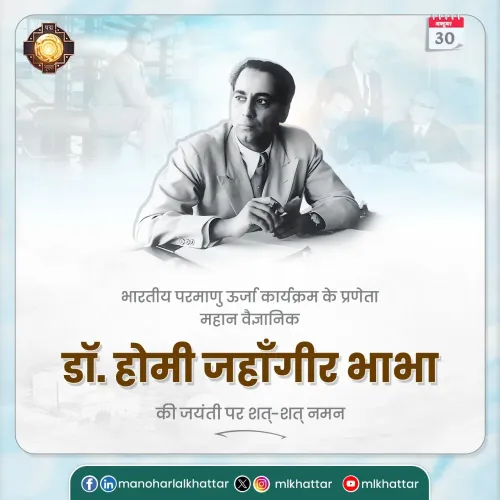
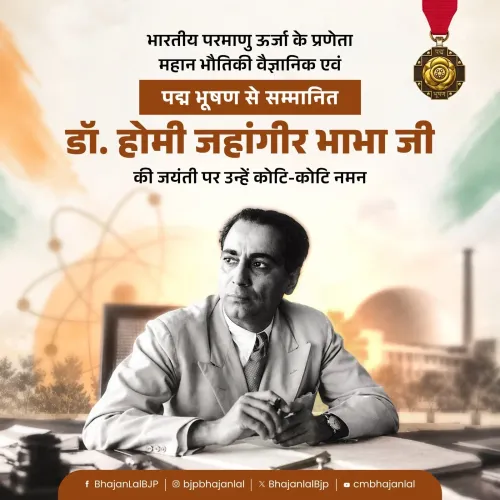
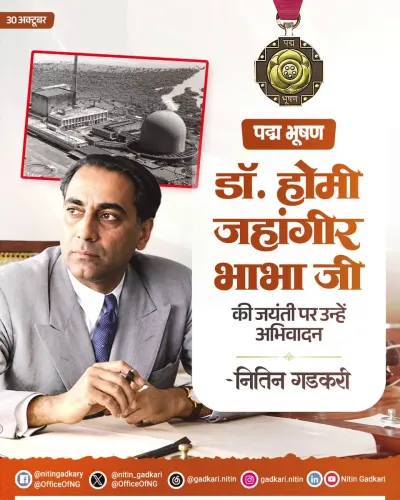
CM Mohan Yadav pays tribute to Dr. Homi Bhabha on birth anniversary
Synopsis
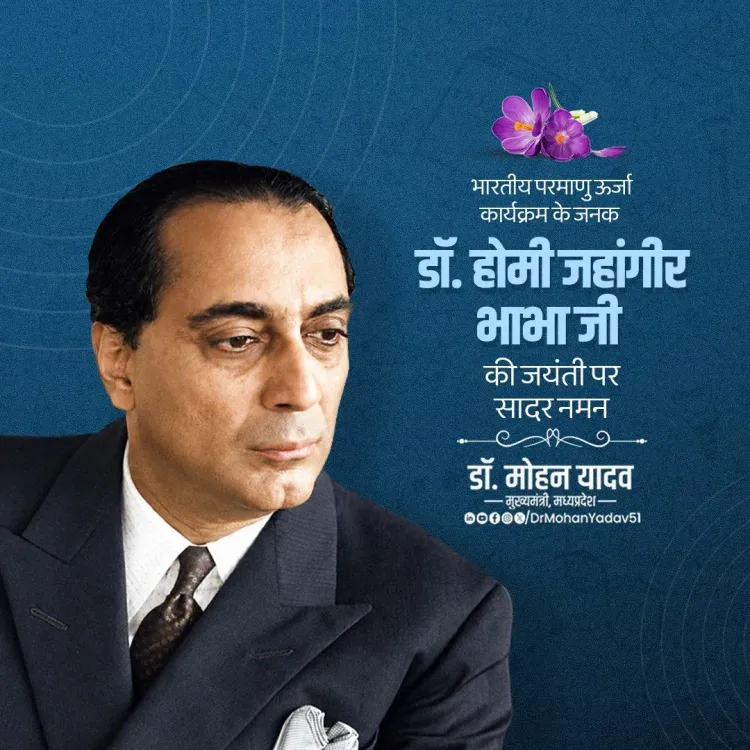
Madhya Pradesh CM Dr. Mohan Yadav paid tribute to Dr. Homi Jehangir Bhabha on his birth anniversary, honouring the founder of India's nuclear energy programme and first chairman of the Atomic Energy Commission for his enduring legacy of scientific self-reliance.
Key Takeaways
MP Chief Minister Dr.
Mohan Yadav posted a tribute to Dr.
Homi Jehangir Bhabha on his birth anniversary on 30 October 2026 .
Bhabha is widely recognised as the father of India's nuclear energy programme .
He founded the Tata Institute of Fundamental Research in 1945 and became the first chairman of the Atomic Energy Commission in 1948 .
Bhabha designed India's landmark three-stage nuclear power programme , which continues to guide the country's civilian nuclear strategy.
Yadav specifically highlighted Bhabha's role in making India self-reliant ( atmanirbhar ) in nuclear energy — connecting a historical legacy to a current policy priority.
On the birth anniversary of the architect of India's nuclear age, Madhya Pradesh Chief Minister Dr. Mohan Yadav offered a public tribute on Friday, 30 October 2026 to Dr. Homi Jehangir Bhabha — the visionary scientist without whom India's atomic ambitions might have remained a distant dream.
In his post, Dr. Yadav wrote: 'भारतीय परमाणु ऊर्जा कार्यक्रम के जनक, महान वैज्ञानिक डॉ. होमी जहांगीर भाभा जी की जयंती पर सादर नमन करता हूं' — 'I bow in respectful tribute to the great scientist Dr. Homi Jehangir Bhabha, father of the Indian nuclear energy programme, on his birth anniversary.' He added that Bhabha's contribution to making the country self-reliant in nuclear energy and giving new direction to scientific progress 'will always be remembered.'
The man who gave India its atomic foundation
Dr. Homi Jehangir Bhabha is widely regarded as the founding architect of India's nuclear energy programme. In 1945, he established the Tata Institute of Fundamental Research, planting the seed of organised scientific inquiry in a nation still under colonial rule. When India gained independence, the government moved fast: the Atomic Energy Commission was constituted in 1948, with Bhabha installed as its first chairman.
From that position, Bhabha shaped the now-legendary three-stage nuclear power programme — a long-arc strategy designed to leverage India's vast thorium reserves and build genuine energy independence. Decades on, that blueprint still governs India's civilian nuclear roadmap. The institution he nurtured, today known as the Bhabha Atomic Research Centre (BARC) in Mumbai, remains the nerve centre of India's nuclear science.
Self-reliance in science — a recurring political touchstone
Dr. Yadav's tribute lands squarely within a well-established tradition: Indian political leaders across the spectrum mark the birth anniversaries of foundational scientists as occasions to anchor contemporary policy ambitions — particularly atmanirbharta (self-reliance) — in historical legitimacy. The word Dr. Yadav chose, 'आत्मनिर्भर' (self-reliant), is deliberate. It ties Bhabha's mid-century mission directly to the present government's self-reliance agenda in strategic sectors.
For Madhya Pradesh, the tribute also carries local resonance: the state hosts nuclear research-linked institutions and has been part of conversations on expanding India's domestic nuclear supply chain. No specific announcement accompanied today's post.
Bhabha's legacy endures not just in reactors and research centres but in a generation of Indian scientists trained to think that frontier technology was something India could build — not merely buy. That conviction, seeded in the late 1940s, is still the operating system beneath every nuclear milestone India celebrates today.
Point of View
Making the message harder to contest. For Dr. Mohan Yadav, invoking Bhabha's 'atmanirbhar' mission echoes a central pillar of the BJP-led Centre's strategic-sector push. The timing also matters: as India negotiates nuclear cooperation agreements and expands domestic reactor capacity, re-anchoring the discourse in Bhabha's original vision lends civilian nuclear expansion a patriotic, non-partisan legitimacy. Watch whether state-level governments — including Madhya Pradesh — announce complementary actions around nuclear education or research infrastructure in the coming months.
NationPress
30 Oct 2026
Frequently Asked Questions
Who was Dr. Homi Jehangir Bhabha?
Dr. Homi Jehangir Bhabha was India's foremost nuclear physicist and is regarded as the father of India's nuclear energy programme. He founded the Tata Institute of Fundamental Research in 1945 and served as the first chairman of the Atomic Energy Commission from 1948.
What is the three-stage nuclear power programme associated with Bhabha?
The three-stage nuclear power programme is a long-term strategy Bhabha outlined in the 1950s to leverage India's thorium reserves for energy independence. It involves a progression from natural uranium reactors to fast breeder reactors to thorium-based reactors, and it still governs India's civilian nuclear roadmap.
Why did CM Mohan Yadav pay tribute to Homi Bhabha?
30 October is Dr. Homi Jehangir Bhabha's birth anniversary. Madhya Pradesh Chief Minister Dr. Mohan Yadav posted a tribute honouring Bhabha's role in building India's nuclear energy capability and steering scientific self-reliance.
What is the Tata Institute of Fundamental Research?
The Tata Institute of Fundamental Research (TIFR) is a premier Indian research institution founded by Dr. Homi Bhabha in 1945. It was instrumental in laying the scientific groundwork for India's nuclear and space programmes.
What is India's Atomic Energy Commission?
India's Atomic Energy Commission was constituted in 1948 to oversee the country's nuclear research and energy efforts. Dr. Homi Bhabha was its first chairman and shaped its foundational direction toward civilian nuclear power and scientific self-sufficiency.