CM Himanta Remembers Guwahati's Darkest Day: 2008 Serial Blasts
Synopsis
On the 18th anniversary of the deadly 2008 Guwahati serial bomb blasts, Assam Chief Minister Himanta Biswa Sarma paid solemn tribute to the victims, calling it one of Assam's darkest chapters and reaffirming his government's commitment to lasting peace and prosperity.
Key Takeaways
30 October 2008 : Coordinated serial bomb blasts struck Guwahati and other Assam locations, killing more than 80 people and wounding hundreds.
ULFA (United Liberation Front of Asom) was widely accused of carrying out the 2008 attacks.
Assam CM Himanta Biswa Sarma called the bombings 'one of the darkest chapters in Assam's history' in his anniversary tribute.
Sarma pledged that Assam would 'never return back to those days' and committed to keeping the state peaceful and prosperous.
Assam has seen a marked decline in large-scale insurgent violence since the late 2000s through security operations, development, and peace negotiations.
The anniversary serves as an annual marker of Assam's transition from an era of militancy to relative stability.
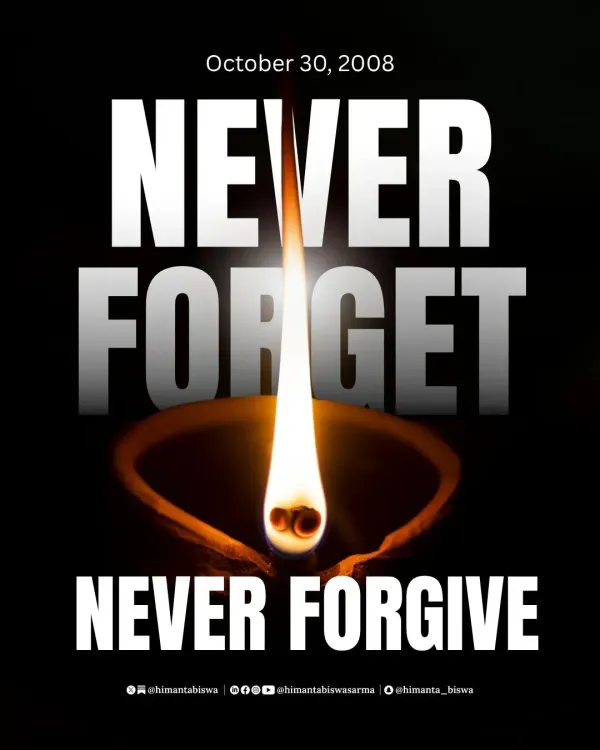
Eighteen years on, the wounds of a single October morning still run deep. On 30 October 2026, Assam Chief Minister Himanta Biswa Sarma paused to remember the victims of the 2008 Guwahati serial bomb blasts — a day he called 'one of the darkest chapters in Assam's history' — and renewed his government's vow that the state would never return to that era of terror.
The day Guwahati bled: what happened on 30 October 2008
On 30 October 2008, a series of coordinated bomb explosions tore through Guwahati and several other locations across Assam, killing more than 80 people and wounding hundreds more. The blasts struck crowded public spaces in quick succession, shattering the city's sense of normalcy in a matter of hours. The United Liberation Front of Asom (ULFA), the insurgent group that had waged a decades-long armed campaign in the state, was widely accused of carrying out the coordinated attack.
The scale of the carnage — dozens of lives erased in a single morning — sent a shock through the entire country and became a grim reference point in any reckoning with Assam's long struggle against militancy. CM Sarma, writing on the anniversary, said he 'can never forget that fateful day which shook the collective conscience of our nation.'
From serial blasts to sustained peace: Assam's long turn
The Assam of 2026 is, by most measurable indicators, a fundamentally different state from the one that burned that October. Since the late 2000s, a sustained combination of security operations, peace negotiations with ULFA factions, and successive development pushes has driven large-scale insurgent violence to historically low levels. The 1985 Assam Accord — which addressed grievances around illegal immigration and political representation — had laid some of the foundational groundwork, but the decisive shift came through relentless pressure on armed groups in the years that followed.
Remembrance of the 2008 blasts has become an annual marker for state leadership to underscore precisely this arc: from a state synonymous with extortion, displacement, and bombings to one projecting stability and investment. Sarma's post fits squarely within that narrative — a tribute, but also a reminder of how far the state has travelled.
The pledge on the anniversary
Chief Minister Sarma did not limit his post to grief. He paired the tribute with a forward-facing commitment: 'We shall never return back to those days and ensure that Assam remains a peaceful and prosperous State in the years to come.' That framing — mourning the past while anchoring the future — reflects the Assam government's consistent positioning on security and development as twin pillars of the post-insurgency era.
For the families of the more than 80 people killed and the hundreds injured in Guwahati and across the state on that day, the anniversary remains a wound that governance statistics cannot fully close. Their wait for lasting justice and accountability continues even as the political landscape shifts around them.
Assam has come a long way from the smoke of October 2008 — but on the anniversary of its worst single day of terror, the state pauses, as it must, to count its dead.
Point of View
The BJP-led Assam government reinforces its core electoral narrative: that the party's governance ended an era of serial bombings and extortion that cost the state decades of development. The tribute also subtly keeps the pressure on ongoing peace talks with remaining ULFA factions, signalling that the government's patience with militancy is exhausted. In the broader Northeast, where multiple insurgencies are at varying stages of resolution, Assam's transition is held up as a template — making Sarma's words carry weight well beyond the state's borders.
NationPress
30 Oct 2026
Frequently Asked Questions
What were the 2008 Guwahati serial bomb blasts?
The 2008 Guwahati serial bomb blasts were a series of coordinated explosions on 30 October 2008 that struck Guwahati and other locations across Assam , killing more than 80 people and injuring hundreds. The ULFA insurgent group was widely accused of carrying out the attacks.
Why does Assam CM Himanta Biswa Sarma pay tribute on 30 October every year?
30 October marks the anniversary of the deadly 2008 Assam serial bomb blasts . CM Himanta Biswa Sarma pays tribute each year to honour the victims and reaffirm his government's commitment to keeping Assam free from insurgent violence.
Who was responsible for the 2008 Assam bomb blasts?
The United Liberation Front of Asom (ULFA) , an insurgent organisation long active in Assam, was widely accused of responsibility for the 30 October 2008 serial bomb blasts.
Has insurgent violence declined in Assam since the 2008 blasts?
Yes. Assam has witnessed a significant decline in large-scale insurgent violence since the late 2000s, driven by a combination of security operations, peace negotiations with armed groups, and development programmes. The 2008 blasts are now remembered as a turning point after which the state moved steadily toward stability.
What is NEDA and what is Himanta Biswa Sarma's role in it?
NEDA — the North-East Democratic Alliance — is a BJP-led political grouping of non-Congress parties across India's northeastern states. Himanta Biswa Sarma , the Chief Minister of Assam, serves as its convenor.