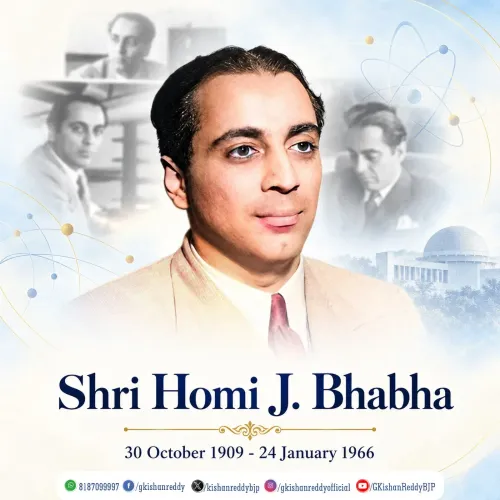
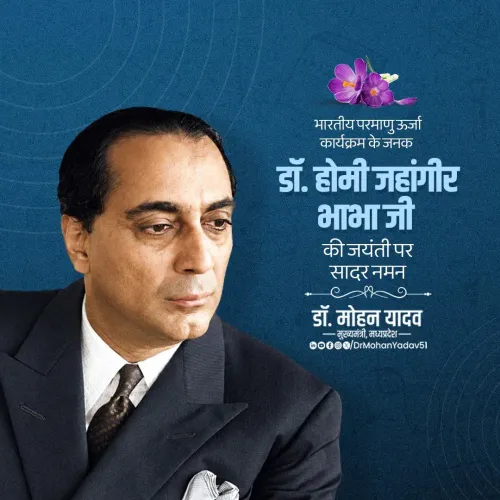
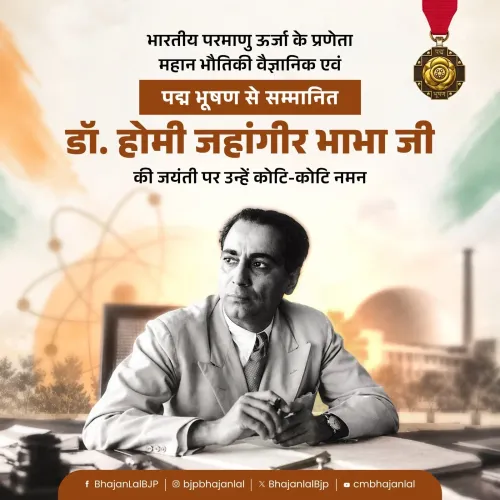
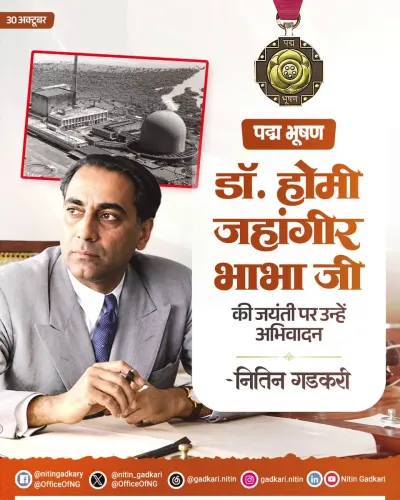
Karnataka CM's Office Honours Homi Bhabha on Birth Anniversary

Synopsis
The Chief Minister's Office of Karnataka paid tribute to Dr. Homi Jehangir Bhabha on his birth anniversary, honouring the founder of TIFR and the Indian Atomic Energy Commission as the architect of India's nuclear self-reliance.
Key Takeaways
The Chief Minister's Office of Karnataka posted a Kannada-language tribute to Dr.
Homi Jehangir Bhabha on 30 October 2026 , his birth anniversary.
Bhabha is credited with founding the Tata Institute of Fundamental Research in 1945 to build India's scientific talent base.
He established the Indian Atomic Energy Commission in 1948 and served as its first chairman.
Bhabha formulated India's three-stage nuclear power programme in the 1950s , anchored in the country's thorium reserves.
The CMO described his scientific vision as 'unparalleled' and credited him with laying the foundation for India's technological self-reliance in the post-independence era.
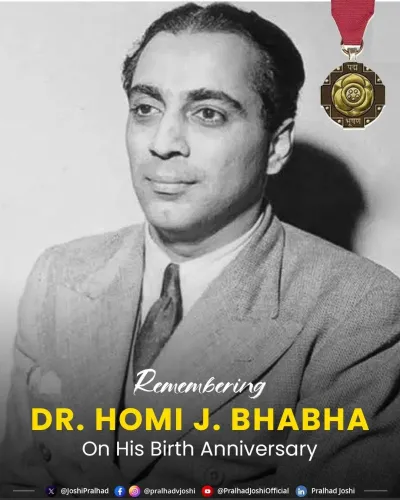
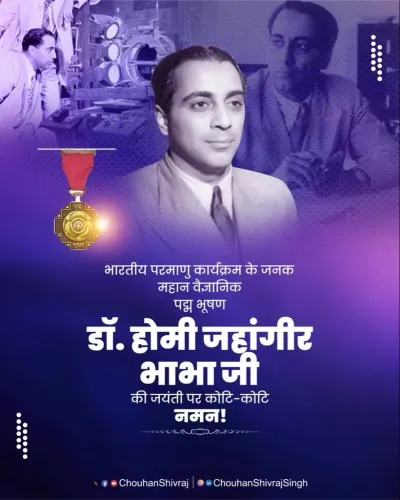
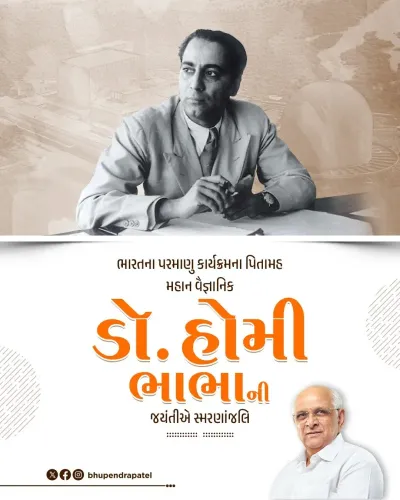
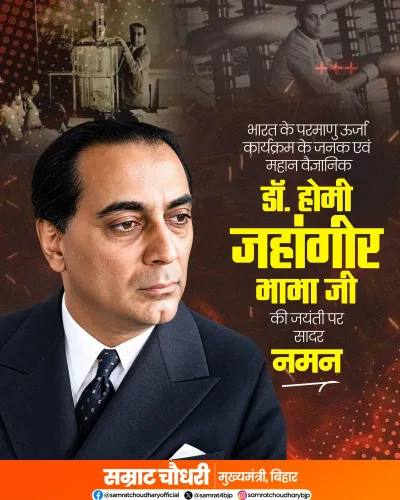
On the birth anniversary of the scientist who put India on the global nuclear map, the Chief Minister's Office of Karnataka paid tribute on Friday, 30 October 2026 to Dr. Homi Jehangir Bhabha — the visionary physicist revered as the father of India's atomic energy programme.
The tribute, posted in Kannada, saluted Bhabha as a 'mahaan darshaniika vaijnaanika' — a great visionary scientist — who 'placed India in the front ranks of global nuclear power and laid the firm foundation for the country's scientific and technological self-reliance.' The post recalled that even in resource-scarce post-independence India, Bhabha held an unshakeable conviction: only science and research could build a new nation.
The institutions Bhabha built — and why they still matter
The CMO specifically cited two landmark acts of institution-building. In 1945, Bhabha founded the Tata Institute of Fundamental Research (TIFR) in Bombay — a home for fundamental sciences designed to identify and nurture domestic talent at a time when India had no such infrastructure. Three years later, in 1948, he became the founding chairman of the Indian Atomic Energy Commission, the statutory body that would steer the nation's nuclear ambitions for decades.
Together, those two moves did something structural: they created both the talent pipeline and the policy architecture for a self-reliant nuclear programme, all within the first three years of independence. In the 1950s, Bhabha further crystallised this vision by formulating India's three-stage nuclear power programme — a long-arc strategy built around the country's abundant thorium reserves that continues to guide the Department of Atomic Energy to this day.
Why Karnataka's tribute carries resonance
The Chief Minister's Office choosing to mark Bhabha's birth anniversary in Kannada reflects the state's own deep connection to India's scientific establishment. Karnataka is home to major defence, space, and research institutions, and the tribute fits a broader pattern of state governments reinforcing the post-1947 narrative of institution-led self-reliance — a narrative that has gained fresh urgency as India pursues energy security and strategic autonomy in the 2020s.
Bhabha's scientific foresight, the CMO noted, was 'adviteeyya' — unparalleled. That word choice is precise: a man who blueprinted a nuclear future for a newly sovereign nation before the concrete was even dry on its democratic institutions deserves nothing less.
Seventy-eight years after the Atomic Energy Commission's founding, the institutions Bhabha built remain the backbone of India's civilian and strategic nuclear capabilities — the most enduring proof that one scientist's conviction can outlast generations.
Point of View
The post implicitly connects Bhabha's mid-20th-century blueprinting to India's ongoing pursuit of civilian nuclear energy and energy security. Such commemorations also serve a softer political function — reinforcing a cross-party, pan-India scientific nationalism that transcends regional identity. As India expands its nuclear power capacity and seeks greater weight in global non-proliferation forums, figures like Bhabha become useful anchors for a modernisation narrative rooted in indigenous genius.
NationPress
30 Oct 2026
Frequently Asked Questions
When is Homi Jehangir Bhabha's birth anniversary?
Dr. Homi Jehangir Bhabha was born on 30 October 1909 , and his birth anniversary is observed annually on that date.
Why is Homi Bhabha called the father of India's nuclear programme?
Bhabha is called the father of India's nuclear programme because he founded the Tata Institute of Fundamental Research in 1945 , established the Indian Atomic Energy Commission in 1948 , and formulated the country's three-stage nuclear power strategy in the 1950s .
What is the Tata Institute of Fundamental Research and who founded it?
The Tata Institute of Fundamental Research (TIFR) is a premier Indian research institution founded in 1945 by Dr. Homi Jehangir Bhabha to advance fundamental sciences and nurture domestic scientific talent.
What is India's three-stage nuclear power programme?
India's three-stage nuclear power programme was formulated by Dr. Bhabha in the 1950s as a long-term strategy to achieve energy self-reliance by progressively utilising the country's abundant thorium reserves, and it continues to guide the Department of Atomic Energy today.
Why did the Karnataka CM's Office post a tribute to Homi Bhabha?
The Chief Minister's Office of Karnataka posted the tribute on 30 October 2026 to mark Bhabha's birth anniversary, honouring his role in building India's scientific and nuclear institutions in the post-independence era.