CM Vishnu Deo Sai pays tribute to Ashok Singhal on death anniversary
Synopsis
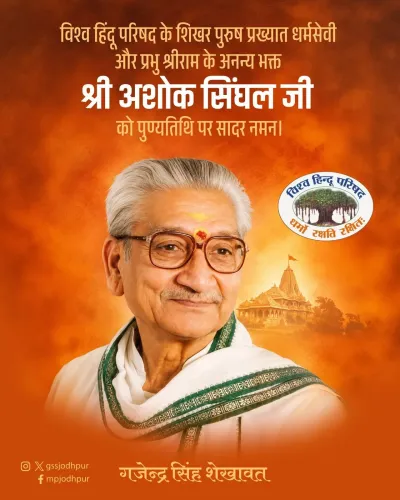
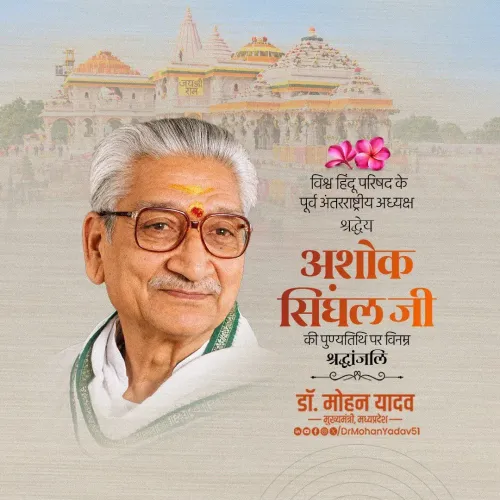
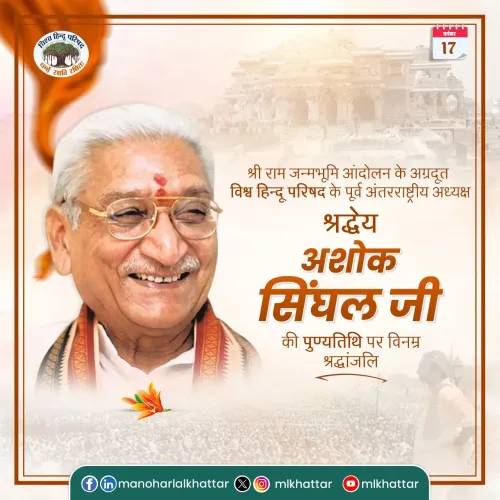
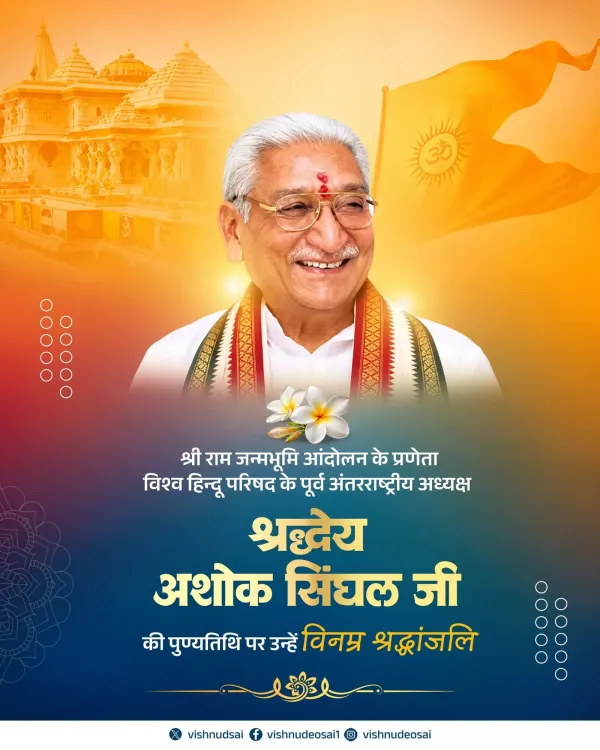
Chhattisgarh Chief Minister Vishnu Deo Sai paid tribute to Ashok Singhal, former VHP international president and Ram Janmabhoomi movement pioneer, on his death anniversary, honouring his life of service to nation, faith, and Indian culture.
Key Takeaways
Chhattisgarh CM Vishnu Deo Sai paid tribute to Ashok Singhal on his death anniversary on 17 November 2026 .
Ashok Singhal was former international president of the Vishva Hindu Parishad (VHP) , founded in 1964 .
Singhal is widely credited as the chief organiser of the Ram Janmabhoomi movement , which campaigned for a temple at Ayodhya .
The Supreme Court of India cleared the way for Ram Temple construction in its November 2019 Ayodhya verdict.
CM Sai described Singhal's life as dedicated to patriotism, religious devotion, and the renaissance of Indian culture.
Such tributes are part of the BJP 's established practice of commemorating figures linked to the Hindu nationalist tradition.
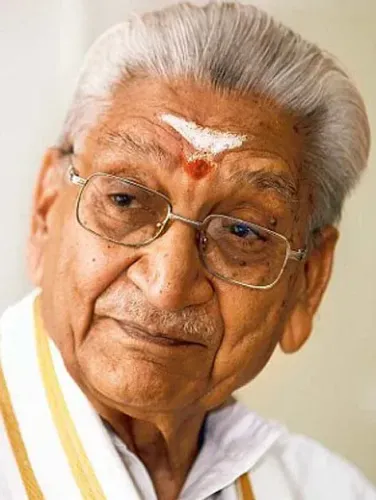
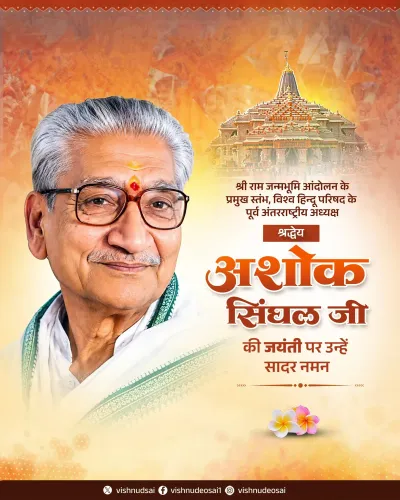
A movement that reshaped modern India's most charged political and religious landscape had, at its heart, one organiser whose name became synonymous with the Ram Janmabhoomi cause. On Tuesday, Chhattisgarh Chief Minister Vishnu Deo Sai offered a solemn tribute to Ashok Singhal, the former international president of the Vishva Hindu Parishad (VHP), on his death anniversary.
Posting on X in Hindi, CM Sai wrote: 'श्रीराम जन्मभूमि आंदोलन के प्रणेता एवं विश्व हिंदू परिषद के पूर्व अंतरराष्ट्रीय अध्यक्ष श्रद्धेय अशोक सिंघल जी की पुण्यतिथि पर उन्हें विनम्र श्रद्धांजलि एवं सादर नमन!' — 'Humble tribute and respectful salutations to the revered Ashok Singhal Ji, pioneer of the Shri Ram Janmabhoomi movement and former international president of the Vishva Hindu Parishad, on his death anniversary.' He added that Singhal's 'entire life remained dedicated to patriotism, religious devotion, and the renaissance of Indian culture,' and that his dedication to nation and dharma 'will continue to inspire us all.'
Who was Ashok Singhal and why the Ram Janmabhoomi movement still matters
Ashok Singhal was the defining organisational force behind the Ram Janmabhoomi agitation — the decades-long campaign to build a temple at the site in Ayodhya believed to be Lord Rama's birthplace. As international president of the Vishva Hindu Parishad, the Hindu nationalist body founded in 1964, he mobilised millions across the country and kept the movement at the centre of India's public life through the 1980s and 1990s.
The legal and political arc he helped set in motion culminated long after his passing: in November 2019, the Supreme Court of India delivered its landmark verdict on the Ayodhya title dispute, clearing the way for construction of the Ram Temple. The temple, whose cause Singhal championed through his entire public career, stands as the most visible downstream consequence of the movement he led.
BJP's established practice of commemorating ideological predecessors
CM Sai's tribute is part of a consistent pattern among BJP leaders at both state and national levels — marking the death anniversaries of figures associated with the Ram Janmabhoomi agitation and the broader Hindu nationalist tradition. For a party whose political identity is deeply intertwined with the Ayodhya movement, these commemorations serve both as acts of remembrance and as public reaffirmations of ideological continuity.
Singhal's legacy sits at the intersection of religion, law, and electoral politics — a rare combination that explains why tributes to him carry weight far beyond ceremonial gesture.
Decades after the movement reached its peak, the name Ashok Singhal remains shorthand for a singular, unyielding conviction — and for the BJP, keeping that memory alive is itself a form of political statement.
Point of View
Commemorating Singhal also allows the party to claim custodianship of a historic victory. For CM Sai, a leader consolidating BJP's hold over Chhattisgarh, aligning publicly with that lineage signals continuity with the party's core base. The pattern is consistent and deliberate: keeping the memory of movement architects alive is itself a form of political communication.
NationPress
17 Nov 2026
Frequently Asked Questions
Who was Ashok Singhal?
Ashok Singhal was the former international president of the Vishva Hindu Parishad (VHP) and the principal organiser of the Ram Janmabhoomi movement that campaigned for a Ram Temple in Ayodhya.
What is the Ram Janmabhoomi movement?
The Ram Janmabhoomi movement was a decades-long campaign to build a temple at the site in Ayodhya believed to be Lord Rama's birthplace. The Supreme Court of India cleared the way for temple construction in November 2019.
What did Vishnu Deo Sai say about Ashok Singhal?
CM Vishnu Deo Sai said Singhal's entire life was dedicated to patriotism, religious devotion, and the renaissance of Indian culture, and that his dedication to nation and dharma will continue to inspire everyone.
What is the Vishva Hindu Parishad (VHP)?
The Vishva Hindu Parishad is a Hindu nationalist organisation founded in 1964 to promote Hindu unity and cultural causes. Ashok Singhal served as its international president.
Why do BJP leaders regularly pay tribute to Ashok Singhal?
BJP leaders commemorate Singhal because he was a central figure in the Ram Janmabhoomi agitation, which is closely linked to the party's ideological identity. These tributes reinforce continuity with the Hindu nationalist tradition the party champions.