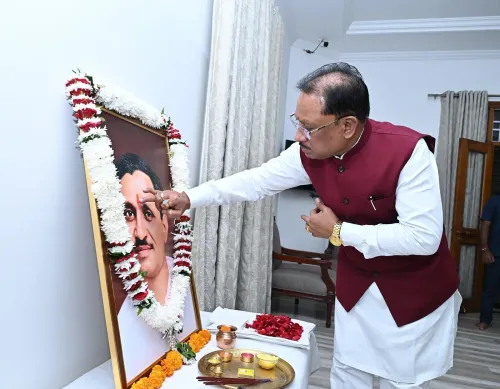
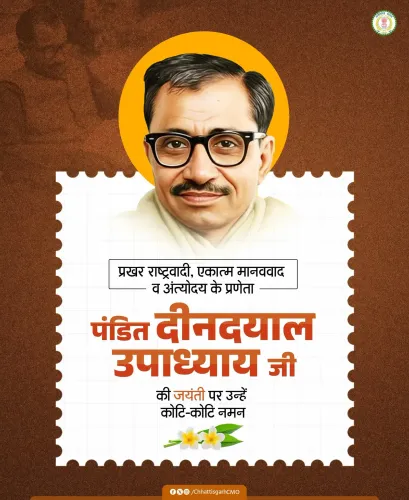
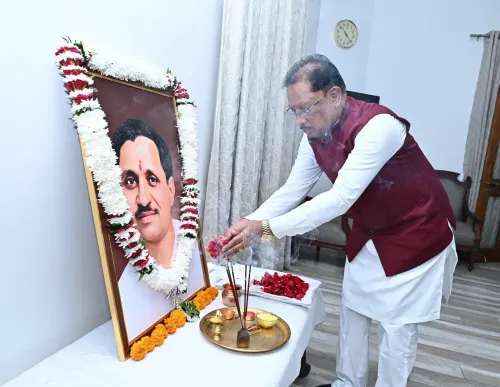
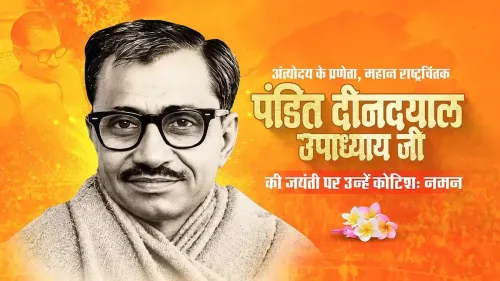
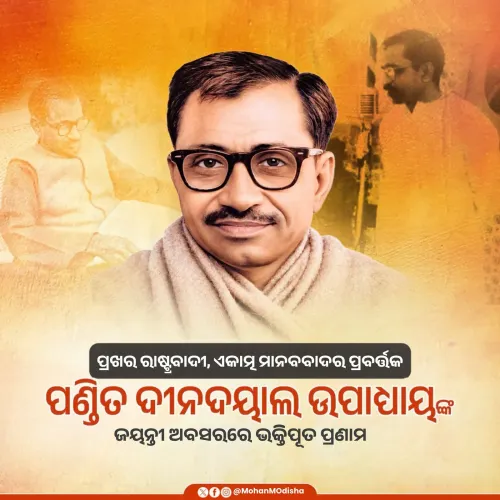
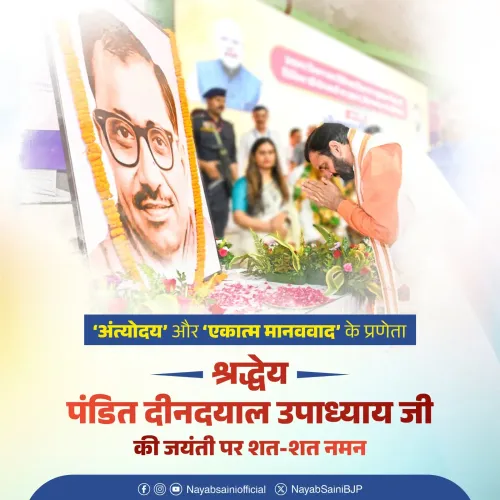
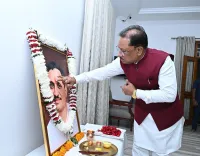
CM Vishnu Deo Sai Pays Tribute to Deendayal Upadhyay on Birth Anniversary
Synopsis
Chhattisgarh Chief Minister Vishnu Deo Sai paid tribute to Pandit Deendayal Upadhyay on his birth anniversary, invoking Integral Humanism and Antyodaya to reaffirm his government's commitment to the welfare of the poorest citizens.
Key Takeaways
Chhattisgarh CM Vishnu Deo Sai paid tribute to Pandit Deendayal Upadhyay on his birth anniversary on 25 September 2026 .
Deendayal Upadhyay founded the Bharatiya Jana Sangh in 1951 , the ideological precursor to the BJP.
His two core ideas — Integral Humanism and Antyodaya — place the upliftment of the weakest citizen at the centre of governance.
The BJP formally adopted Integral Humanism as its official ideology in the 1960s .
Antyodaya Anna Yojana , launched in 2000 , is among the most prominent policy expressions of the Antyodaya principle.
CM Sai reaffirmed commitment to reaching the 'last person in society' with the 'light of development' in Chhattisgarh.
On the birth anniversary of Pandit Deendayal Upadhyay, the founding father of a political philosophy that still shapes India's ruling party, Chhattisgarh Chief Minister Vishnu Deo Sai offered a heartfelt tribute on Friday, 25 September 2026 — reaffirming his government's commitment to carrying Upadhyay's vision to the last person in the last village.
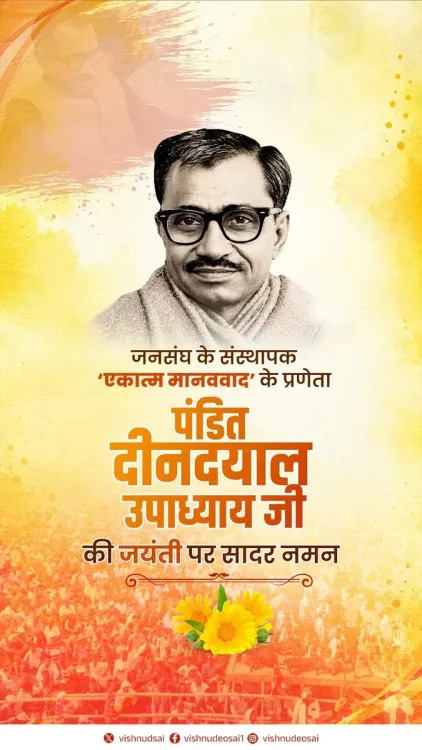
In his post, CM Sai described Upadhyay as the pioneer of 'Ekatm Manaavvaad' (Integral Humanism) and 'Antyodaya' — two ideas that together argue society is only as strong as its weakest member. 'His Integral Human Philosophy,' the Chief Minister wrote, 'always inspires the welfare of the poor, deprived and exploited sections standing on the last rung of society. Imbibing his thoughts, we remain continuously committed to taking the light of development to the last person in society.'
Who Was Pandit Deendayal Upadhyay — and Why He Still Matters
Pandit Deendayal Upadhyay founded the Bharatiya Jana Sangh in 1951, a party that would later merge into the Janata Party in 1977 and eventually contribute to the birth of the Bharatiya Janata Party. His most lasting intellectual contribution was Integral Humanism — a philosophy rooted in the idea that genuine human development cannot be achieved by focusing solely on economics or politics; it must tend to the spiritual, cultural, and material dimensions of life simultaneously.
The BJP formally adopted Integral Humanism as its official ideology in the 1960s, making Upadhyay not just a historical figure but the ideological anchor of India's most powerful political party today. His concept of Antyodaya — literally 'rise of the last' — placed the poorest citizen at the centre of governance, a framing that has since been institutionalised in schemes such as the Antyodaya Anna Yojana, launched in 2000 to supply subsidised food grain to the country's most vulnerable households.
From Philosophy to Policy: Chhattisgarh's Welfare Lens
For Chief Minister Sai, the tribute is more than ceremonial. BJP leaders across the country mark Upadhyay's birth anniversary each year by drawing an explicit line between his philosophy and active governance — and Chhattisgarh is no exception. The state's welfare programmes targeting tribal communities, Below Poverty Line households, and marginalised agricultural workers are increasingly framed through the Antyodaya lens.
The Antyodaya principle's enduring political utility lies in its specificity: it demands measurable outreach to the bottom-most economic strata, not just aggregate growth numbers. That is a powerful accountability frame — and one CM Sai is consciously invoking as his government continues its rollout of development initiatives across Chhattisgarh's rural and tribal heartland.
On a day BJP leaders across India pause to remember their ideological patriarch, the Chief Minister's message is pointed: the philosophy is not a museum piece — it is a working mandate.
Point of View
Invoking Antyodaya in Chhattisgarh carries extra weight: the state has a large tribal and marginalised population that makes the philosophy a live governance benchmark, not merely a rhetorical one. The consistent alignment of welfare scheme language with Upadhyay's vocabulary also serves a deeper function — it frames the BJP's social policy in a home-grown intellectual tradition rather than an imported ideological framework. Watching whether specific Chhattisgarh programmes are relaunched or rebranded around this anniversary will indicate how far the tribute translates into tangible policy momentum.
NationPress
25 Sept 2026
Frequently Asked Questions
Who was Pandit Deendayal Upadhyay?
Pandit Deendayal Upadhyay was the founder of the Bharatiya Jana Sangh in 1951 and the philosopher behind Integral Humanism and Antyodaya — ideas that prioritise the welfare of the weakest section of society and form the official ideology of the BJP.
What is Antyodaya philosophy?
Antyodaya, meaning 'rise of the last', is a principle articulated by Deendayal Upadhyay that places the poorest and most marginalised citizen at the centre of development. It has since been institutionalised in schemes like the Antyodaya Anna Yojana launched in 2000.
What is Integral Humanism in BJP ideology?
Integral Humanism is a philosophy developed by Deendayal Upadhyay that argues for holistic human development — addressing spiritual, cultural, and material needs together. The BJP adopted it as its official ideology in the 1960s.
When is Deendayal Upadhyay's birth anniversary celebrated?
Deendayal Upadhyay's birth anniversary falls on 25 September and is observed each year by BJP leaders across India with tributes, events, and reaffirmations of his Antyodaya and Integral Humanism principles.
What did Chhattisgarh CM Vishnu Deo Sai say about Deendayal Upadhyay?
CM Vishnu Deo Sai paid tribute to Upadhyay as the pioneer of Integral Humanism and Antyodaya, and reaffirmed his government's commitment to taking the 'light of development' to the last person in society, drawing on Upadhyay's philosophy as a guiding mandate.