CM Sai Pays Tribute to Deendayal Upadhyay on Birth Anniversary
Synopsis
Chhattisgarh Chief Minister Vishnu Deo Sai paid tribute to Pandit Deendayal Upadhyay on his birth anniversary at the official residence in Raipur, invoking his Antyodaya and Integral Humanism principles as a guiding philosophy for governance and welfare.
Key Takeaways
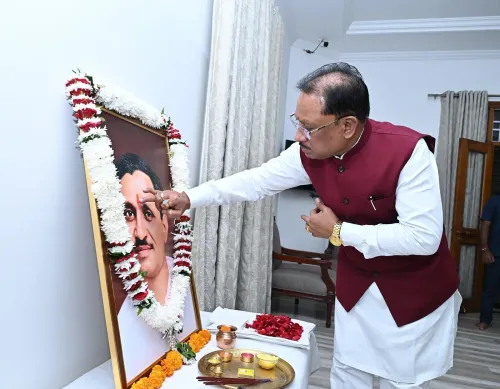
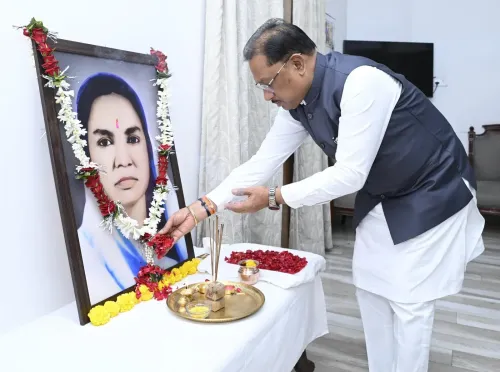
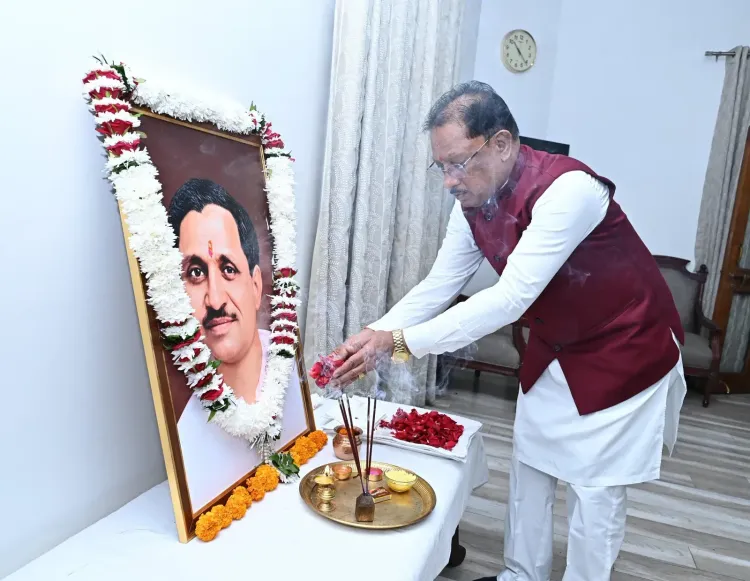
CM Vishnu Deo Sai offered floral tributes to Pandit Deendayal Upadhyay at the Chief Minister's residence in Raipur on 25 September 2026 .
Upadhyay is regarded as the ideological founding figure of the Bharatiya Jana Sangh , forerunner of the BJP, and pioneer of Ekatma Manavvad (Integral Humanism) and Antyodaya .
His Antyodaya principle — welfare of the last person in society — directly inspired the Deendayal Antyodaya Yojana launched by the central government in 2015 .
25 September is observed as Deendayal Jayanti by BJP governments across India, with official portrait tributes and ideological reaffirmations.
In Chhattisgarh , with its large tribal and rural population, the Antyodaya framework carries direct relevance to state welfare programmes targeting marginalised communities.
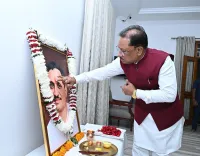
On the birth anniversary of one of India's most consequential political philosophers, Chhattisgarh Chief Minister Vishnu Deo Sai offered floral tributes to a portrait of Pandit Deendayal Upadhyay at the Chief Minister's official residence in Raipur on Friday, 25 September 2026. The homage placed the ideological architect of Integral Humanism and Antyodaya at the centre of the state's public life for the day.
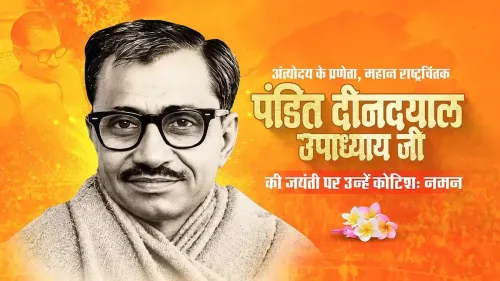
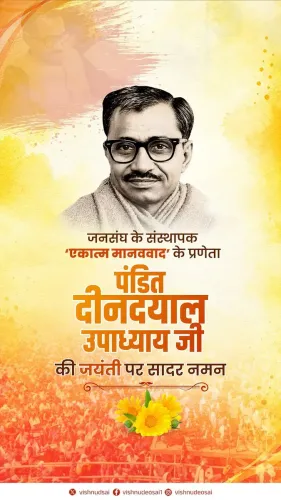
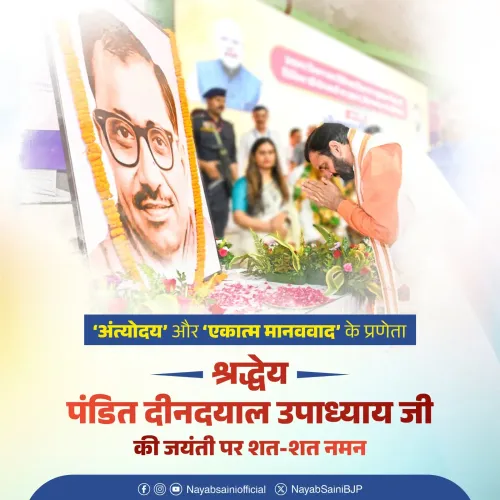
CM Sai, posting in Hindi, described Upadhyay as 'Ekatma Manavvad aur Antyodaya ke praneta, mahan rashtrachintак' — 'the pioneer of Integral Humanism and Antyodaya, a great national thinker'. He wrote that Upadhyay's life remained dedicated to national service, the upliftment of the poor and the marginalised, and the welfare of the person standing on the last rung of society. 'His thoughts and ideals continue to guide all of us on the path of national service,' Sai added, closing with 'Koti-koti naman' — a salute repeated a hundred million times.
The Philosophy Behind the Tribute
Pandit Deendayal Upadhyay was born on 25 September 1916 and rose to become the defining ideologue of the Bharatiya Jana Sangh, the political forerunner of today's BJP. His concept of Ekatma Manavvad — Integral Humanism — argued for an indigenous model of development rooted in Indian civilisational values rather than either Western capitalism or Soviet socialism. Equally central was Antyodaya, the principle that a society must be judged by how it treats the person at its very bottom.
That principle did not remain philosophical. In 2015, the central government launched the Deendayal Antyodaya Yojana, a flagship livelihood scheme for rural and urban poor that bore his name directly — a signal of how foundational his thinking remains to the BJP's welfare architecture.
A Party-Wide Day of Observance
Across India's BJP-governed states, 25 September is marked with portrait tributes, party events, and invocations of Upadhyay's philosophy at official residences and party offices — an annual ritual that renews the ideological lineage stretching back to the Jana Sangh era. For chief ministers like Sai, the observance is both a personal act of reverence and a public statement of governing philosophy: that the party's welfare programmes draw from a coherent intellectual tradition, not merely electoral calculation.
In Chhattisgarh — a state with a large tribal and rural population — the Antyodaya principle carries particular weight. The state's welfare programmes targeting its most marginalised communities are regularly framed within this vocabulary, giving the anniversary a local resonance that goes beyond symbolism.
Whether the 2026 observance precedes any specific policy announcement remains to be confirmed — but the annual cadence of Deendayal Jayanti has consistently served as a platform for BJP governments to restate their commitment to last-mile welfare delivery. The ideologue born in 1916 remains, a century on, a living reference point for the party that governs a billion people.
Point of View
Signalling that the party's welfare programmes descend from a coherent philosophical tradition rather than populist improvisation. For CM Sai, invoking Antyodaya in Chhattisgarh — a state defined by its adivasi and rural poor — grounds state welfare policy in an intellectual lineage that predates the party's electoral dominance. The ritual also reinforces internal party culture, reminding the cadre of an origin story distinct from Nehruvian socialism. Watch for whether the anniversary triggers a concrete policy announcement in the state's welfare or livelihood space.
NationPress
25 Sept 2026
Frequently Asked Questions
Who was Pandit Deendayal Upadhyay?
Pandit Deendayal Upadhyay, born on 25 September 1916 , was an Indian political thinker and the principal ideologue of the Bharatiya Jana Sangh . He propounded Integral Humanism (Ekatma Manavvad) and the Antyodaya principle, which holds that a nation's progress must be measured by the welfare of its most marginalised citizen.
What is Antyodaya and how does it connect to government schemes?
Antyodaya is a concept championed by Deendayal Upadhyay that prioritises the upliftment of the person at the very bottom of the social ladder. The central government institutionalised this idea with the Deendayal Antyodaya Yojana in 2015 , a scheme focused on livelihood support for rural and urban poor.
Why did CM Vishnu Deo Sai pay tribute on 25 September?
25 September is Deendayal Jayanti , the birth anniversary of Pandit Deendayal Upadhyay. Chhattisgarh Chief Minister Vishnu Deo Sai offered floral tributes at the official residence in Raipur as part of the BJP's nationwide observance of the day.
What is Ekatma Manavvad or Integral Humanism?
Ekatma Manavvad , or Integral Humanism, is a political philosophy articulated by Deendayal Upadhyay that proposes an indigenous Indian model of development grounded in civilisational values — distinct from both Western capitalism and communist ideology — with the human being, not the state or market, at its centre.
How does Chhattisgarh relate to the Antyodaya philosophy?
Chhattisgarh has a large tribal and rural population, making the Antyodaya principle of prioritising the most marginalised particularly resonant in state governance. The BJP government in the state regularly frames welfare and livelihood programmes within this philosophical framework.