CM Vishnu Deo Sai pays tribute to JP Narayan on death anniversary
Synopsis
Chhattisgarh CM Vishnu Deo Sai honoured Bharat Ratna Jayaprakash Narayan on his death anniversary, October 8, 2026, calling his life, democratic struggle, and Total Revolution ideology an eternal inspiration for putting national interest first.
Key Takeaways
Chhattisgarh Chief Minister Vishnu Deo Sai paid tribute to Jayaprakash Narayan on his death anniversary, October 8, 2026 .
JP Narayan, known as Loknayak , passed away on October 8, 1979 and was awarded the Bharat Ratna posthumously in 1999 .
His Sampurna Kranti (Total Revolution) movement of 1974 galvanised a nationwide democratic uprising against authoritarianism.
CM Sai invoked Narayan's ideal of placing rashtra-hit (national interest) above all personal and political considerations.
JP's legacy is claimed across the Indian political spectrum, reflecting the broad reach of his democratic philosophy.
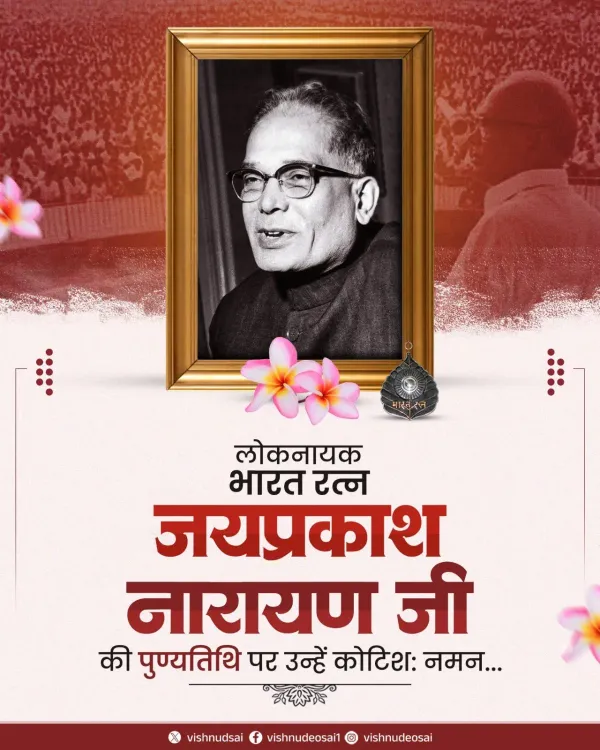
On the death anniversary of one of India's most consequential democratic voices, Chhattisgarh Chief Minister Vishnu Deo Sai offered heartfelt homage to Jayaprakash Narayan — freedom fighter, social reformer, and the man who shook an authoritarian government to its foundations — on October 8, 2026.
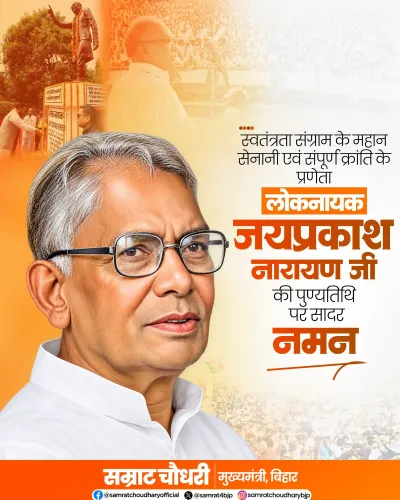
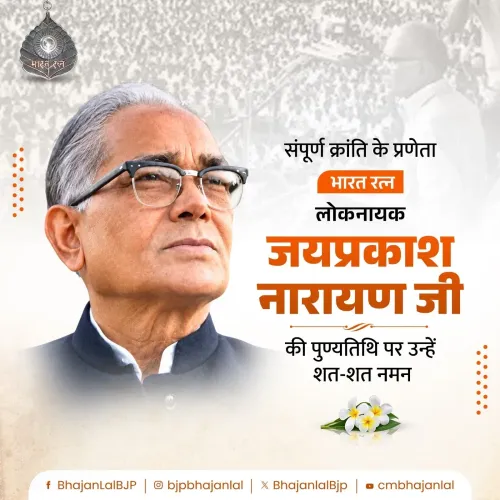
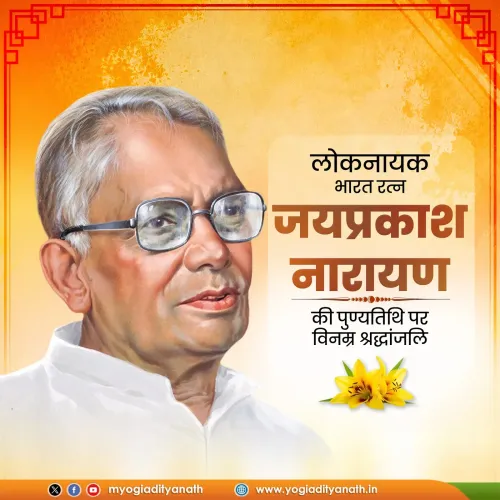
In his tribute post, CM Sai wrote: 'सम्पूर्ण क्रांति के उद्घोषक... लोकनायक भारत रत्न जयप्रकाश नारायण जी की पुण्यतिथि पर उन्हें कोटिशः नमन' — roughly, 'Countless salutations to Loknayak, Bharat Ratna Jayaprakash Narayan, the herald of Total Revolution, on his death anniversary.' He added that Narayan's life, his struggle for democracy and public welfare, and his ideas would continue to inspire all to place the nation's interest above all else.
The Loknayak who declared 'Total Revolution'
Jayaprakash Narayan — widely known as JP or Loknayak ('People's Leader') — was born on October 11, 1902, and passed away on October 8, 1979. A towering figure in India's freedom movement, he later became the conscience of post-Independence Indian democracy. His call for 'Sampurna Kranti' (Total Revolution) in 1974 galvanised a nationwide mass movement against corruption and authoritarianism, directly challenging the government of the day and ultimately reshaping Indian politics. He was awarded the Bharat Ratna posthumously in 1999.
A legacy that outlasts its era
JP's movement is credited with uniting opposition parties across ideological lines — a feat rarely repeated in Indian history. His insistence that democracy must be participatory, not merely procedural, remains a touchstone invoked across the political spectrum. Leaders from the BJP to the Janata family trace ideological lineage to his 1974-77 movement, making his anniversary a moment of broad, cross-party reflection.
CM Sai's tribute underscores that Narayan's vision of rashtra-hit (national interest) as the supreme duty of public life continues to resonate in contemporary governance discourse — a reminder that the most durable political legacies are built not on power, but on principle.
Point of View
Honouring JP reinforces a narrative of continuity with India's anti-Emergency democratic tradition, a lineage the party has long sought to claim. The emphasis on 'national interest above all' subtly frames JP's revolutionary ethic in a governance register — less protest, more duty. At a time when questions of democratic accountability remain live, the Loknayak's name carries weight that is neither purely ceremonial nor politically innocent.
NationPress
8 Oct 2026
Frequently Asked Questions
Who was Jayaprakash Narayan and why is he remembered?
Jayaprakash Narayan, known as Loknayak, was a freedom fighter and social reformer who led the 1974 Sampurna Kranti (Total Revolution) movement against corruption and authoritarian rule. He is remembered as one of the most consequential figures in post-Independence Indian democracy and was awarded the Bharat Ratna posthumously in 1999.
When did Jayaprakash Narayan die?
Jayaprakash Narayan passed away on October 8, 1979. His death anniversary is observed annually on this date.
What was the Sampurna Kranti movement?
Sampurna Kranti, or Total Revolution, was a mass movement launched by JP Narayan in 1974. It called for sweeping social, political, and economic transformation, uniting opposition parties and ultimately challenging the government of the day in one of independent India's most significant democratic confrontations.
Why did Chhattisgarh CM Vishnu Deo Sai pay tribute to JP Narayan?
CM Vishnu Deo Sai paid tribute on JP Narayan's death anniversary, October 8, 2026, honouring his legacy as a freedom fighter, democratic guardian, and herald of Total Revolution, and citing his ideology as a continuing inspiration for placing national interest above all else.
When was Jayaprakash Narayan awarded the Bharat Ratna?
Jayaprakash Narayan was awarded the Bharat Ratna posthumously in 1999, India's highest civilian honour, in recognition of his extraordinary contribution to the nation.