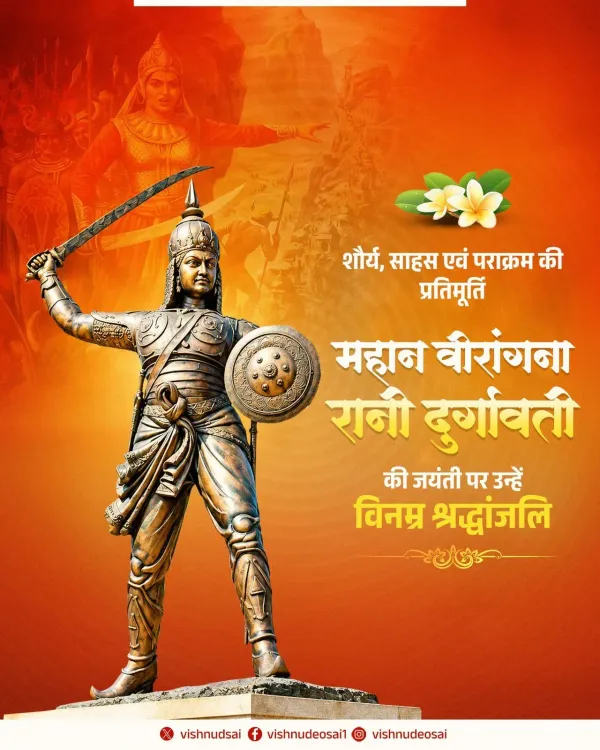
CM Vishnu Deo Sai pays tribute to Rani Durgavati on her Jayanti
Synopsis
Chhattisgarh Chief Minister Vishnu Deo Sai on 5 October 2026 honoured Rani Durgavati, the sixteenth-century Gond warrior queen of Garha-Katanga, on her birth anniversary, calling her sacrifice in defence of the motherland eternally worthy of remembrance.
Key Takeaways
CM Vishnu Deo Sai posted a tribute to Rani Durgavati on her birth anniversary on 5 October 2026 .
He described her as a symbol of 'indomitable courage, valour, and self-respect' — adamya sahas, shaurya aur swabhiman.
Rani Durgavati ruled the kingdom of Garha-Katanga in the sixteenth century and died in battle against Mughal forces in 1564 rather than surrender.
Her legacy is especially significant in Chhattisgarh and Madhya Pradesh , where she is venerated across tribal and non-tribal communities.
The tribute reflects the Chhattisgarh government's broader cultural outreach centred on honouring pre-colonial indigenous rulers in a state with a large Scheduled Tribe population.
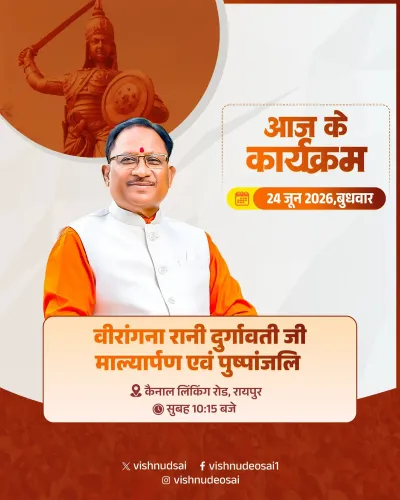
On the birth anniversary of one of central India's most celebrated warrior queens, Chhattisgarh Chief Minister Vishnu Deo Sai paid a respectful tribute to Rani Durgavati of Garha-Katanga on 5 October 2026, honouring her legacy of defiance, sacrifice, and sovereign pride.
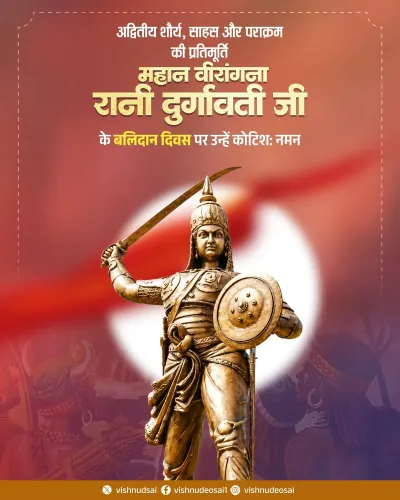
In his post, CM Sai wrote: 'Adamya sahas, shaurya aur swabhiman ki pratik, Garha-Katanga ki virangana Rani Durgavati ji ki jayanti par unhe sadar naman' — 'Respectful salutations to Rani Durgavati, the warrior queen of Garha-Katanga and symbol of indomitable courage, valour, and self-respect, on her birth anniversary.' He described her sacrifice in defence of the motherland as eternally worthy of remembrance, and called her life a continuing inspiration to serve the nation and society with dedicated spirit.
The warrior queen of Garha-Katanga
Rani Durgavati was the sixteenth-century Gond queen who ruled the kingdom of Garha-Katanga, in present-day Madhya Pradesh, with exceptional administrative and military ability after the death of her husband Dalpat Shah. She is most celebrated for her fierce resistance against the Mughal general Asaf Khan in 1564, when she chose to fight — and ultimately fall — rather than surrender her kingdom. Her death in battle rather than capitulation made her an enduring symbol of sovereign dignity across the Gondwana region and beyond.
Her legacy holds particular resonance in the heartland states of Chhattisgarh and Madhya Pradesh, where she is venerated as a protector figure by tribal and non-tribal communities alike. Educational institutions, civic squares, and government schemes in both states bear her name, reflecting how deeply her memory is woven into the regional identity.
Why the tribute carries weight from Raipur
For a BJP chief minister seated in Raipur, invoking Rani Durgavati's jayanti is both a cultural act and a signal of continuity with a tradition of honouring pre-colonial indigenous rulers. The Chhattisgarh government has consistently promoted the histories of regional heroes as part of its cultural outreach in a state with a significant Scheduled Tribe population. Rani Durgavati's Gond lineage makes her especially resonant in this political and social landscape.
Her story — of a queen who administered a prosperous kingdom, commanded armies, and chose death over subjugation — remains a touchstone for conversations about women's leadership, indigenous sovereignty, and regional pride. Every year, her jayanti draws tributes from leaders across the political spectrum, but the gestures carry particular weight in states that claim her geography as their own heritage.
Four and a half centuries after her last battle, a sitting chief minister still finds it worth pausing to say: her courage is eternally worth remembering. That alone tells you how tall she stands in the region's memory.
Point of View
Non-Mughal heroes as symbols of national and regional identity — a strategy with particular electoral traction in tribal-majority states like Chhattisgarh. Rani Durgavati's Gond lineage makes her a figure who bridges cultural pride and community outreach among Scheduled Tribe voters. Invoking her on her jayanti reinforces the government's narrative that indigenous sovereignty and sacrifice are foundational to Indian civilisational memory. The gesture is ceremonial in form but carries clear political and cultural signalling.
NationPress
5 Oct 2026
Frequently Asked Questions
Who was Rani Durgavati?
Rani Durgavati was a sixteenth-century Gond queen who ruled the kingdom of Garha-Katanga, in present-day Madhya Pradesh. She is celebrated for her fierce military resistance against Mughal forces in 1564 and her choice to die in battle rather than surrender.
When is Rani Durgavati Jayanti celebrated?
Rani Durgavati Jayanti is observed on 5 October each year to mark her birth anniversary.
Why did CM Vishnu Deo Sai tribute Rani Durgavati?
As Chhattisgarh Chief Minister, Vishnu Deo Sai paid tribute on her birth anniversary, honouring her as a symbol of courage and sacrifice and drawing inspiration from her life for public service.
What was the kingdom of Garha-Katanga?
Garha-Katanga was a Gond kingdom spanning parts of present-day Madhya Pradesh and Chhattisgarh. It was one of the most powerful kingdoms of central India in the sixteenth century before falling to Mughal forces.
How is Rani Durgavati remembered in Chhattisgarh and Madhya Pradesh today?
Rani Durgavati is venerated across both states through institutions, public squares, and government schemes named after her. She is especially significant to tribal communities given her Gond lineage.