CM Yogi Declares Encephalitis Eradicated in Gorakhpur
Synopsis
Chief Minister Yogi Adityanath declared on 14 June 2026 that encephalitis has been eradicated in Gorakhpur, a city long plagued by seasonal AES outbreaks. He also highlighted the Gorakhpur Fertilizer Plant's role in ensuring timely urea supply to farmers in eastern Uttar Pradesh ahead of the kharif season.
Key Takeaways
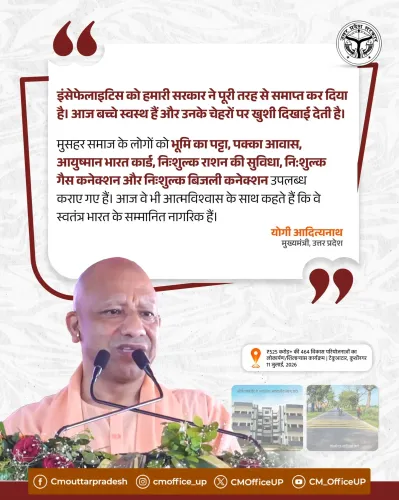
CM Yogi Adityanath declared encephalitis eradicated in Gorakhpur on 14 June 2026 .
Gorakhpur has historically been one of India's worst-affected districts for Acute Encephalitis Syndrome and Japanese Encephalitis, particularly among children.
The Uttar Pradesh government has pursued vector control, sanitation, and paediatric care measures against AES since 2017 .
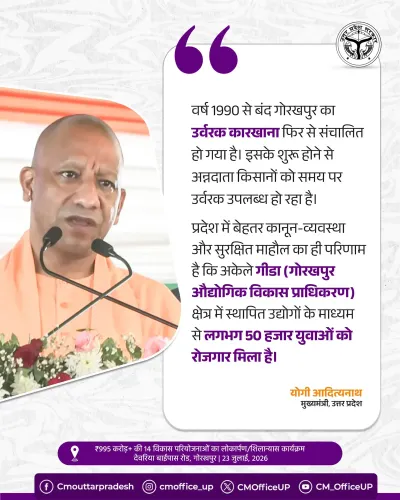
The Gorakhpur Fertilizer Plant , a revived public-sector urea unit approved by the Union Cabinet in 2016-17 , is supplying fertilizers to farmers in the Purvanchal region.
Official AES surveillance data for the 2026 monsoon season will be critical to independently verifying the eradication claim.
Farmers in eastern Uttar Pradesh are the primary beneficiaries of the plant's timely urea output during the kharif sowing season.
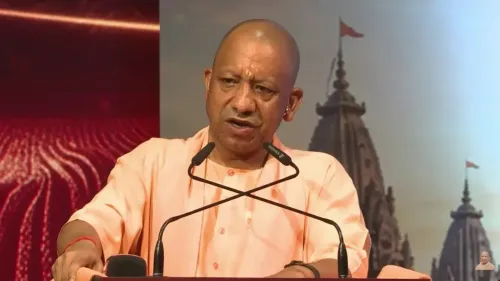
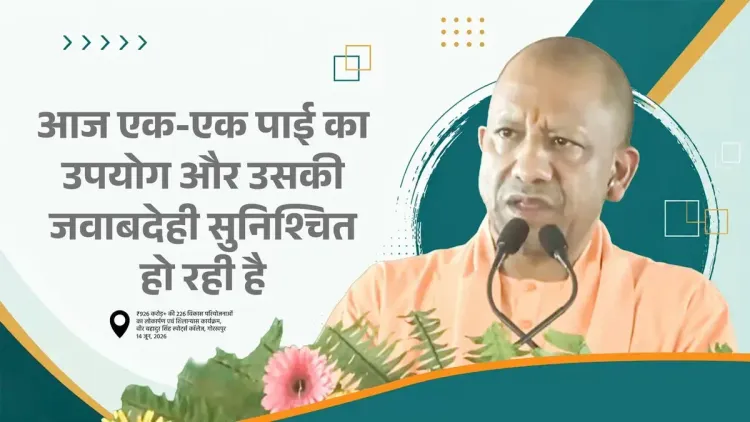
The Chief Minister's Office of Uttar Pradesh on Sunday, 14 June 2026 quoted Chief Minister Yogi Adityanath declaring that encephalitis has been eliminated in Gorakhpur, while also highlighting the role of the city's fertilizer plant in ensuring timely urea supply to farmers across the region.
Context
In his statement, CM Yogi Adityanath said — 'Aaj Gorakhpur mein Insephalitis ka khatma hua hai' — 'Today, encephalitis has been eradicated in Gorakhpur.' He also noted that the fertilizer factory is providing fertilizers in a timely manner to annadata (provider-of-grain) farmers for better yields. The remarks were shared through the official CMO account on X, accompanied by a video.
Gorakhpur has for decades been a hotspot for Acute Encephalitis Syndrome (AES) and Japanese Encephalitis (JE), diseases that historically peaked during the monsoon season and disproportionately affected children in the Purvanchal region of eastern Uttar Pradesh.
Policy Backdrop
Since the Yogi Adityanath government came to power in 2017, Uttar Pradesh has pursued an intensive multi-pronged strategy against AES and JE — encompassing vector control, improved sanitation, expanded paediatric care infrastructure, and a stronger ambulance network in high-burden eastern districts.
On the industrial front, the Gorakhpur Fertilizer Plant — a public-sector urea manufacturing unit that had remained shuttered for years — was approved for revival by the Union Cabinet in 2016-17 and subsequently re-engineered and commissioned under the present state and central governments. The plant was designed to address the chronic fertilizer supply gaps faced by farmers in the Purvanchal belt.
Stakeholders and Impact
The encephalitis declaration, if borne out by official surveillance data, would mark a landmark public-health milestone for Gorakhpur and its surrounding districts, where families — particularly those with young children — have lived under the seasonal threat of the disease for generations.
Farmers across eastern Uttar Pradesh stand as the primary beneficiaries of the fertilizer plant's operations. Timely and adequate urea availability is critical during the kharif sowing season, and any disruption has historically led to distress among cultivators in the region. The plant's steady output is intended to break that cycle of supply uncertainty.
The pairing of a public-health claim with an agricultural deliverable in a single statement reflects the administration's broader strategy of showcasing regionally focused, visible outcomes in Purvanchal — a politically significant constituency for the ruling party.
What's Next
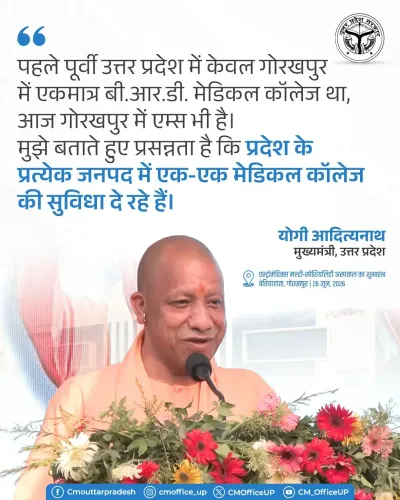
The government's claim of encephalitis eradication in Gorakhpur will be closely watched against official AES surveillance data for the 2026 monsoon season, which typically runs from June to September — the period when the disease has historically spiked. Independent health authorities and public-health researchers are expected to scrutinise case-count figures from district hospitals and the BRD Medical College in Gorakhpur.
Similarly, periodic production and offtake figures from the Gorakhpur Fertilizer Plant will indicate whether the unit is meeting the demand of farmers ahead of the critical kharif season. If the encephalitis eradication claim is validated by end-of-season data, it would represent one of the most significant public-health turnarounds in the state's recent history.
Point of View
The Chief Minister's own constituency and a symbol of his governance identity. For years, the annual AES death toll at BRD Medical College was a political liability; framing its end as a definitive milestone signals a conscious effort to convert that liability into electoral capital. The pairing with the fertilizer plant narrative reinforces the administration's 'development plus welfare' pitch to eastern UP's agrarian voter base. However, the claim will only acquire lasting credibility once independent monsoon-season surveillance data confirms the absence of fresh AES clusters.
NationPress
14 Sept 2026
Frequently Asked Questions
Has encephalitis really been eradicated in Gorakhpur?
Chief Minister Yogi Adityanath declared on 14 June 2026 that encephalitis has been eradicated in Gorakhpur. The claim will be verified against official AES surveillance data for the 2026 monsoon season, which is the traditional peak period for the disease.
What is the Gorakhpur Fertilizer Plant and who does it benefit?
The Gorakhpur Fertilizer Plant is a revived public-sector urea manufacturing unit whose restart was approved by the Union Cabinet in 2016-17. It primarily benefits farmers in the Purvanchal region of eastern Uttar Pradesh by ensuring timely urea supply during the kharif sowing season.
What steps did the Yogi government take against encephalitis in Gorakhpur?
Since 2017, the Yogi Adityanath government intensified vector-control measures, improved sanitation, expanded paediatric care infrastructure, and strengthened ambulance networks in Gorakhpur and neighbouring high-burden districts to tackle Acute Encephalitis Syndrome and Japanese Encephalitis.
Why is Gorakhpur significant for CM Yogi Adityanath?
Gorakhpur is the constituency from which Yogi Adityanath has been elected as a Member of the Legislative Assembly, making it the political and symbolic heartland of his governance record. Encephalitis outbreaks in the city were historically a major criticism of local administration.
When does encephalitis typically peak in eastern Uttar Pradesh?
Acute Encephalitis Syndrome and Japanese Encephalitis cases in eastern Uttar Pradesh have historically spiked during the monsoon season, roughly from June to September, when waterlogging and mosquito breeding create conditions for disease transmission.