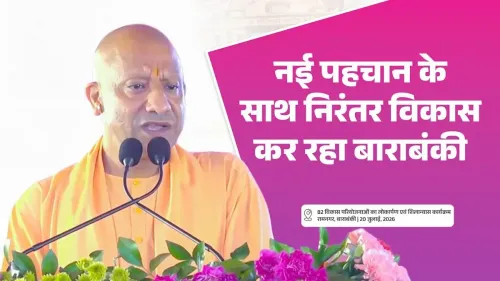
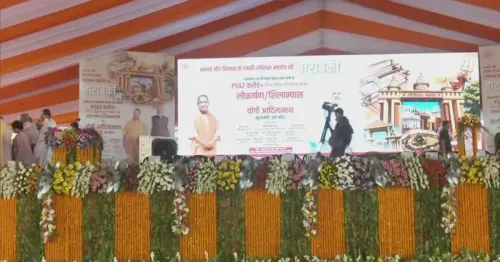
CM Yogi eyes Barabanki as State Capital Region between Lucknow, Ayodhya
Synopsis
Chief Minister Yogi Adityanath has announced that Barabanki is being developed as a State Capital Region, leveraging its position between Lucknow and Ayodhya to channel infrastructure investment and economic growth to the district.
Key Takeaways
Barabanki is being developed as a State Capital Region (SCR) by the Uttar Pradesh government.
The district sits geographically between Lucknow , the state capital, and Ayodhya , a major pilgrimage and tourism hub.
CM Yogi Adityanath stated that development reaching Lucknow and Ayodhya 'will certainly benefit Barabanki.' The SCR model mirrors the National Capital Region framework used around Delhi to integrate adjacent districts into coordinated planning zones.
Barabanki residents and regional businesses are identified as the primary stakeholders expected to benefit.
Budget allocations and tender notifications for Barabanki-specific projects will be the key indicators of implementation progress.
The Chief Minister's Office of Uttar Pradesh announced on Monday, 20 July 2026, that the state government is developing Barabanki as a State Capital Region (SCR), positioning the district to benefit from development spillover from both Lucknow and Ayodhya.
Context
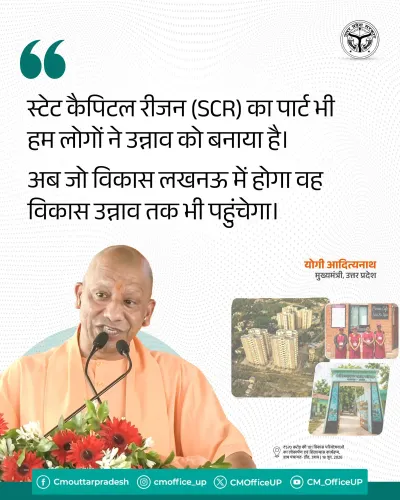
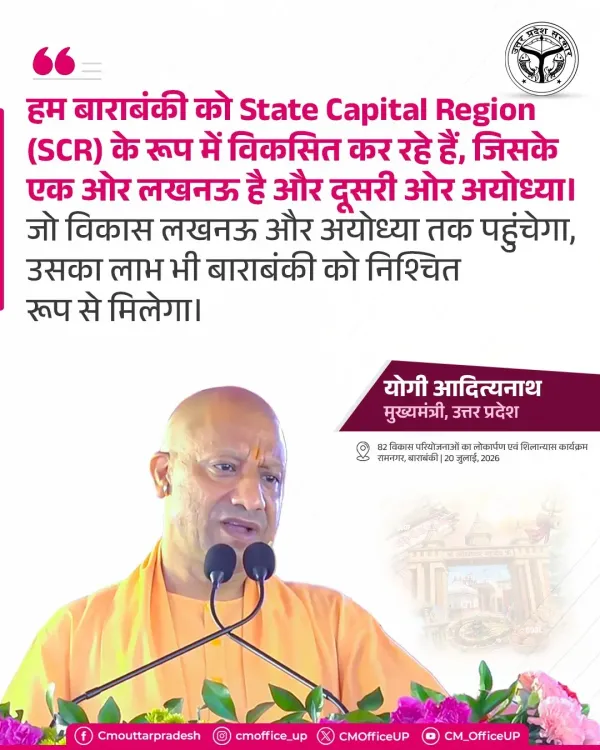
Chief Minister Yogi Adityanath stated, in a post attributed to his office: 'हम बाराबंकी को State Capital Region (SCR) के रूप में विकसित कर रहे हैं' ('We are developing Barabanki as a State Capital Region'), adding that whatever development reaches Lucknow and Ayodhya 'will certainly benefit Barabanki as well.' The remark underlines the state's intent to use Barabanki's geographic centrality — flanked on one side by the state capital and on the other by the pilgrimage city — as a planning asset rather than a passive corridor.
Barabanki is a district in central Uttar Pradesh that has historically functioned as a transit zone between Lucknow's administrative economy and Ayodhya's religious economy. Formalising it within a State Capital Region framework would, in principle, entitle it to coordinated land-use planning, infrastructure investment, and regulatory alignment with the core capital zone.
Policy Backdrop
The SCR concept extends a planning model familiar from the National Capital Region (NCR), which integrates Delhi with surrounding districts across multiple states. Uttar Pradesh has previously used regional designations and expressway corridors — including the Purvanchal Expressway and the Lucknow–Agra Expressway — to channel investment from established urban nodes toward intermediate districts. The SCR designation for Barabanki appears to continue that pattern.
The policy lineage also draws on the state's post-2019 acceleration of infrastructure spending in Ayodhya following the Supreme Court's verdict on the Ram Janmabhoomi site. Since then, road widening, airport development, and hotel-zone planning have transformed Ayodhya's built environment. A formal SCR framework would create a planning bridge that connects Ayodhya's tourism economy with Lucknow's commercial and administrative base, with Barabanki positioned at the junction.
Stakeholders and Impact
Barabanki's residents and regional businesses stand to be the most direct beneficiaries if the SCR framework translates into on-ground investment. Improved road and rail connectivity, industrial land allocation, and logistics infrastructure are among the categories typically associated with capital-region planning. Agricultural communities in the district could also see land-value appreciation if planned development zones are notified.
At the same time, the announcement is at the stage of a stated policy intent. Budget allocations, master-plan notifications, and tender activity will determine whether the SCR designation produces tangible change on the ground. Urban planners and local bodies in Barabanki will need to align their development plans with any state-level SCR master framework once it is formally gazetted.
What's Next
The immediate signals to watch are state budget line items and infrastructure tender notifications specifically earmarked for Barabanki under the SCR framework. If the government follows the NCR model, a statutory or executive order defining SCR boundaries, a nodal authority, and a regional plan would be the next formal steps. CM Yogi Adityanath's statement sets a political direction; the administrative machinery must now produce the enabling instruments that give the designation legal and financial weight.
For Uttar Pradesh, anchoring Barabanki within a capital-region structure would mark a significant step in its ambition to build a contiguous development corridor stretching from Lucknow through Barabanki to Ayodhya — a corridor that combines administrative, commercial, and religious-tourism gravity into a single planned zone.
Point of View
If backed by statutory instruments and budget commitments, could become a template for other intermediate districts along UP's major development corridors. The critical test will be whether the designation moves from political statement to gazetted plan within the current term.
NationPress
21 Jul 2026
Frequently Asked Questions
What is the State Capital Region (SCR) in Uttar Pradesh?
The State Capital Region is a proposed planning framework by the Uttar Pradesh government that would extend coordinated infrastructure investment and land-use planning from Lucknow to adjacent districts, with Barabanki being the first district publicly named under this concept.
Why is Barabanki being developed as a State Capital Region?
Barabanki is geographically situated between Lucknow and Ayodhya, making it a natural corridor to absorb and distribute development benefits from both the state capital and the fast-growing pilgrimage city of Ayodhya.
What did CM Yogi Adityanath say about Barabanki development?
CM Yogi Adityanath stated that Uttar Pradesh is developing Barabanki as a State Capital Region and that whatever development reaches Lucknow and Ayodhya 'will certainly benefit Barabanki as well.'
How will Barabanki residents benefit from the SCR designation?
If implemented, the SCR framework could bring improved road and rail connectivity, industrial land allocation, logistics infrastructure, and higher land values to Barabanki, benefiting residents and regional businesses.
What is the difference between SCR and NCR?
The National Capital Region (NCR) integrates Delhi with surrounding districts across multiple states under a statutory authority. The proposed State Capital Region (SCR) for Barabanki would apply a similar planning model at the state level, centred on Lucknow as the state capital.