CM Yogi: Malihabad Dasheri Mango Gets GI Tag
Synopsis
The Chief Minister's Office of Uttar Pradesh announced on 3 July 2026 that the Malihabad Dasheri mango has received a Geographical Indication Tag. CM Yogi Adityanath called the certification a milestone that elevates the iconic fruit to a global brand, benefiting farmers and orchard owners in Lucknow district.
Key Takeaways
The Malihabad Dasheri mango has been granted a Geographical Indication (GI) Tag , announced by the Chief Minister's Office of Uttar Pradesh on 3 July 2026 .
CM Yogi Adityanath described the GI Tag as making the mango a 'global brand.' Malihabad in Lucknow district has cultivated the Dasheri variety for centuries; the tag provides legal protection against imitation and mislabelling.
India's GI framework is governed by the Geographical Indications of Goods (Registration and Protection) Act, 1999 .
The tag is expected to help mango farmers and orchard owners in Malihabad command premium prices in domestic and export markets.
Next steps include establishing branding standards, packaging norms, and export promotion measures for the certified mango.
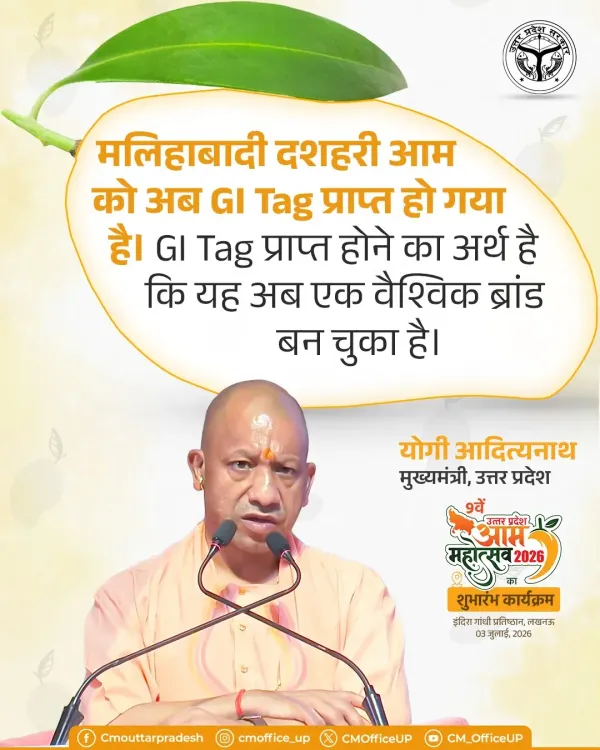
The Chief Minister's Office of Uttar Pradesh announced on Friday, 3 July 2026 that the Malihabad Dasheri mango has been granted a Geographical Indication (GI) Tag, marking the iconic fruit's entry into the ranks of globally recognised regional products. Chief Minister Yogi Adityanath described the development as the mango becoming a 'global brand.'
Posting on behalf of the Chief Minister, the office quoted CM Yogi Adityanath as saying: 'Malihābādī Dashaharī ām ko ab GI Tag prāpt ho gayā hai' — 'The Malihabad Dasheri mango has now received a GI Tag. Receiving a GI Tag means it has now become a global brand.'
Context
Malihabad, a town in Lucknow district, Uttar Pradesh, has been synonymous with the Dasheri mango for centuries. The variety is prized for its distinct sweetness, thin skin, and rich aroma — qualities that set it apart from other mango cultivars grown across the subcontinent. Orchards in the region support the livelihoods of thousands of farmers and orchard owners who have cultivated this variety across generations.
A GI Tag is a certification that a product originates from a specific geographic region and possesses qualities or a reputation attributable to that origin. Under India's Geographical Indications of Goods (Registration and Protection) Act, 1999, the tag provides legal protection against imitation and unauthorised use of the product's name in commerce.
Policy Backdrop
India has steadily expanded GI registrations for agricultural produce, handicrafts, and textiles as part of a broader national strategy to preserve traditional knowledge, improve rural incomes, and sharpen the country's export competitiveness. Uttar Pradesh has emerged as one of the more active states in this push, securing GI tags for several region-specific products ranging from Banarasi silk sarees to Lucknow's chikankari embroidery.
The GI framework gives producers a collective legal identity that can be leveraged in both domestic retail and international trade. For an agricultural commodity like the Dasheri mango, the tag can underpin premium pricing, stricter quality standards, and dedicated export promotion — tools that directly benefit growers at the farm level.
Stakeholders and Impact
The most immediate beneficiaries are the mango farmers and orchard owners of Malihabad, who will now be able to market their produce under a protected designation. The GI Tag is expected to deter counterfeit labelling — a persistent problem where mangoes grown outside the region are sold under the Dasheri name — and enable genuine producers to command better prices.
Consumers, both in India and abroad, stand to gain clearer assurance of authenticity and quality. Export markets in West Asia, Europe, and North America, where Indian mangoes already have a following, could see expanded demand for a product now backed by an internationally recognised certification framework.
What's Next
The grant of the GI Tag is the beginning of a longer process. Authorities and farmer collectives will need to establish branding guidelines, packaging standards, and traceability mechanisms to make the tag commercially meaningful. Export promotion bodies will likely be tasked with positioning the Malihabad Dasheri in overseas markets as a premium, origin-verified product.
How quickly the state government moves to build the institutional infrastructure around the tag — from producer groups to quality-testing protocols — will determine whether the GI designation translates into tangible income gains for the farming communities of Malihabad.
Point of View
High-visibility policy wins that resonate with rural constituencies while aligning with the Centre's 'vocal for local' and agricultural export push. The real test, however, will be in execution: past GI awards in India have sometimes remained symbolic because the institutional scaffolding — producer groups, quality audits, export linkages — was never fully built out. Whether Lucknow's orchard belt sees measurable income gains will depend on how aggressively the state follows through beyond the announcement.
NationPress
3 Jul 2026
Frequently Asked Questions
What is the Malihabad Dasheri mango?
The Malihabad Dasheri mango is a premium mango variety native to Malihabad town in Lucknow district, Uttar Pradesh, known for its distinct sweetness, thin skin, and rich aroma. It has been cultivated in the region for centuries and is now protected under a Geographical Indication Tag.
What does a GI Tag mean for the Dasheri mango?
A GI Tag certifies that the Dasheri mango originates from the Malihabad region and carries qualities tied to that geography. Under India's GI Act of 1999, it gives producers legal protection against imitation and allows them to market the product as an authenticated, origin-specific item — both domestically and in export markets.
Who announced the GI Tag for the Malihabad Dasheri mango?
The Chief Minister's Office of Uttar Pradesh announced the GI Tag on 3 July 2026, quoting Chief Minister Yogi Adityanath, who called the recognition a milestone that makes the mango a global brand.
How will the GI Tag benefit Malihabad mango farmers?
The GI Tag is expected to help farmers and orchard owners in Malihabad command premium prices by deterring counterfeit labelling, enabling quality-based branding, and opening doors to export promotion initiatives in markets such as West Asia and Europe.
How many GI Tags does Uttar Pradesh have?
Uttar Pradesh has secured multiple GI Tags for region-specific products — including Banarasi silk sarees and Lucknow chikankari embroidery — as part of a broader national push to protect traditional knowledge and support rural economies. The Malihabad Dasheri mango is the latest addition to this list.