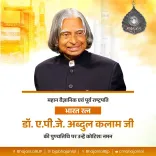
CM Yogi Pays Tribute to APJ Abdul Kalam on Death Anniversary
Synopsis
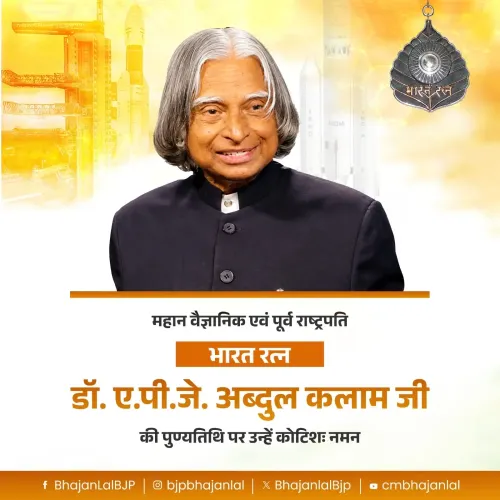
Uttar Pradesh Chief Minister Yogi Adityanath paid tribute to former President Dr. A.P.J. Abdul Kalam on his death anniversary on 27 July 2026, honouring his role in India's missile programme, Pokhran-II nuclear tests, and his enduring inspiration for the nation's youth.
Key Takeaways
CM Yogi Adityanath posted a tribute to Dr.
Abdul Kalam on his death anniversary, 27 July 2026 .
Kalam served as India's 11th President (2002–2007) and is widely known as the 'Missile Man of India.' He led the Integrated Guided Missile Development Programme (IGMDP) at DRDO in the 1980s , producing the Agni and Prithvi missile families.
Kalam was Chief Scientific Adviser to the Prime Minister during the Pokhran-II nuclear tests of May 1998 , cementing India's status as a nuclear-weapons state.
He was awarded the Bharat Ratna in 1997 , India's highest civilian honour.
Kalam passed away on 27 July 2015 at the age of 83 in Shillong .
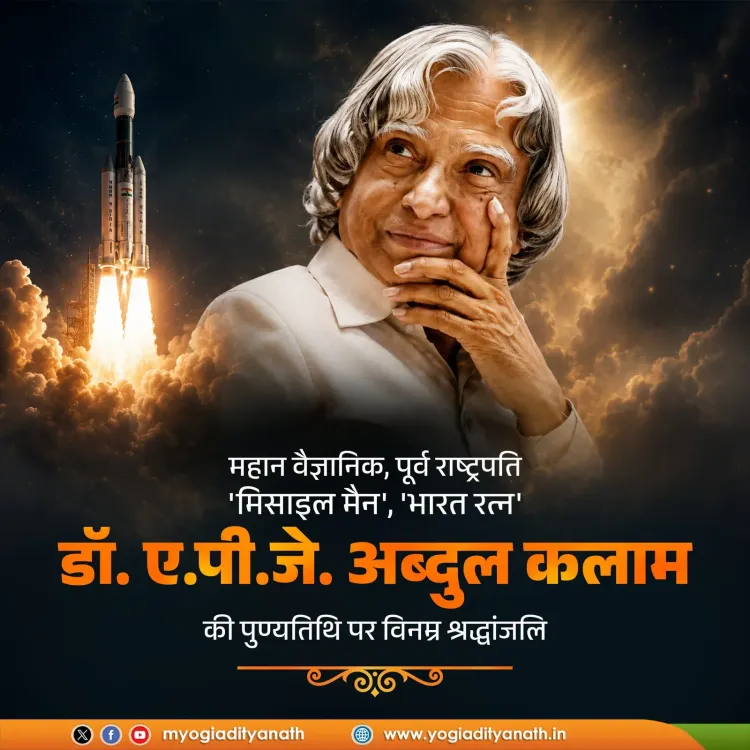
Uttar Pradesh Chief Minister Yogi Adityanath on Monday, 27 July 2026 paid homage to former President and 'Bharat Ratna' awardee Dr. A.P.J. Abdul Kalam on his death anniversary, honouring the scientist-statesman's unparalleled contributions to India's defence, space, and nuclear programmes.
In his post, the Chief Minister offered a humble tribute — 'विनम्र श्रद्धांजलि' (humble salutations) — describing Kalam's contributions to defence and space science as giving India 'a new global identity,' and his role in making the nation a nuclear power as 'unprecedented.' He added that Kalam's 'vision, simplicity, and dedication to national service remain an inspiration for the youth.'
Context
Dr. Avul Pakir Jainulabdeen Abdul Kalam passed away on 27 July 2015 while delivering a lecture at the Indian Institute of Management, Shillong. He was 83 years old. Every year on this date, political leaders, scientists, and citizens across India observe his death anniversary, recalling his decades of service to the nation's strategic and scientific establishment.
Kalam served as India's 11th President from 2002 to 2007, a tenure marked by his close engagement with students and youth — earning him the popular title 'People's President.' Before entering Rashtrapati Bhavan, he spent the bulk of his career as a scientist and administrator at the Defence Research and Development Organisation (DRDO) and the Indian Space Research Organisation (ISRO).
Policy Backdrop
Kalam's most consequential scientific legacy rests on two pillars. The first is the Integrated Guided Missile Development Programme (IGMDP), launched in the 1980s under his leadership at DRDO. The programme produced a family of indigenous missiles — including Agni and Prithvi — that became the backbone of India's strategic deterrence and earned Kalam the sobriquet 'Missile Man of India.'
The second is India's nuclear weapons capability. Kalam served as Chief Scientific Adviser to the Prime Minister during the landmark Pokhran-II nuclear tests of May 1998, which established India as a nuclear-weapons state. His role in both programmes was recognised with the Bharat Ratna, India's highest civilian honour, awarded in 1997 — a year before Pokhran-II.
Stakeholders and Impact
Annual tributes to Kalam carry particular resonance for India's defence and space scientific community, for whom he remains a defining institutional figure. His emphasis on indigenous capability — encapsulated in his vision of a self-reliant India — continues to inform policy discourse around Atmanirbhar Bharat in defence manufacturing and space exploration.
For Indian youth, Kalam occupies a singular inspirational role. His books, public addresses, and personal conduct as a frugal, deeply committed public servant made him one of the most widely admired figures in post-independence India, cutting across regional, religious, and political lines.
What's Next
Commemorative events are typically held across the country on 27 July each year, including at educational institutions, DRDO and ISRO campuses, and Kalam's memorial at Pei Karumbu in Rameswaram, Tamil Nadu. The anniversary also serves as a recurring moment for government and policy voices to reaffirm commitments to indigenous defence production and space ambition — two domains Kalam helped place at the centre of India's strategic identity. Any announcements tied to defence indigenisation or upcoming space missions in the days around this date will likely be viewed through the lens of his enduring legacy.
Point of View
Cross-party political consensus that frames Kalam's scientific legacy as a non-partisan national asset. By specifically invoking Kalam's role in nuclear capability and global recognition for India, the tribute aligns with the ruling party's sustained emphasis on strategic autonomy and indigenous defence production under the Atmanirbhar Bharat framework. The reference to Kalam as an inspiration for youth also reflects a deliberate political investment in the scientist-statesman's image as a unifying, aspirational figure — one who transcends the usual fault lines of Indian politics. Such annual commemorations reinforce the symbolic continuity between India's foundational strategic programmes of the 1980s and 1990s and present-day ambitions in defence and space.
NationPress
27 Jul 2026
Frequently Asked Questions
When did APJ Abdul Kalam die and how is his anniversary observed?
Dr. A.P.J. Abdul Kalam passed away on 27 July 2015 at the age of 83 in Shillong. His death anniversary is observed annually with tributes from political leaders, scientists, and educational institutions across India.
Why is APJ Abdul Kalam called the Missile Man of India?
Kalam earned the title 'Missile Man of India' for leading the Integrated Guided Missile Development Programme (IGMDP) at DRDO in the 1980s, which produced the Agni and Prithvi missile families that form the backbone of India's strategic deterrence.
What was APJ Abdul Kalam's role in the Pokhran nuclear tests?
Kalam served as Chief Scientific Adviser to the Prime Minister during the Pokhran-II nuclear tests conducted in May 1998, playing a central role in establishing India as a nuclear-weapons state.
What is the Bharat Ratna and when did Kalam receive it?
The Bharat Ratna is India's highest civilian honour. Dr. A.P.J. Abdul Kalam was awarded the Bharat Ratna in 1997, recognising his extraordinary contributions to science and national service.
What did CM Yogi Adityanath say about APJ Abdul Kalam?
CM Yogi Adityanath described Kalam's contributions to defence and space science as giving India a new global identity, called his role in making India a nuclear power 'unprecedented,' and said his vision, simplicity, and dedication to national service remain an inspiration for Indian youth.