CM Yogi Greets UP on Guru Purnima, Urges Reverence for Teachers
Synopsis
Uttar Pradesh Chief Minister Yogi Adityanath marked Guru Purnima on 27 July 2026 with a message urging citizens to honour their teachers and live by their ideals, linking reverence for the guru tradition to the broader goal of a developed Uttar Pradesh.
Key Takeaways
CM Yogi Adityanath posted Guru Purnima greetings on 27 July 2026 , addressed to the people of Uttar Pradesh .
He described the guru as 'the light of knowledge' who leads disciples from ignorance to truth, values, and enlightenment — rooted in Sanatan tradition.
The Chief Minister specifically urged citizens to always remember their gurus and to internalise the ideals imparted by them.
He linked individual growth and the development of a ' विकसित प्रदेश ' (developed state) to honouring the guru-shishya tradition.
The message continues an established pattern of BJP -led state governments connecting Hindu cultural observances with governance and development goals.
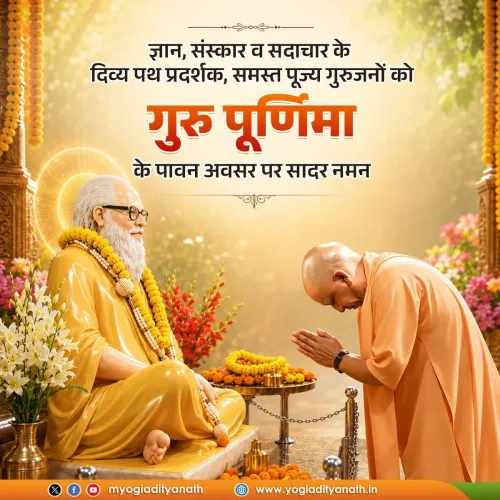
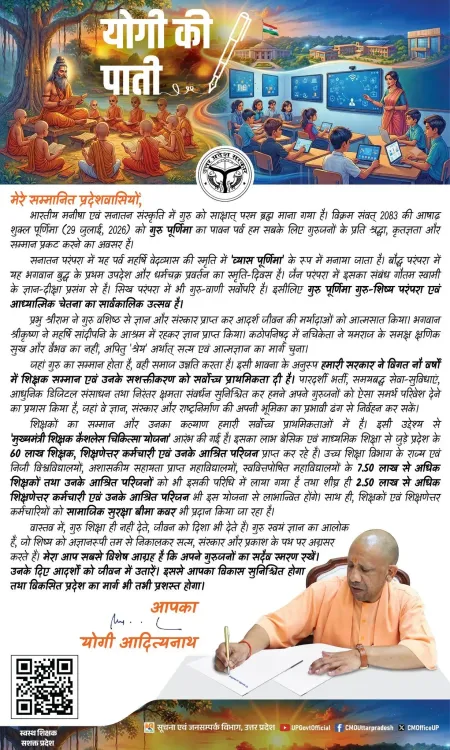
Uttar Pradesh Chief Minister Yogi Adityanath on Monday, 27 July 2026, extended Guru Purnima greetings to the people of Uttar Pradesh, invoking the Sanatan tradition of venerating the guru as the supreme embodiment of knowledge and urging citizens to enshrine the ideals of their teachers in daily life.
Context
Guru Purnima, observed on the full moon of the Hindu month of Ashadha, is one of the most revered occasions in the guru-shishya (teacher-disciple) tradition of Indian civilisation. The festival is marked across the country by students, disciples, and devotees paying homage to those who have guided them — academically, spiritually, and morally.
In his post, CM Yogi wrote: 'गुरु स्वयं ज्ञान का आलोक हैं, जो शिष्य को अज्ञानरूपी तम से निकालकर सत्य, संस्कार और प्रकाश के पथ पर अग्रसर करते हैं' — translated: 'The guru is himself the light of knowledge, who leads the disciple from the darkness of ignorance towards truth, values, and enlightenment.'
Policy Backdrop
The message reflects a broader pattern among BJP-led state governments of using significant Hindu observances to reinforce the link between Sanatan cultural values and the goal of societal progress. Uttar Pradesh, India's most populous state, has been governed by the BJP since 2017, and CM Yogi — who also heads the Gorakhnath Math in Gorakhpur — has consistently woven religious and cultural messaging into his public communications.
The Chief Minister's appeal went beyond ceremonial wishes. He specifically called on citizens to 'always remember your gurus' and to 'internalise the ideals they imparted,' adding that individual growth and the development of a 'developed state' (विकसित प्रदेश) are contingent on honouring that tradition.
Stakeholders and Impact
Teachers and students across Uttar Pradesh are the most immediate audience for this message. The state has one of the largest student populations in India, and Guru Purnima is widely observed in schools, colleges, and religious institutions throughout the region.
By tying the observance to the idea of a 'developed Uttar Pradesh,' the Chief Minister frames cultural reverence not merely as a spiritual exercise but as a civic value — suggesting that respect for traditional knowledge systems and modern development goals are complementary rather than competing priorities.
What's Next
Cultural messaging of this nature around major Hindu festivals often precedes or accompanies state-level education or outreach initiatives in Uttar Pradesh. Observers will watch for any follow-up programmes — in schools, gurukuls, or community spaces — that operationalise the guru-tradition theme in the coming months. The broader alignment of Sanatan values with development rhetoric is expected to remain a consistent feature of the state government's public communication.
Point of View
The Chief Minister folds a cultural observance into the state's development narrative, a rhetorical move that has become a hallmark of BJP-governed states. The message is unlikely to generate political controversy on its own, but it signals how cultural capital is being steadily woven into the fabric of governance communication in the state. Over time, such messaging shapes public expectations of what the state stands for — not just in policy terms, but in civilisational ones.
NationPress
25 Oct 2026
Frequently Asked Questions
What is Guru Purnima and why is it celebrated?
Guru Purnima is a Hindu festival observed on the full moon of the month of Ashadha to honour teachers and spiritual guides in the guru-shishya tradition. It is celebrated across India in schools, colleges, and religious institutions.
What did CM Yogi Adityanath say on Guru Purnima 2026?
CM Yogi Adityanath urged the people of Uttar Pradesh to always remember their gurus, internalise the ideals they imparted, and said that individual growth and the development of the state depend on honouring the guru tradition.
When did CM Yogi post his Guru Purnima message?
CM Yogi Adityanath posted his Guru Purnima message on Monday, 27 July 2026, at approximately 6:59 AM IST on his official X account.
What is the connection between Guru Purnima and Sanatan culture?
In Sanatan (Hindu) tradition, the guru is regarded as the embodiment of the divine and the supreme source of knowledge. Guru Purnima formalises this reverence, with disciples paying homage to those who have guided them spiritually and intellectually.
Who is Yogi Adityanath and what is the Gorakhnath Math?
Yogi Adityanath is the Chief Minister of Uttar Pradesh and a senior BJP leader. He is also the head of the Gorakhnath Math, a prominent religious institution in Gorakhpur, Uttar Pradesh, which has historically been influential in the region's spiritual and social life.