CM Yogi pays tribute to Nanaji Deshmukh on birth anniversary
Synopsis
Uttar Pradesh Chief Minister Yogi Adityanath marked the birth anniversary of Bharat Ratna Nanaji Deshmukh on 11 October, honouring the Jana Sangh founding member's lifelong commitment to rural uplift, self-reliance, and service to the last person in society.
Key Takeaways
CM Yogi Adityanath paid tribute to Nanaji Deshmukh on his birth anniversary on 11 October 2026 .
Deshmukh, born 11 October 1916 , was a founding member of the Bharatiya Jana Sangh and a lifelong RSS pracharak.
He was awarded the Bharat Ratna posthumously in 2019 and the Padma Vibhushan in 1999 .
CM Yogi invoked Deshmukh's three core ideals: Gramoday , Swavalamban , and Antyodaya as inspiration for building an equitable, self-reliant India.
Deshmukh's rural development work in Chitrakoot remains a landmark model in Indian policy discourse.
A life spent entirely in service — no office, no salary, no personal ambition. On the birth anniversary of Nanaji Deshmukh, Uttar Pradesh Chief Minister Yogi Adityanath paused to honour the man who walked away from Parliament to rebuild rural India from the ground up.
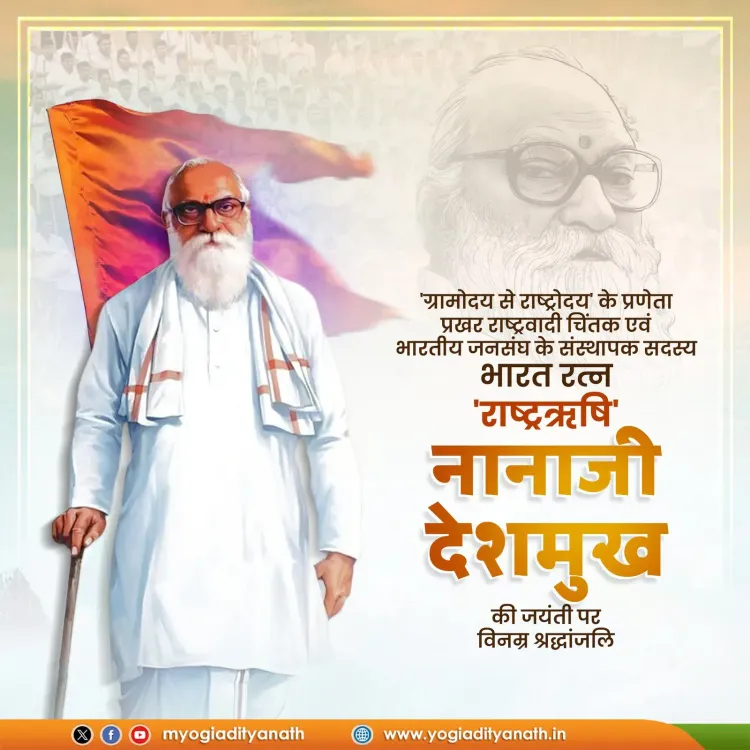
Posting on Sunday, 11 October 2026, CM Yogi offered what he called a 'vinम्र श्रद्धांजलि' — a humble tribute — to Deshmukh, describing him as 'Rashtra Rishi' (sage of the nation) and invoking his three foundational ideals: Gramoday (village uplift), Swavalamban (self-reliance), and Antyodaya (service to the last person in line). In CM Yogi's words, Deshmukh 'dedicated his entire life to public service, rural development, and social upliftment, treating these as the bedrock of nation-building.' His great ideas, the post adds, continue to inspire the building of an equitable and 'self-reliant India.'
From Jana Sangh founder to 'Bharat Ratna' — who was Nanaji Deshmukh?
Nanaji Deshmukh — born 11 October 1916 in Hingoli, Maharashtra — was a founding member of the Bharatiya Jana Sangh, the ideological precursor to today's Bharatiya Janata Party. A lifelong RSS pracharak, he rose to national prominence as an organiser, editor, and social entrepreneur before making a choice that defined his legacy: in 1977, after being elected to the Lok Sabha, he voluntarily declined ministerial office in the Janata Party government, arguing that people over sixty should step back from electoral politics and serve society directly.
He kept that promise. Moving to the drought-prone Chitrakoot region on the Uttar Pradesh–Madhya Pradesh border, he founded the Deendayal Research Institute and launched an integrated rural development experiment that transformed dozens of villages — covering health, education, agriculture, and self-employment in a single model. The Government of India awarded him the Padma Vibhushan in 1999 and the nation's highest civilian honour, the Bharat Ratna, posthumously in 2019. He passed away on 27 February 2010.
Why 'Antyodaya' and 'Atmanirbhar Bharat' share the same root
CM Yogi's tribute is not merely ceremonial — it draws a deliberate ideological line. The term Antyodaya, meaning 'rise of the last,' was popularised by Pandit Deendayal Upadhyaya, another Jana Sangh icon, and Deshmukh spent his post-political life operationalising it in the field. The current BJP government's flagship Atmanirbhar Bharat (Self-Reliant India) framework explicitly borrows from this tradition — making the tribute as much a statement of policy continuity as personal reverence.
Chitrakoot's transformation under Deshmukh's stewardship remains a cited benchmark in Indian rural-development discourse: a region once marked by poverty and dacoit activity becoming a model of village-level self-governance and enterprise. That story, invoked every year on his birth anniversary, is the subtext CM Yogi's post carries into the present.
Nanaji Deshmukh did not wait for policy to reach the village. He moved to the village and became the policy. That is the standard his admirers say India is still measuring itself against.
Point of View
The post signals that the party views Deshmukh not just as a historical figure but as a living policy template. In an era when rural distress and village-level infrastructure remain electoral flashpoints in Uttar Pradesh, invoking Deshmukh's Chitrakoot model carries both symbolic and strategic weight. The tribute also quietly reinforces the RSS-BJP ideological continuum at a moment when that lineage is central to the party's self-narrative.
NationPress
11 Oct 2026
Frequently Asked Questions
Who was Nanaji Deshmukh?
Nanaji Deshmukh (1916–2010) was a founding member of the Bharatiya Jana Sangh, a lifelong RSS pracharak, and a pioneering rural development activist who transformed villages in the Chitrakoot region. He was awarded the Bharat Ratna posthumously in 2019.
When is Nanaji Deshmukh's birth anniversary?
Nanaji Deshmukh was born on 11 October 1916, and his birth anniversary is observed every year on 11 October.
What is the meaning of Antyodaya?
Antyodaya means 'rise of the last' — a philosophy of prioritising the most marginalised section of society in development and governance. It was a guiding principle of Nanaji Deshmukh's social work.
Why did Nanaji Deshmukh receive the Bharat Ratna?
Nanaji Deshmukh received the Bharat Ratna posthumously in 2019 in recognition of his lifelong contribution to rural development, social upliftment, and public service, particularly his transformative work in the Chitrakoot region.
What did CM Yogi say about Nanaji Deshmukh?
CM Yogi Adityanath described Nanaji Deshmukh as 'Rashtra Rishi' and honoured his ideals of Gramoday, Swavalamban, and Antyodaya, saying his great ideas continue to inspire the building of an equitable and self-reliant India.