CM Yogi redefines freedom on Independence Day
Synopsis
On Independence Day 2026, CM Yogi Adityanath declared that true freedom means liberation not just from colonial rule but from anarchy, backwardness, poverty, illiteracy and inequality — framing Uttar Pradesh's governance agenda against five enduring deficits.
Key Takeaways
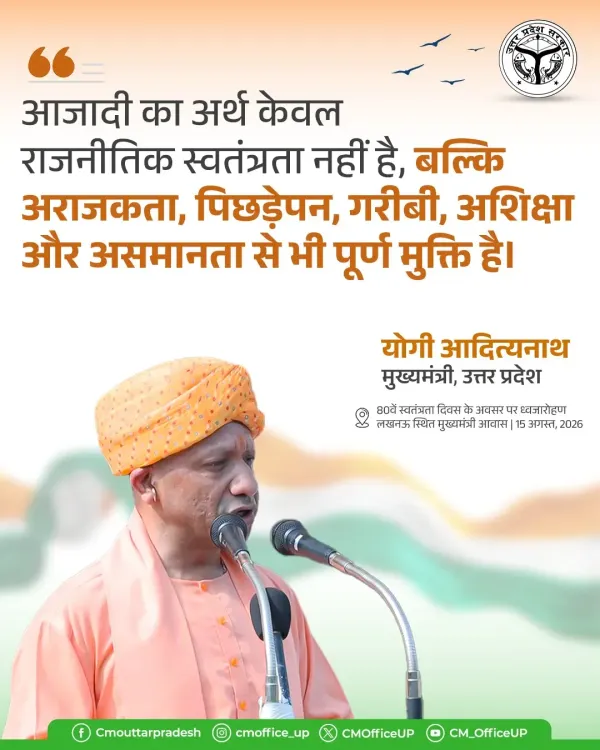
CM Yogi Adityanath posted the statement on 15 August 2026 via the official Chief Minister's Office account.
He defined freedom as liberation from five conditions: anarchy, backwardness, poverty, illiteracy and inequality .
The framing directly mirrors the stated policy pillars of the Uttar Pradesh government since 2017 .
Uttar Pradesh is India's most populous state, making its socio-economic trajectory a nationally significant benchmark.
The statement follows a long tradition in Indian politics of expanding the definition of independence beyond political sovereignty.
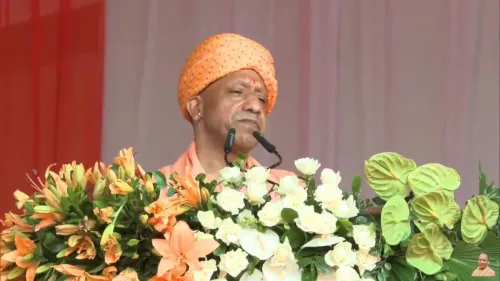
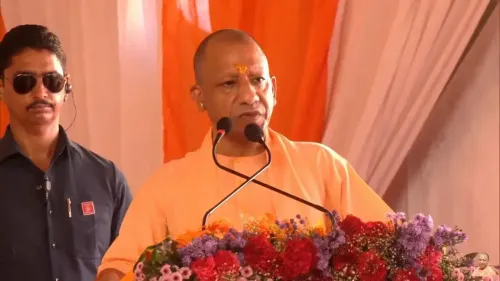
On Independence Day, 15 August 2026, the Chief Minister's Office of Uttar Pradesh shared a pointed declaration from Chief Minister Yogi Adityanath — one that stretches the meaning of freedom far beyond the political.
The statement, posted in Hindi, reads: 'Aazadi ka arth keval rajnitik swatantrata nahin hai, balki arajkata, pichhadeepan, garibi, ashiksha aur asamanta se bhi poorn mukti hai' — 'Freedom does not mean only political independence; it means complete liberation from anarchy, backwardness, poverty, illiteracy and inequality.'
A century-old idea, freshly restated
The framing is not new to Indian political thought. Since 1947, leaders across the spectrum have argued that the promise of 15 August remains unfinished so long as socio-economic deprivation persists. What the statement does is anchor that tradition firmly in the present governance agenda of Uttar Pradesh — India's most populous state, home to roughly 240 million people.
CM Yogi has governed the state since 2017, and his administration has repeatedly tied its policy priorities — law and order, school enrolment, poverty alleviation — to a broader argument about what genuine freedom looks like on the ground. The five conditions named in the post — anarchy, backwardness, poverty, illiteracy, inequality — map almost exactly onto the pillars the state government has cited in successive budget speeches and scheme launches.
Five freedoms Uttar Pradesh is still chasing
Each word in the list carries political weight. 'Anarchy' is a consistent reference point for the Yogi administration's law-and-order positioning. 'Backwardness' and 'poverty' point to the state's long-standing challenge of economic catch-up in a region that has historically lagged national averages on per-capita income and human development indices. 'Illiteracy' flags education access — a domain where Uttar Pradesh has made measurable gains in school enrolment but still faces quality gaps. 'Inequality' is the broadest of the five, gesturing at caste, gender and regional disparities that no single scheme has resolved.
Taken together, the statement is less a policy announcement than a governing philosophy — a reminder, on the anniversary of independence, that the state's work is defined against these five deficits.
The real test of such declarations, of course, is the budget line and the scheme delivery that follow. Watch for state allocations targeting education access and social equity in the months ahead — that is where the rhetoric meets the road.
Point of View
Poverty, illiteracy and inequality as forms of un-freedom, he positions his administration's law-and-order and development record as the continuation of the independence project itself. The five-point formulation is not rhetorical accident — each term maps onto a domain where the Yogi government has staked a governance claim. For a state heading into future electoral cycles, anchoring routine policy priorities inside the moral vocabulary of national liberation is a well-worn but effective move. The sharper question is whether the state's budget allocations and scheme outcomes will substantiate the philosophy the Chief Minister articulates on the podium.
NationPress
29 Sept 2026
Frequently Asked Questions
What did CM Yogi Adityanath say on Independence Day 2026?
CM Yogi Adityanath stated that freedom means not only political independence but complete liberation from anarchy, backwardness, poverty, illiteracy and inequality.
When did the Chief Minister's Office of UP post this statement?
The post was published on 15 August 2026 at approximately 10:09 AM IST on the official CMOfficeUP account on X.
What is the governance focus of Yogi Adityanath in Uttar Pradesh?
Since taking office in 2017 , CM Yogi's administration has focused on law and order, school enrolment, poverty reduction and infrastructure development across Uttar Pradesh .
Why do Indian leaders link Independence Day to socio-economic goals?
Indian political tradition since 1947 holds that political sovereignty is incomplete without economic and social equity — a theme leaders across parties invoke on 15 August each year.
What should we watch after this statement from the UP CM?
Watch for state budget allocations and new scheme announcements in Uttar Pradesh targeting education access, poverty alleviation and social equality in the coming months.