CM Yogi to Preserve KD Singh Babu Haveli, Build Museum
Synopsis
Chief Minister Yogi Adityanath has announced plans to preserve the haveli of two-time Olympic gold medallist K.D. Singh 'Babu' in Barabanki and build a museum in his name, honouring one of India's greatest hockey legends.
Key Takeaways
CM Yogi Adityanath announced the preservation of K.D.
Singh 'Babu's haveli in Barabanki, Uttar Pradesh on 20 July 2026 .
A museum dedicated to K.D.
Singh 'Babu' will be constructed at the haveli site.
Singh 'Babu' captained India to Olympic gold medals in 1948 and 1952 .
The project aligns with the Yogi Adityanath government's broader heritage conservation and sports-tourism push in UP.
No construction timeline or budget has been announced yet; implementation details are awaited.
The museum could establish Barabanki as a destination for Indian hockey heritage and sports tourism.
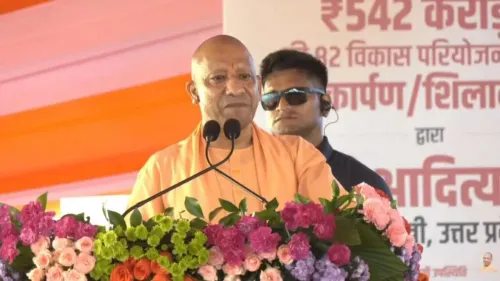
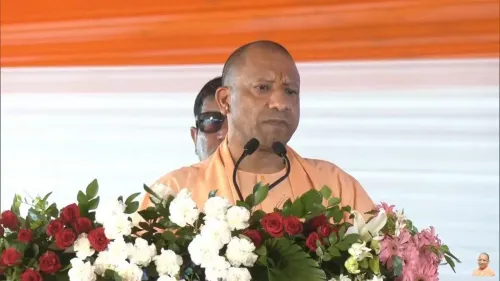
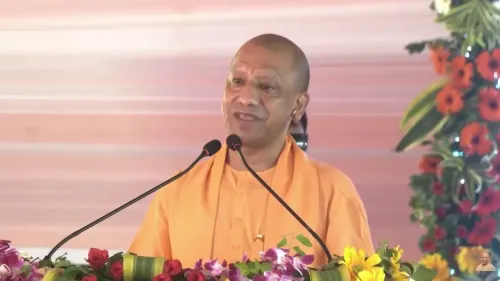
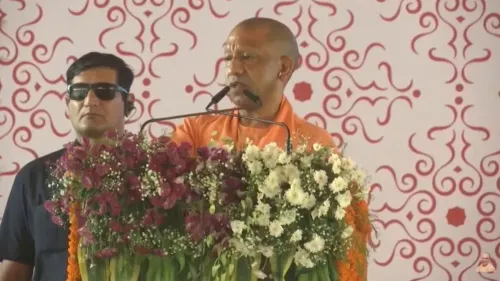
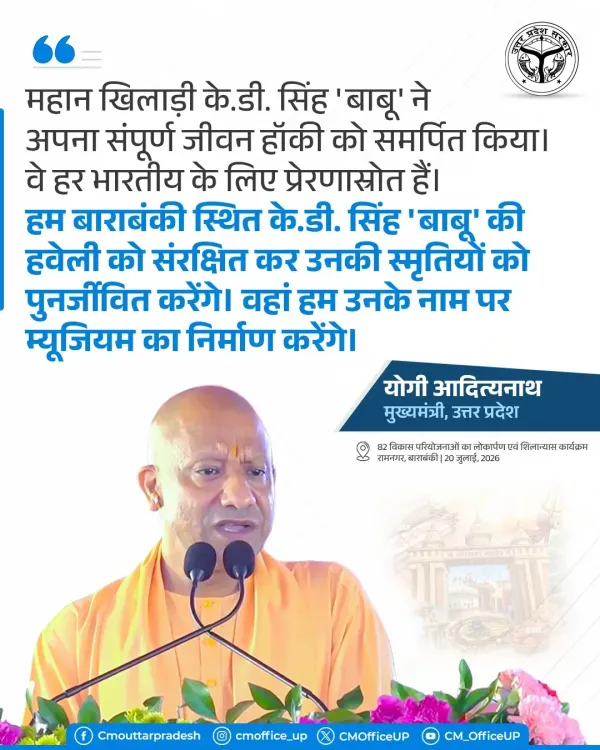
The Chief Minister's Office of Uttar Pradesh announced on Monday, 20 July 2026 that Chief Minister Yogi Adityanath has pledged to preserve the ancestral haveli of legendary hockey player K.D. Singh 'Babu' in Barabanki and construct a museum in his honour at the site.
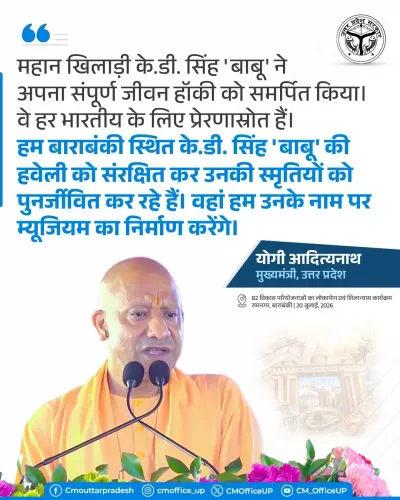
Sharing the announcement on X, the Chief Minister's Office quoted CM Yogi Adityanath: 'महान खिलाड़ी के.डी. सिंह 'बाबू' ने अपना संपूर्ण जीवन हॉकी को समर्पित किया।' ('The great player K.D. Singh 'Babu' dedicated his entire life to hockey. He is an inspiration for every Indian. We will preserve K.D. Singh 'Babu's haveli in Barabanki and revive his memories. We will build a museum in his name there.')
Context
K.D. Singh 'Babu' is among the most celebrated names in Indian sporting history. He captained the Indian national hockey team to Olympic gold medals in 1948 (London) and 1952 (Helsinki), cementing India's dominance in the sport during that era. Born and raised in Barabanki, Uttar Pradesh, his haveli in the district holds deep historical and sentimental significance for the region.
Despite his stature in Indian hockey, tangible memorials dedicated to him have remained limited. The announcement marks one of the most concrete state-level commitments to preserving his legacy.
Policy Backdrop
The Yogi Adityanath government, in office since 2017, has undertaken several heritage conservation and sports-promotion initiatives across Uttar Pradesh. Converting residences of celebrated athletes into museums or memorials is a pattern seen across Indian states, particularly for figures from the 1948–1956 Olympic hockey era — a golden period when India won consecutive gold medals.
Such projects are typically positioned at the intersection of cultural preservation and sports tourism, aligning with the state's broader push to develop destination-worthy heritage sites. Uttar Pradesh has actively pursued this model under its current administration, linking local icons to regional identity and tourism potential.
Stakeholders and Impact
Residents of Barabanki stand to benefit most directly, with the proposed museum potentially drawing visitors interested in India's Olympic sporting heritage. Sports historians and hockey associations are also key stakeholders, as such an institution could serve as an archival and educational resource documenting the pre-independence and early post-independence era of Indian hockey.
For the broader sporting community, the announcement signals state-level recognition of athletes who shaped India's identity on the world stage but whose physical legacies have often gone unpreserved. Local economies in heritage-tourism circuits could also see downstream benefits if the project is developed with visitor infrastructure.
What's Next
No specific construction timeline, budget allocation, or implementation agency has been announced alongside this commitment. Observers will watch for follow-up notifications from the Uttar Pradesh government regarding project scope, funding, and any coordination with national sports bodies or the Archaeological Survey of India for conservation of the haveli structure.
If executed, the museum at Barabanki could become a landmark destination for hockey enthusiasts and students of Indian sporting history, giving the district a distinctive cultural identity rooted in one of its most celebrated sons.
Point of View
Athletes who delivered the country its most celebrated sporting triumphs. However, the absence of a budget figure or timeline means this remains a political commitment rather than a funded project, and its credibility will hinge on visible follow-through. If delivered, it could set a precedent for other states to similarly institutionalise the legacies of their Olympic-era sporting heroes.
NationPress
21 Jul 2026
Frequently Asked Questions
Who was K.D. Singh Babu?
K.D. Singh 'Babu' was an Indian field hockey player from Barabanki, Uttar Pradesh, who captained India to Olympic gold medals in 1948 (London) and 1952 (Helsinki), making him one of the country's greatest sporting icons.
Where is K.D. Singh Babu's haveli located?
The haveli of K.D. Singh 'Babu' is located in Barabanki district, Uttar Pradesh, which was also his birthplace.
What has CM Yogi Adityanath announced for KD Singh Babu?
Chief Minister Yogi Adityanath announced on 20 July 2026 that the Uttar Pradesh government will preserve K.D. Singh 'Babu's ancestral haveli in Barabanki and build a museum in his name at the site.
Has a timeline or budget been announced for the KD Singh Babu museum?
No specific construction timeline or budget allocation has been announced alongside the commitment; further details from the Uttar Pradesh government are awaited.
Why is K.D. Singh Babu significant for Uttar Pradesh?
K.D. Singh 'Babu' was born in Barabanki, Uttar Pradesh, and his Olympic achievements in 1948 and 1952 make him one of the most celebrated sporting figures associated with the state and with India's hockey legacy.