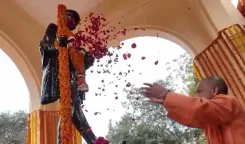
CM Yogi pays tribute to Lal Bahadur Shastri on birth anniversary
Synopsis
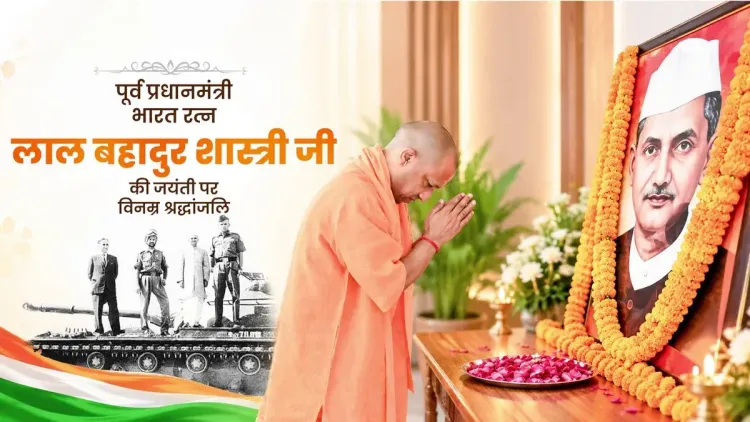
Uttar Pradesh Chief Minister Yogi Adityanath marked Lal Bahadur Shastri's birth anniversary on 2 October 2026, paying tribute to the Bharat Ratna-decorated former Prime Minister's resolve, simplicity, and the iconic 'Jai Jawan, Jai Kisan' legacy.
Key Takeaways
CM Yogi Adityanath paid tribute to former PM Lal Bahadur Shastri on his 2 October birth anniversary.
Shastri, born in 1904 in present-day Uttar Pradesh , served as India's second Prime Minister from 1964 to 1966.
His slogan 'Jai Jawan, Jai Kisan' was coined during the Indo-Pakistani War of 1965 to honour soldiers and farmers.
Shastri was posthumously awarded the Bharat Ratna in 1966 .
2 October is also the birth anniversary of Mahatma Gandhi , giving the date dual national significance.
On the birth anniversary of Lal Bahadur Shastri — the former Prime Minister who galvanised a nation with the immortal call 'Jai Jawan, Jai Kisan' ('Hail the Soldier, Hail the Farmer') — Uttar Pradesh Chief Minister Yogi Adityanath offered a heartfelt tribute on Friday, 2 October 2026, honouring the leader's enduring legacy of integrity, simplicity, and resolve.
In his post, CM Yogi wrote that Shastri's rallying cry had filled soldiers and farmers alike with 'indomitable energy,' and that his 'firm leadership, honesty and simple life will remain an inspiration for the countrymen for ages to come.' The tribute reflects the reverence Shastri commands across party lines — a statesman remembered as much for his moral stature as for his wartime courage.
The man behind 'Jai Jawan, Jai Kisan'
Lal Bahadur Shastri, born on 2 October 1904 in Mughalsarai, United Provinces (present-day Uttar Pradesh), served as India's second Prime Minister from 1964 to 1966. A close disciple of Mahatma Gandhi — whose own birth anniversary falls on the same date — Shastri rose from humble origins to lead the nation through one of its gravest tests: the Indo-Pakistani War of 1965.
It was during that conflict that he coined the slogan 'Jai Jawan, Jai Kisan' — a dual salute to the soldier defending the border and the farmer feeding the nation — which became one of independent India's most enduring political phrases. He was posthumously awarded the Bharat Ratna, India's highest civilian honour, in 1966.
A legacy rooted in Uttar Pradesh
Shastri's roots run deep in the same state CM Yogi governs. Born and raised in what is now Uttar Pradesh, he remains a towering figure in the state's political and cultural memory. His life — marked by voluntary austerity, including appeals to citizens to fast one day a week during the 1965 food shortage — continues to be invoked as a benchmark for public-spirited leadership.
The tribute from Lucknow on a morning when India simultaneously remembers Mahatma Gandhi underscores how 2 October carries a singular weight in the national calendar — two giants, born the same day, both from different threads of the same independence movement.
Point of View
Making the homage a state-rooted act as much as a national one. The emphasis on 'Jai Jawan, Jai Kisan' aligns with the BJP's sustained outreach to both defence and agrarian constituencies, framing Shastri's legacy as a shared nationalist inheritance rather than Congress patrimony. Invoking his 'simplicity and honesty' also serves as a quiet marker of governance values the ruling party wishes to associate itself with. On a day India simultaneously observes Gandhi Jayanti, the dual tribute reflects a broader effort to claim the full spectrum of the independence-era moral tradition.
NationPress
2 Oct 2026
Frequently Asked Questions
When is Lal Bahadur Shastri's birth anniversary?
Lal Bahadur Shastri was born on 2 October 1904 , a date also shared with Mahatma Gandhi's birth anniversary, making it one of the most significant days in India's national calendar.
What does 'Jai Jawan, Jai Kisan' mean?
'Jai Jawan, Jai Kisan' translates to 'Hail the Soldier, Hail the Farmer.' The slogan was coined by Prime Minister Lal Bahadur Shastri during the Indo-Pakistani War of 1965 to honour the two pillars he saw as foundational to India's security and sustenance.
Was Lal Bahadur Shastri awarded the Bharat Ratna?
Yes. Lal Bahadur Shastri was posthumously awarded the Bharat Ratna , India's highest civilian honour, in 1966 , shortly after his death in Tashkent.
Why did CM Yogi Adityanath pay tribute to Lal Bahadur Shastri?
CM Yogi Adityanath posted a tribute on 2 October 2026 to mark Shastri's birth anniversary, honouring his leadership during the 1965 war, his iconic 'Jai Jawan, Jai Kisan' slogan, and his reputation for honesty and simplicity in public life.
Where was Lal Bahadur Shastri from?
Lal Bahadur Shastri was born in Mughalsarai , in the United Provinces, which is now part of Uttar Pradesh , making him one of the state's most celebrated native sons.