Uttarakhand CMO pays tribute to warrior Teelu Rauteli on her Jayanti
Synopsis
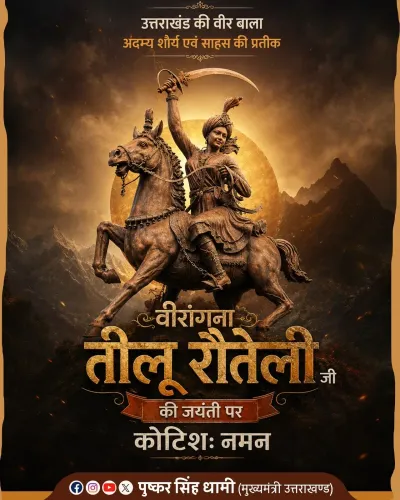
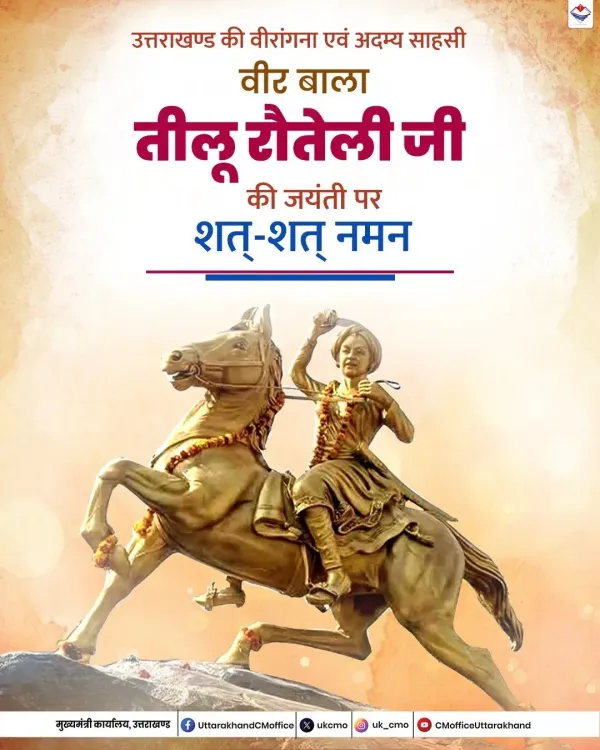
The Chief Minister's Office of Uttarakhand paid tribute to Teelu Rauteli on her Jayanti on 8 August 2026, honouring the legendary regional warrior with a 'shat-shat naman' and reaffirming the state's connection to its Pahadi folk heritage.
Key Takeaways
The Uttarakhand CMO posted an official tribute to Teelu Rauteli on 8 August 2026 , her birth anniversary (Jayanti).
Rauteli is celebrated in Uttarakhand's folk tradition as a veerangana — a brave woman warrior who embodied fearless resistance.
The tribute used the phrase 'shat-shat naman' , a Hindi expression of deep, hundredfold reverence.
The post is part of a broader pattern of Indian state governments officially marking anniversaries of regional historical and folk figures.
Uttarakhand, formed in 2000 , has a distinct Pahadi cultural identity in which figures like Rauteli hold enduring significance.
She is remembered as a symbol of fearless resistance — a woman warrior whose legend has endured for centuries in the hills of Uttarakhand. On Saturday, 8 August 2026, the Chief Minister's Office of Uttarakhand offered its reverence to Teelu Rauteli on her birth anniversary, honouring her as veerangana (brave daughter) and adamya sahasi veer bala (indomitably courageous warrior maiden).
The warrior the hills remember
Teelu Rauteli occupies a singular place in Uttarakhand's folk memory. Celebrated across the Garhwal and Kumaon regions as a legendary female fighter, she is invoked as a figure of courage and resistance — a woman who, according to regional tradition, took up arms and refused to yield. The CMO's post, written in Hindi, offered a hundredfold salutation — 'shat-shat naman' — a phrase that carries deep reverence in the subcontinent's cultural idiom.A state's ritual of remembrance
The tribute is part of a well-established pattern across Indian states: chief ministers' offices mark the birth and death anniversaries of regional folk heroes as an act of cultural custodianship. For Uttarakhand — a state carved out in 2000 with a distinct Pahadi identity — figures like Teelu Rauteli are not footnotes. They are the connective tissue between a mountain people and their history. Official acknowledgement on her Jayanti keeps that thread alive in the public square.Point of View
These official acknowledgements serve a state-building function, weaving together a shared Pahadi identity across Garhwal and Kumaon. The consistency of such tributes year after year signals that regional heritage messaging is now a standing pillar of governance communication, not an afterthought. It also reflects how folk memory — particularly of women warriors — is increasingly being elevated in official discourse as a counter-narrative to mainstream historical accounts.
NationPress
22 Sept 2026
Frequently Asked Questions
Who is Teelu Rauteli?
Teelu Rauteli is a legendary female warrior figure from Uttarakhand, celebrated in regional folklore for her bravery and spirit of resistance. She is regarded as one of the most iconic 'veeranganas' — brave women — in the folk tradition of the Garhwal and Kumaon hills.
Why does Uttarakhand celebrate Teelu Rauteli Jayanti?
Teelu Rauteli Jayanti marks the birth anniversary of the revered folk warrior. The Uttarakhand government and cultural organisations observe the day to honour her legacy and keep the region's folk heritage alive in public memory.
What does 'shat-shat naman' mean?
'Shat-shat naman' is a Hindi phrase meaning 'a hundredfold salutation' or 'deepest reverence'. It is commonly used in official tributes in India to express profound respect for a historical or cultural figure.
What did the Uttarakhand CMO post about Teelu Rauteli?
On 8 August 2026, the Chief Minister's Office of Uttarakhand posted a tribute on X honouring Teelu Rauteli on her Jayanti, describing her as 'veerangana' and 'adamya sahasi veer bala' — an indomitably courageous warrior maiden — and offering a 'shat-shat naman'.
When was Uttarakhand formed as a separate state?
Uttarakhand was carved out as a separate state from Uttar Pradesh on 9 November 2000, with a distinct Pahadi cultural and geographical identity.