Does Criticism Based on Facts Strengthen Our Democracy While Motivated Fatalism Harms It? Hardeep Puri
Click to start listening
Synopsis
Union Minister Hardeep Singh Puri highlights how constructive criticism can strengthen India's democracy, contrasting it with the dangers of motivated fatalism. He emphasizes the importance of factual discourse as the nation moves towards 2026, ensuring that improvement comes through accountability, not cynicism. Discover the implications of his remarks on India's socio-economic landscape.
Key Takeaways
- Constructive criticism is essential for democracy.
- Motivated fatalism can harm public discourse.
- India's economic data is improving and reliable.
- GST has established a robust compliance framework.
- Welfare initiatives have lifted millions out of poverty.
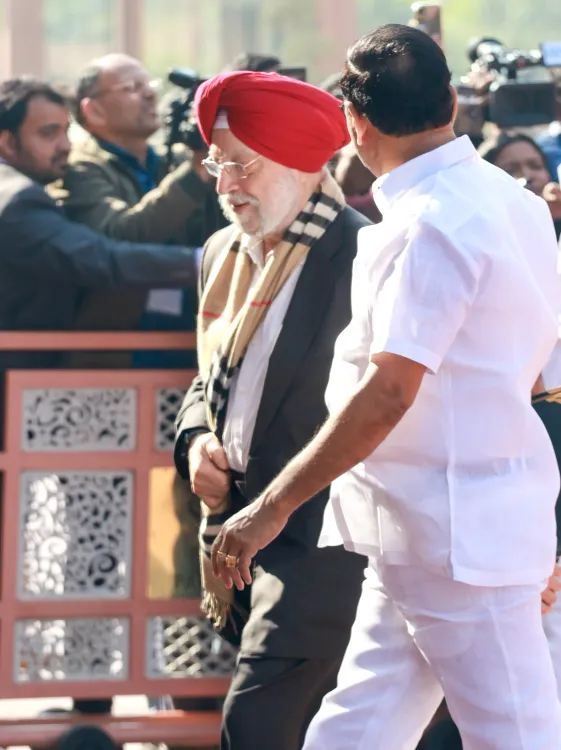
New Delhi, Jan 8 (NationPress) Union Minister Hardeep Singh Puri remarked on Thursday that India's democracy is enhanced by constructive criticism, unlike the motivated fatalism propagated by certain "experts," who appear to be driven more by their political agendas than by genuine academic integrity.
As we approach 2026, the minister emphasized that public discourse in India ought to commence with a renewed sense of responsibility, rather than by merely rehashing insinuations, assumptions, and superficial claims as economic evaluations.
Puri pointed out that a specific type of commentary has emerged, one that simplifies reform efforts into caricatures and interprets every flawed transition as evidence of irrevocable failure.
He noted, "The recurring themes are well-known: India's datasets are unreliable, economic growth is not reaching the underprivileged, crony capitalism prevails, and India struggles to manufacture at scale, among others."
However, he asserted that these claims do not withstand factual examination. Under Prime Minister Narendra Modi's leadership, India has opted for a challenging path of implementation, and it is the outcomes—validated by data and experienced in homes—that will ultimately outlast transient moments of despair, Puri added.
The minister reiterated that as we move toward 2026, public debate in India should be initiated with a sense of New Year discipline.
"We should embrace scrutiny, even pointed criticism, but we must also demand that arguments come with accountability. A republic of over 1.4 billion cannot be transformed through cynicism. Achieving jobs, productivity, exports, and inclusion is no easy feat, and progress is made through the diligent work of design, execution, rectification, and scaling. A New Year is an opportunity to distinguish skepticism from pessimism," he remarked.
"In recent years, a certain style of commentary has developed that trivializes the efforts of reform, treating every imperfect transition as evidence of an irreversible calamity, while offering a familiar excuse: India is supposedly doomed by its policymakers. This attitude undermines trust in statistics and markets, fosters fatalism among entrepreneurs and investors, and provides external actors with a ready-made script for pressuring India during negotiations. Expertise must remain accountable to facts," Puri added.
He expressed concern that some commentators, despite their strong professional and academic credentials, have resorted to such posturing. Some individuals, whom he has known personally and who have built their identities and reputations in India, now appear to be pursuing careers by disparaging the nation.
The minister further emphasized that the claim about India's datasets being uniquely unreliable does not fit well with the overall trajectory. The introduction of GST has established a national invoice trail and a compliance culture that was nonexistent a decade ago. Digital payments have created another framework for auditing. In November 2025, UPI recorded 20 billion transactions worth over Rs 26 lakh crore. These represent substantial, verifiable systems that enhance opportunities for measurement, cross-checks, and necessary adjustments.
Furthermore, evidence of improved welfare and inclusion challenges this fatalism. According to NITI Aayog's National Multidimensional Poverty Index, nearly 24 crore Indians have escaped multidimensional poverty between 2013-14 and 2022-23, with the percentage dropping from nearly 30% to about 11%.
Direct Benefit Transfer has improved delivery, with cumulative transfers surpassing Rs 45 lakh crore in 2025 and savings exceeding Rs 3.5 lakh crore due to reduced leakages throughout the DBT period. Financial inclusion has become a widespread infrastructure, with over 56 crore Jan Dhan accounts," he concluded.
Point of View
It's vital to recognize the nuanced debate surrounding India's socio-economic progress. Hardeep Puri's emphasis on factual criticism over motivated fatalism aligns with the broader narrative of enhancing public discourse. The nation's path towards growth demands a balance of skepticism and optimism, fostering a responsible environment for constructive dialogue.
NationPress
09/01/2026
Frequently Asked Questions
What did Hardeep Puri say about criticism and democracy?
Hardeep Puri stated that constructive criticism is beneficial for India's democracy, while motivated fatalism by certain experts undermines it.
What are the key points raised by Puri regarding India's economic data?
Puri argued that claims about India's economic data being unreliable do not hold up against factual scrutiny, citing improvements in welfare and inclusion.
How has GST impacted India's compliance culture?
The introduction of GST has created a national invoice trail and a compliance culture that significantly enhances transparency and auditing.