CM Dhami Clears Voluntary Land Consolidation in 11 Hill Districts
Synopsis
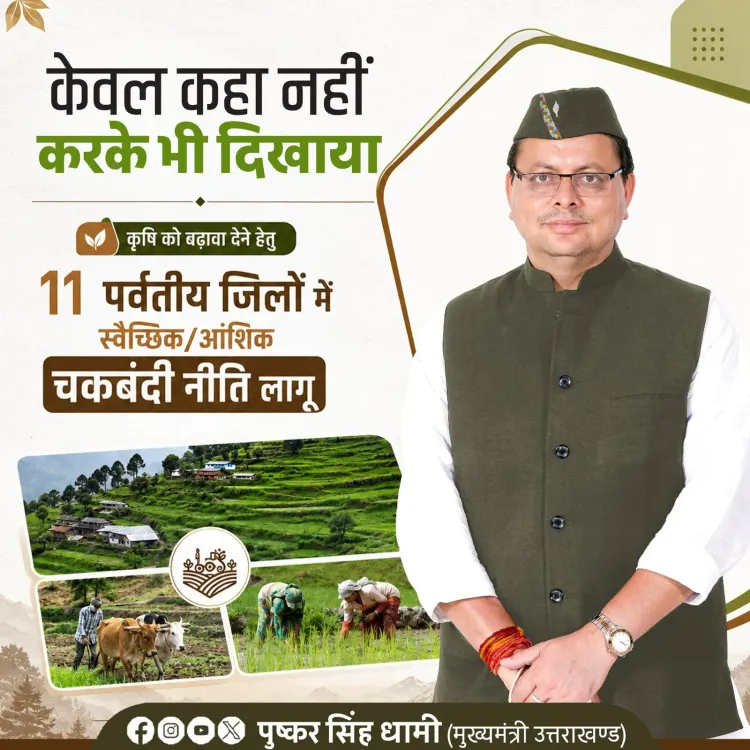
Uttarakhand CM Pushkar Singh Dhami has approved a voluntary and partial chakbandi (land consolidation) policy for 11 mountainous districts, aiming to merge fragmented farm holdings, ease cultivation, and boost the rural hill economy — fulfilling a long-standing demand of hill farmers.
Key Takeaways
Uttarakhand CM Pushkar Singh Dhami announced a voluntary/partial chakbandi policy on 12 June 2026 .
The policy covers all 11 mountainous districts of Uttarakhand.
It aims to consolidate small, scattered farm plots into larger, workable holdings.
Participation is voluntary and partial — farmers are not compelled to join.
The move is expected to improve farming efficiency, irrigation access, and rural incomes in hill areas.
The policy responds to a years-old demand of hill farmers and follows the lineage of the UP Consolidation of Holdings Act, 1953.
Uttarakhand Chief Minister Pushkar Singh Dhami on Friday, 12 June 2026, announced that the state government has taken a significant decision to implement a voluntary and partial chakbandi (land consolidation) policy across 11 mountainous districts of the state, responding to a long-standing demand of hill farmers.
Context
In his post on X, CM Dhami stated: 'Honouring the years-old demand of farmers in mountainous regions and the sentiments of the people, the state government has taken the important decision to implement a voluntary/partial chakbandi policy in 11 hill districts.' He added that the measure 'will pave the way for integrating small, scattered fields, providing convenience to farmers in agriculture and giving new strength to the rural economy.'
The announcement directly addresses one of the most persistent structural problems facing Uttarakhand's hill farmers — extreme fragmentation of agricultural holdings caused by steep terrain and inheritance-driven subdivision of land over generations.
Policy Backdrop
Land consolidation in the region has deep legislative roots. The Uttar Pradesh Consolidation of Holdings Act, 1953, established the framework for merging scattered plots into compact, workable units — a law that continued to apply to areas forming present-day Uttarakhand after the state was carved out in 2000.
The new policy adopts a voluntary and partial model, meaning farmers are not compelled to participate. This approach is consistent with a broader pattern seen across India's Himalayan states, where governments have favoured incentive-based consolidation over compulsory acquisition to avoid social friction while still improving input use, irrigation access, and the scope for mechanisation.
Fragmented holdings across hill districts have historically suppressed per-acre productivity, raised the cost of cultivation, and made it difficult to extend irrigation infrastructure or deploy machinery on economically viable plots.
Stakeholders and Impact
The primary beneficiaries are small and marginal farmers spread across Uttarakhand's 11 mountainous districts, who have long pressed successive state governments for a workable consolidation mechanism. Consolidated plots are expected to reduce the time and cost farmers spend moving between dispersed parcels and to improve access to institutional credit, which typically requires clear, contiguous land records as collateral.
The rural economy of hill Uttarakhand — already under pressure from out-migration and the decline of subsistence farming — stands to gain if consolidation raises agricultural income and encourages younger residents to stay on the land. Village-level governance bodies and revenue officials will be central to implementing the voluntary process on the ground.
What's Next
The immediate focus will be on the rollout of pilot guidelines and operational procedures for voluntary consolidation across the 11 districts. Observers will watch for any accompanying state budget allocations, amendments to existing land-records legislation, or the appointment of district-level nodal officers to manage the process.
If early pilots demonstrate measurable gains in farm productivity and rural incomes, the policy could serve as a template for other hill states grappling with the same structural constraints — making Uttarakhand's experiment one with implications beyond its own borders.
Point of View
CM Dhami avoids the social conflict that has derailed similar efforts in other states, while still claiming a substantive reform. The move fits a wider BJP pattern of addressing structural rural grievances through state-level executive action rather than legislative overhaul. Whether the policy translates into on-ground change will depend entirely on implementation capacity at the district and village revenue level — the traditional bottleneck in Indian land administration.
NationPress
26 Oct 2026
Frequently Asked Questions
What is the chakbandi policy announced by CM Dhami?
The chakbandi policy is a voluntary and partial land consolidation scheme approved by Uttarakhand CM Pushkar Singh Dhami for 11 hill districts. It merges small, scattered agricultural plots into larger, compact holdings to make farming easier and more productive.
Which districts in Uttarakhand are covered under the new chakbandi policy?
The policy covers all 11 mountainous districts of Uttarakhand. Specific district names were not listed in the announcement, but the scheme targets the state's hill regions where land fragmentation is most acute.
Is the Uttarakhand chakbandi policy compulsory for farmers?
No. The policy is explicitly described as voluntary and partial, meaning farmers can choose whether or not to participate. This design is intended to avoid coercion and social conflict.
How will land consolidation help Uttarakhand's hill farmers?
Consolidating fragmented plots reduces the time and cost of moving between dispersed fields, improves access to irrigation and mechanisation, strengthens land records for credit purposes, and is expected to raise overall farm productivity and rural incomes.
What is the legal background of chakbandi in Uttarakhand?
Land consolidation in the region is rooted in the Uttar Pradesh Consolidation of Holdings Act, 1953, which continued to apply after Uttarakhand was formed as a separate state in 2000. The new policy builds on this existing legal framework.