Karnataka Excise Dept ran as bribe syndicate, ED says after 14-location raids
Synopsis
The ED's post-raid statement on Karnataka's Excise Department is damning in its specificity: fixed monthly bribes from liquor shops, a central pooling mechanism, an unofficial cash book, and officers running proxy liquor businesses to launder proceeds. With ₹13.3 crore seized and a PWD minister's relative among those searched, the case strikes at the heart of Karnataka's Congress government.
Key Takeaways
The ED alleged the Karnataka Excise Department functioned as an organised bribe-collection syndicate involving public officials and private individuals.
Searches were conducted on 24 June 2025 at 14 locations across Bengaluru , Mysuru , and Belagavi under the PMLA, 2002 .
Total assets seized amount to approximately ₹13.3 crore , including ₹5.5 crore cash, ₹7.8 crore in gold jewellery, and ₹3.3 lakh in foreign currency.
Key officials named: Jagdish Nayak , K.M.
Thammanna , and Y.D.
Manjunath — the last being the brother-in-law of PWD Minister Satish Jarkiholi .
The ED detected a money laundering route where officers allegedly held liquor licences in family members' names to project bribe proceeds as legitimate income.
No arrests have been made; investigation is ongoing.
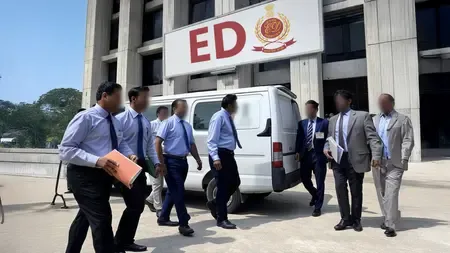
The Enforcement Directorate (ED) on 25 June 2025 alleged that the Karnataka Excise Department operated as an organised bribe-collection syndicate involving public officials, their associates, and private individuals — a finding that emerged from sweeping searches conducted a day earlier across Bengaluru, Mysuru, and Belagavi. The raids, carried out at 14 locations under the Prevention of Money Laundering Act (PMLA), 2002, yielded total seized assets of approximately ₹13.3 crore.
What the ED Found
According to an official statement issued by the ED's Bengaluru Zonal Office, the Excise Department's alleged corruption network functioned like a 'well-oiled machine' running on bribe money generated by various excise shops, each of which reportedly paid a fixed monthly amount to field officers. The agency said bribes were also generated during the renewal, shifting, and fresh issuance of liquor licences.
The ED stated that the money collected was 'centrally pooled and distributed with the help of intermediaries and associates, who maintain an account of money received and paid in an unofficial cash book' — a document that was seized from one of the searched premises.
Key Officials Named and Assets Seized
The searches covered premises linked to Excise Department officials Jagdish Nayak, K.M. Thammanna, and Y.D. Manjunath, along with their family members, business partners, and close associates. Y.D. Manjunath is the brother-in-law of Public Works Department (PWD) Minister Satish Jarkiholi.
From the premises of Manjunath, his driver, family members, and associates, the ED recovered cash of approximately ₹5.5 crore, gold jewellery valued at around ₹7.8 crore, and foreign currency worth about ₹3.3 lakh. Incriminating digital devices, property documents, and the alleged bribe-distribution cash book were also seized.
A Unique Money Laundering Route
The ED highlighted what it described as a 'unique modus operandi': most Excise Department officers allegedly obtained liquor licences in the names of family members and entities under their control, then ran liquor businesses through these proxies. The income from these businesses was projected as legitimate earnings, effectively integrating proceeds of crime into the regular economy — a textbook layering-and-integration structure under money laundering law.
Background and Legal Basis
The ED's investigation was triggered by an FIR registered by the Karnataka Excise Department itself, alleging the collection of illegal gratification for processing and issuing excise licences and the subsequent personal enrichment of officials. The agency said verifiable complaints and documents related to benami transactions, immovable property acquisitions, and business investments through proxies further supported the probe.
No arrests have been announced as of Thursday. The ED said further investigation is underway to trace additional proceeds of crime, identify more beneficiaries, and map the full extent of the alleged network.
Point of View
'centrally pooled', 'unofficial cash book' — suggests investigators believe this was institutional, not incidental, corruption. The political exposure is significant: a sitting PWD minister's brother-in-law is among those searched, which will test whether the Karnataka government can credibly claim distance from the alleged network. What is often missed in such cases is the downstream effect — if excise licence issuance was systematically monetised, the integrity of the entire licensing regime in the state is in question, not just the conduct of a few officials. The absence of arrests so far indicates the ED is still building its proceeds-of-crime trail, and the seized cash book could prove to be the most consequential document in the case.
NationPress
24 Sept 2026
Frequently Asked Questions
What did the ED allege about the Karnataka Excise Department?
The ED alleged that the Karnataka Excise Department operated as an organised syndicate for bribe collection, with liquor shops paying fixed monthly amounts to field officers and proceeds being centrally pooled and distributed through intermediaries. The agency made these allegations following searches at 14 locations on 24 June 2025.
How much was seized in the Karnataka Excise Department ED raids?
The ED seized total assets of approximately ₹13.3 crore, comprising cash of around ₹5.5 crore, gold jewellery valued at ₹7.8 crore, and foreign currency worth ₹3.3 lakh. These were recovered from the premises of Y.D. Manjunath, his driver, family members, and associates.
Who is Y.D. Manjunath and what is his connection to the Karnataka government?
Y.D. Manjunath is an official of the Karnataka Excise Department and the brother-in-law of PWD Minister Satish Jarkiholi. His premises were among those searched by the ED on 24 June 2025, and the bulk of the seized cash, gold, and foreign currency was recovered from locations linked to him.
What was the money laundering method allegedly used by Excise Department officers?
According to the ED, officers allegedly obtained liquor licences in the names of family members and entities they controlled, then ran liquor businesses through these proxies. Income from these businesses was projected as legitimate earnings, integrating bribe proceeds into the regular economy — a classic layering-and-integration money laundering structure.
Have any arrests been made in the Karnataka Excise Department corruption case?
No arrests have been announced as of 25 June 2025. The ED has stated that further investigation is underway to trace additional proceeds of crime and identify more beneficiaries of the alleged bribe network.