CM Fadnavis pays tribute to Ahilyabai Holkar on her Smruti Din

Synopsis
Maharashtra Chief Minister Devendra Fadnavis marked the Smruti Din of Punyashlok Rajmata Ahilyabai Holkar with a tribute honouring her as a pioneer of women's empowerment, a skilled administrator, and a devoted ruler whose welfare-first governance continues to inspire.
Key Takeaways
CM Devendra Fadnavis paid tribute to Rajmata Ahilyabai Holkar on her annual death anniversary, Smruti Din .
Fadnavis described her as a pioneer of women's empowerment, skilled administrator, and courageous warrior-queen.
Ahilyabai Holkar ruled the Malwa kingdom under the Holkar dynasty of the Maratha confederacy in the 18th century.
Her reign is documented for temple construction, public works, and welfare-oriented administration across the subcontinent.
Tributes to Ahilyabai are a recurring feature in Maharashtra's political calendar, linking contemporary governance to Maratha heritage.
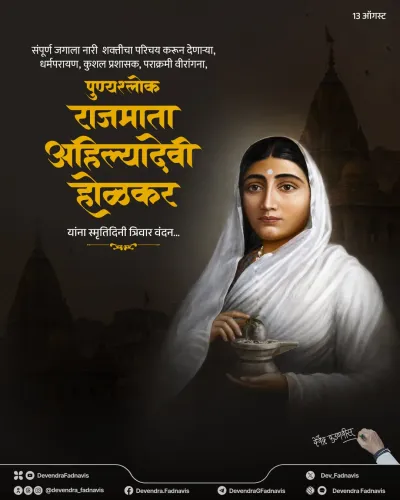
She ruled without a crown of conquest — and yet built temples, roads, and a welfare state that outlasted empires. On the death anniversary of Punyashlok Rajmata Ahilyabai Holkar, Maharashtra Chief Minister Devendra Fadnavis offered a heartfelt tribute to the 18th-century Malwa queen, honouring her legacy of people-centric governance and unwavering public service.
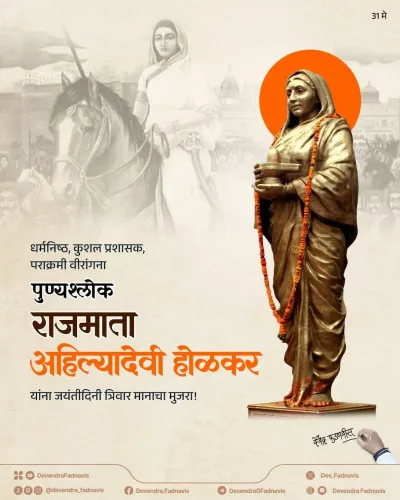
In his post, Fadnavis described Ahilyabai as 'महिला सक्षमीकरणाच्या प्रणेत्या, कुशल प्रशासक, प्रजावत्सल, धर्मनिष्ठ, धाडसी वीरांगना' — a pioneer of women's empowerment, a skilled administrator, devoted to her subjects, deeply faithful, and a courageous warrior-queen. He offered a threefold salutation — trivar vandan — on her Smruti Din, or remembrance day.
Who was Ahilyabai Holkar?
Ahilyabai Holkar was the ruler of the Malwa kingdom, part of the Maratha confederacy's Holkar dynasty, in the latter half of the 18th century. Her reign is documented for large-scale public works — temple construction and restoration across the subcontinent, the building of roads and rest houses, and administrative reforms that prioritised the welfare of ordinary subjects over courtly politics. She is widely regarded as one of the most effective rulers of her era, and her name carries particular resonance in Maharashtra, where she is revered as a symbol of righteous, compassionate leadership.
Why political leaders invoke Ahilyabai
Tributes to pre-colonial rulers on their death anniversaries are a consistent feature of Indian political communication — a way of anchoring contemporary governance ideals to historical precedent. Ahilyabai Holkar is invoked with particular frequency because her record bridges multiple themes at once: women's leadership, administrative competence, religious devotion, and grassroots welfare. For a sitting Chief Minister of Maharashtra, the tribute also carries a regional and cultural dimension, connecting the state's political identity to the broader Maratha heritage.
Fadnavis's tribute, framed around her Smruti Din, reinforces that her legacy is not merely historical — it is held up as a living standard for governance.
Point of View
Linking BJP's stated commitment to women's empowerment and cultural heritage to an unimpeachable 18th-century precedent. Ahilyabai Holkar is a strategically resonant choice: she transcends partisan lines, commands reverence across Maharashtra's communities, and embodies the welfare-state ideal that every government claims as its own. The tribute also signals the importance of the Holkar legacy in Maharashtra's political culture ahead of any state-level commemorative events. Invoking her on Smruti Din keeps the Chief Minister's public positioning anchored in cultural continuity rather than controversy.
NationPress
27 Sept 2026
Frequently Asked Questions
Who was Ahilyabai Holkar and why is she remembered?
Ahilyabai Holkar was the 18th-century ruler of the Malwa kingdom under the Holkar dynasty of the Maratha confederacy. She is remembered for her extensive public works — including temple construction and restoration across India, road-building, and welfare-focused administration — and is widely regarded as one of the most effective and compassionate rulers of her era.
What is Ahilyabai Holkar's Smruti Din?
Smruti Din means 'remembrance day' in Marathi. Ahilyabai Holkar's Smruti Din is her observed death anniversary, marked annually by tributes from political leaders, cultural organisations, and citizens — particularly in Maharashtra.
What did CM Devendra Fadnavis say about Ahilyabai Holkar?
CM Fadnavis described Ahilyabai Holkar as a pioneer of women's empowerment, a skilled administrator, devoted to her subjects, deeply faithful, and a courageous warrior-queen. He offered a threefold salutation — trivar vandan — on her Smruti Din.
Why do Maharashtra politicians frequently tribute Ahilyabai Holkar?
Ahilyabai Holkar is a revered figure in Maharashtra's cultural and political identity due to her documented welfare governance and Maratha heritage. Political leaders invoke her legacy to connect contemporary governance themes — especially women's empowerment and public welfare — to a widely respected historical precedent.
What is the meaning of 'Punyashlok' in Punyashlok Ahilyabai Holkar?
'Punyashlok' is a Sanskrit honorific meaning 'one whose name is sacred' or 'one who is glorified in holy verse.' It is a title of deep reverence bestowed on Ahilyabai Holkar in recognition of her righteous and virtuous rule.