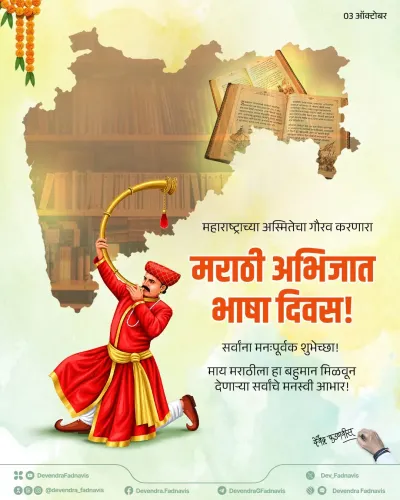
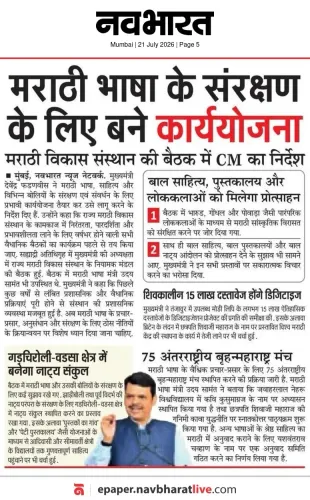
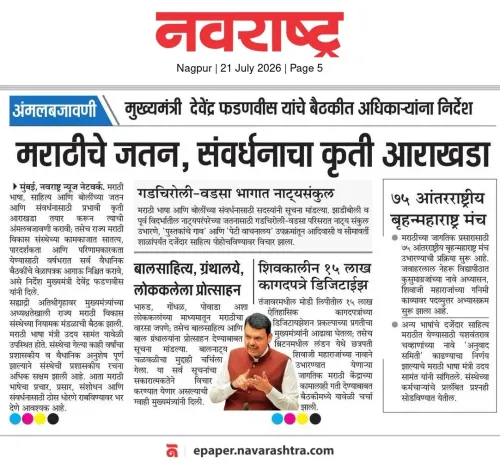
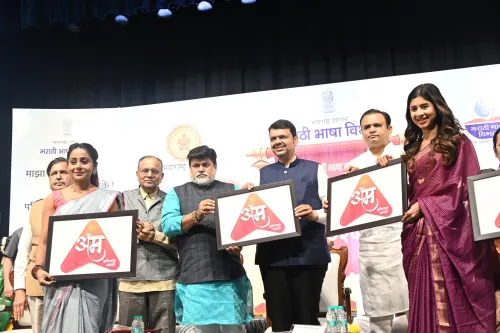
CM Fadnavis launches Abhijat Marathi Bhasha Saptah 2026 in Mumbai
Synopsis
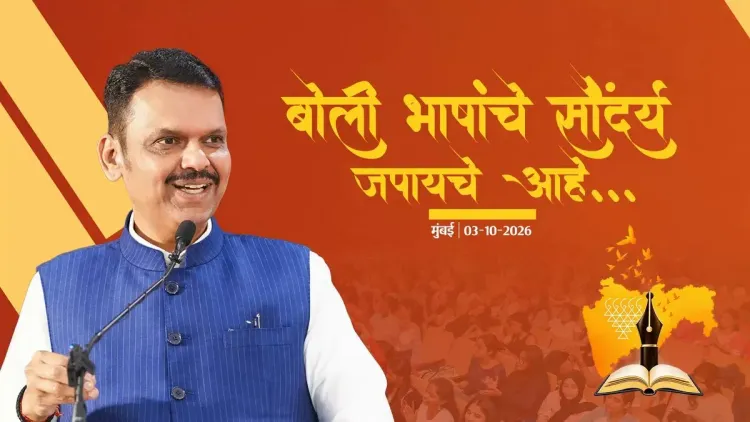
Maharashtra CM Devendra Fadnavis inaugurated the Abhijat Marathi Bhasha Saptah 2026 in Mumbai on October 3, marking a week-long celebration of Marathi's Classical Language status and highlighting that Marathi hosts more literary conventions than any other Indian language.
Key Takeaways
CM Devendra Fadnavis inaugurated the Abhijat Marathi Bhasha Saptah 2026 in Mumbai on October 3, 2026 .
The week-long celebration runs from October 3 to October 10, 2026 .
Fadnavis stated that Marathi hosts the largest number of literary conventions of any language in India.
The Saptah celebrates Marathi's formal Classical Language status, a central government recognition.
Marathi's Classical Language designation unlocks funding for research, manuscript preservation, and academic promotion.
Marathi has a documented literary tradition of over a thousand years , rooted in the Varkari saint-poet tradition.
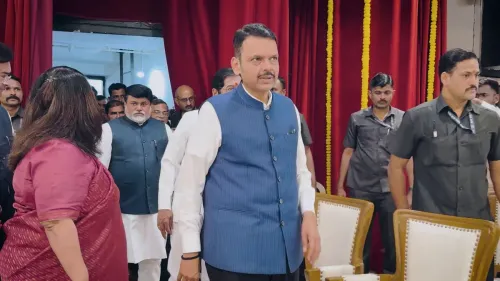
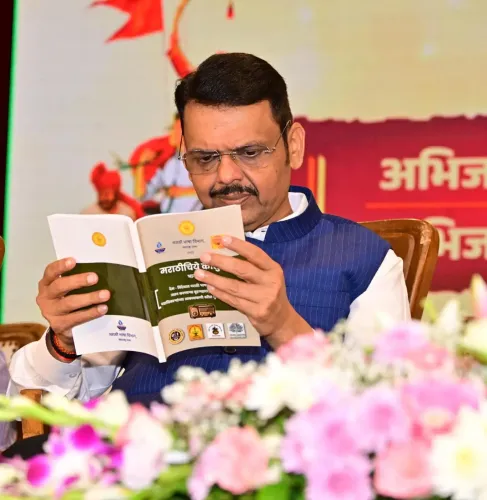
Pride and language met on the same stage in Mumbai on Saturday, October 3, 2026, as Maharashtra Chief Minister Devendra Fadnavis inaugurated the Abhijat Marathi Bhasha Saptah 2026 — a week-long celebration of Marathi's Classical Language status — and declared that no language in India hosts more literary gatherings than Marathi.
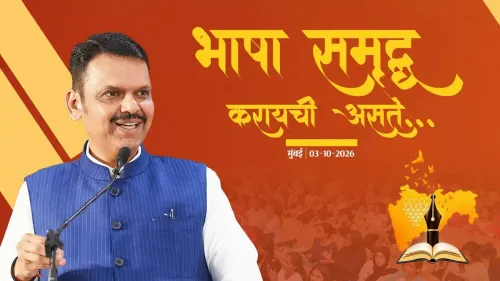
Speaking at the inauguration, CM Fadnavis expressed pride in a striking cultural fact: 'देशात सर्वाधिक साहित्य संमेलने मराठी भाषेत होतात' — 'the largest number of literary conventions in the country are held in the Marathi language.' The remark underscored Marathi's extraordinary literary vitality, setting the tone for a seven-day programme running from October 3 to October 10, 2026.
Marathi's Classical Language recognition and what it means
The Abhijat Marathi Bhasha Saptah — Classical Marathi Language Week — is anchored in Marathi's formal recognition as a Classical Language of India, a status that places it alongside Sanskrit, Tamil, Telugu, Kannada, and Odia. Classical Language designation by the central government unlocks dedicated funding for research, the promotion of ancient manuscripts, and academic chairs, giving institutional muscle to cultural pride.
Marathi, spoken by over 83 million people as a first language, has a documented literary tradition stretching back more than a thousand years, from the Yadava-era poet-saints of the Varkari movement to the modern prose renaissance. The sheer volume of sahitya sammelane — literary conventions — held annually across Maharashtra and the diaspora is a testament to that living tradition.
A week of language, literature, and legacy in Mumbai
By inaugurating the Saptah in Mumbai, the state's political and cultural capital, Fadnavis positioned the event as both a government commitment and a public celebration. The seven-day format suggests a programme likely spanning readings, scholarly panels, and community outreach — a format designed to take Classical Language recognition beyond a gazette notification and into everyday cultural life.
The Chief Minister's choice to highlight literary conventions specifically — rather than script, cinema, or commerce — signals an emphasis on Marathi's intellectual heritage as the centrepiece of its classical identity.
A language that outlasted empires and inspired saints now has a week named in its honour — and a government that wants the world to count every convention it fills.
Point of View
Where Marathi identity has long been a powerful electoral and administrative force. By personally inaugurating the event and foregrounding literary conventions as Marathi's crowning achievement, Fadnavis aligns the BJP-led state government with a cause that commands cross-party emotional resonance — Classical Language status was a long-standing demand of Marathi literary and political circles. The week-long format signals an intent to institutionalise the celebration, potentially making it an annual fixture that converts a policy milestone into sustained cultural programming. Nationally, it also fits a broader pattern of state governments using Classical Language recognition as a platform to assert regional identity within the federal framework.
NationPress
3 Oct 2026
Frequently Asked Questions
What is Abhijat Marathi Bhasha Saptah 2026?
Abhijat Marathi Bhasha Saptah 2026 is a week-long state-organised celebration of Marathi's Classical Language status, running from October 3 to October 10, 2026, inaugurated by Maharashtra CM Devendra Fadnavis in Mumbai.
When did Marathi get Classical Language status?
Marathi was granted Classical Language status by the Government of India, joining Sanskrit, Tamil, Telugu, Kannada, and Odia — a recognition that unlocks dedicated funding for research and manuscript preservation.
What did CM Fadnavis say at the Marathi language week inauguration?
CM Fadnavis said he is proud that the largest number of literary conventions in the country are held in the Marathi language, highlighting Marathi's extraordinary literary vitality.
What are the benefits of Classical Language recognition for Marathi?
Classical Language recognition entitles Marathi to central government funding for academic research, promotion of ancient manuscripts, establishment of academic chairs, and national-level scholarly programmes.
How old is the Marathi literary tradition?
Marathi has a documented literary tradition spanning over a thousand years, rooted in the Varkari saint-poet movement of the Yadava era and continuing through a rich modern prose and poetry tradition.