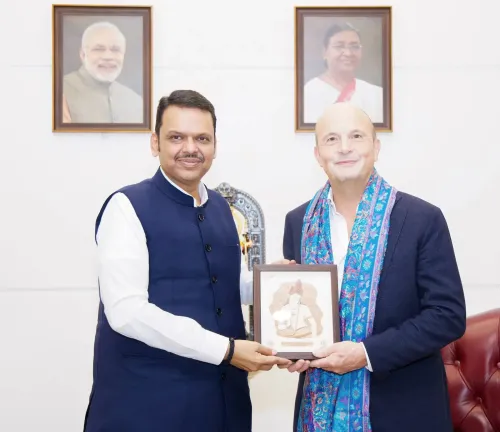
CM Fadnavis Welcomes AstraZeneca's New Mumbai HQ

Synopsis
Maharashtra CM Devendra Fadnavis publicly welcomed AstraZeneca on 16 October 2026 as the British-Swedish pharma giant inaugurated its new international headquarters in Mumbai, signalling a major vote of confidence in Maharashtra as a global life-sciences destination.
Key Takeaways
AstraZeneca inaugurated its new international headquarters in Mumbai on 16 October 2026 .
CM Devendra Fadnavis extended a bilingual English-Marathi welcome on X, calling it 'your new international address'.
AstraZeneca is a British-Swedish multinational pharmaceutical and biotechnology company with existing operations in India.
Mumbai , as Maharashtra's capital and India's financial centre, is a prime destination for multinational corporate headquarters.
Maharashtra has consistently competed with other states to attract pharmaceutical and life-sciences investment through infrastructure and ease-of-business measures.
Details on headcount, operational scope, and state incentives linked to the new headquarters are yet to be announced publicly.
A global pharmaceutical giant has planted its international flag in India's financial capital — and Maharashtra's Chief Minister was first to say welcome. Maharashtra Chief Minister Devendra Fadnavis on Friday, 16 October 2026, extended a public greeting to AstraZeneca as the British-Swedish multinational inaugurated its new international headquarters in Mumbai.
Posting in both English and Marathi, Fadnavis wrote: 'Welcome to Mumbai, AstraZeneca! Congratulations on your new international address.' The Marathi line — ॲस्ट्राझेनेका, मुंबईत आपले स्वागत! नव्या आंतरराष्ट्रीय मुख्यालयाच्या शुभारंभासाठी शुभेच्छा ('AstraZeneca, welcome to Mumbai! Best wishes on the inauguration of your new international headquarters') — signals the personal weight the state government is placing on the milestone.
Why Mumbai, and Why Now
Mumbai has long been the preferred landing pad for multinationals seeking an India base — a deep talent pool, established financial infrastructure, and proximity to the country's largest consumer market make it a natural choice. For AstraZeneca, a company with existing operations across India, formalising an international headquarters here is a step up in commitment, not a first entry.
Maharashtra governments across administrations have competed aggressively with states like Karnataka, Telangana, and Gujarat to keep big-ticket corporate addresses on home turf. Pharmaceutical and life-sciences firms have been a recurring priority in that competition, given the sector's alignment with both employment generation and export potential.
AstraZeneca's India Footprint and What Comes Next
AstraZeneca is one of the world's largest pharmaceutical and biotechnology companies, with a portfolio spanning oncology, cardiovascular, and respiratory drugs. India is a critical market — both as a sales destination and as a manufacturing and R&D hub. An international headquarters in Mumbai could consolidate regional decision-making and signal deeper investment in the subcontinent's fast-growing healthcare economy.
The precise scale of the new headquarters — headcount, operational scope, and any state incentives linked to the move — has not been detailed publicly. Those numbers, when they emerge, will be the real measure of what this address change means for Maharashtra's economy.
For now, the CM's bilingual welcome is a clear signal: Mumbai is open for global pharma business, and Maharashtra intends to keep it that way.
Point of View
A public bilateral-language welcome on social media is low-cost signalling with a clear audience: other multinationals weighing India entry points. The real test will be whether the state follows the headline with concrete incentive disclosures — employment commitments, R&D investment figures, or infrastructure support — because rival states will be watching. In a competitive federalism landscape, the announcement matters, but the follow-through is what builds the track record.
NationPress
16 Oct 2026
Frequently Asked Questions
Where has AstraZeneca opened its new international headquarters?
AstraZeneca inaugurated its new international headquarters in Mumbai , Maharashtra, on 16 October 2026 , as confirmed by Maharashtra CM Devendra Fadnavis's public welcome post on X.
What did CM Devendra Fadnavis say about AstraZeneca coming to Mumbai?
CM Devendra Fadnavis posted a bilingual welcome on X, writing 'Welcome to Mumbai, AstraZeneca! Congratulations on your new international address' in English and extending the same greeting in Marathi.
Why is AstraZeneca setting up its international headquarters in Mumbai?
Mumbai is India's financial capital with deep talent pools, established infrastructure, and access to one of the world's largest consumer markets — factors that make it a top choice for multinational corporations seeking an India or regional base.
What is AstraZeneca's existing presence in India?
AstraZeneca is a British-Swedish pharmaceutical and biotechnology company that already had operations in India before this headquarters inauguration, covering areas including oncology, cardiovascular, and respiratory medicine.
How does Maharashtra attract pharmaceutical companies?
Maharashtra has long competed with other Indian states by offering infrastructure support and ease-of-business measures, with pharmaceutical and life-sciences firms being a recurring priority for state investment promotion efforts.