Rahul, Priyanka's street aggression: Congress fight for Opposition No. 2
Synopsis
The Gandhi siblings have gone from parliamentary to pavement politics — but the street aggression is less about confronting the BJP and more about who leads the Opposition. With Kejriwal sitting out Congress marches and Akhilesh Yadav eyeing UP 2027, the fight for the number-two spot is turning as fierce as the fight against number one.
Key Takeaways
Rahul Gandhi and Priyanka Gandhi Vadra have adopted a markedly more aggressive street-protest style, including physical altercations with police and dramatic public gestures.
The shift mirrors the CJP-style protests of July 2026 , which led to the resignation of then Education Minister Dharmendra Pradhan .
AAP chief Arvind Kejriwal skipped the recent Congress-led march to President Droupadi Murmu , signalling ongoing distance between the two Opposition parties.
Samajwadi Party chief Akhilesh Yadav joined the march but remains primarily focused on the 2027 Uttar Pradesh Assembly elections .
Congress lost the Nagaon Lok Sabha seat in Assam in recent bypolls, underlining the gap between protest momentum and electoral performance.
With seven states going to polls in 2027 , intra-Opposition competition is expected to intensify further.
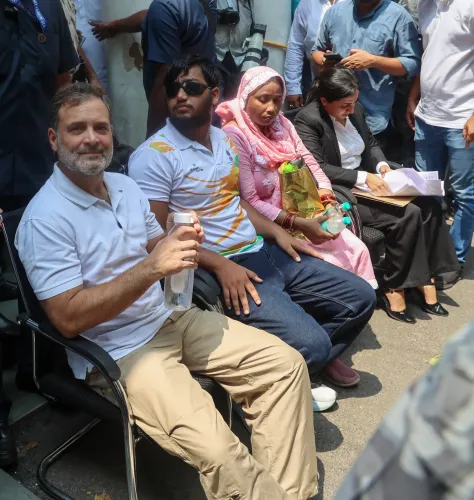
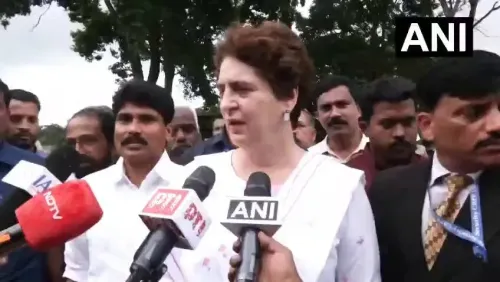
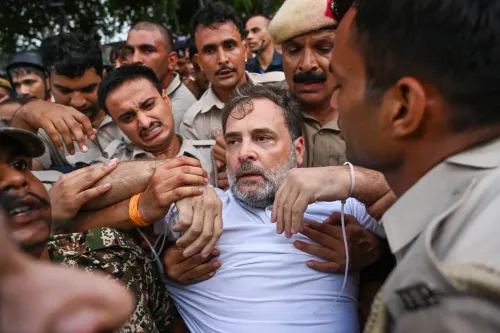
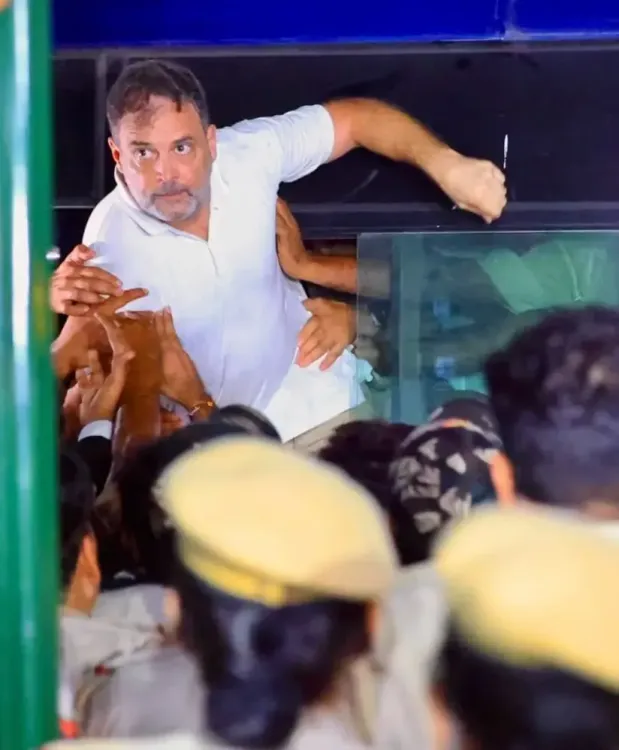
Rahul Gandhi and Priyanka Gandhi Vadra have visibly shifted gears in their political style, trading parliamentary sparring for dramatic street confrontations — elbowing police personnel, dangling from buses, lying on roads and attempting to storm government offices. The escalation, analysts argue, is as much about asserting Congress's primacy within a fractured Opposition as it is about taking on the Bharatiya Janata Party (BJP).
The Street Theatre Explained
The Gandhi siblings' recent agitations bear a striking resemblance to the CJP-style protests first witnessed in July, a wave of street action that culminated in the resignation of then Union Education Minister Dharmendra Pradhan. The visual grammar is familiar: confrontation with security forces, attempts to breach official premises, and scenes engineered for maximum social-media circulation. Every elbow and every shout becomes a clip. Every clip becomes a campaign.
Critics argue, however, that louder protests do not automatically translate into more effective politics. The distinction between being seen as a fighter and actually moving the political needle is one that Congress has historically struggled to close.
The Battle for Opposition Number Two
With the BJP firmly entrenched at the top of national politics, the contest for the number-two position is intensifying — and it is not a straight fight between Congress and the BJP. Rahul Gandhi, as Leader of Opposition in the Lok Sabha, holds a constitutionally recognised position, but that title does not automatically confer leadership over the broader Opposition camp.
Regional satraps have their own power bases and are not easily dislodged. Aam Aadmi Party (AAP) chief Arvind Kejriwal, for instance, conspicuously skipped the recent Congress-led Opposition meeting and march to President Droupadi Murmu over Election Commission concerns. During the NEET controversy earlier this year, the AAP backed the CJP agitation at Jantar Mantar while Congress mounted a separate protest — a telling divergence that underscores how the two parties operate on parallel tracks even when nominally sharing an adversary.
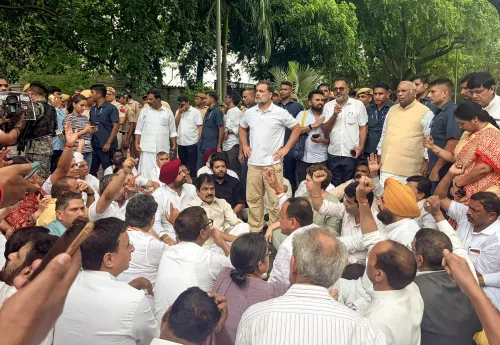
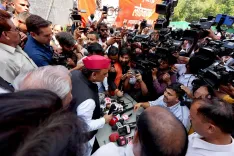
Samajwadi Party chief Akhilesh Yadav walked alongside Rahul Gandhi in the Election Commission march, yet his calculus is governed almost entirely by the 2027 Uttar Pradesh Assembly elections, where the Samajwadi Party enjoys a far stronger organisational footprint than Congress. He cannot afford to subordinate state-level electoral arithmetic to a national narrative scripted in New Delhi.
Congress's Electoral Reality Check
The street momentum runs into a hard electoral wall. Recent bypoll results have been sobering for Congress: it lost the Nagaon Lok Sabha seat in Assam — a constituency it had previously held — while the BJP posted significant gains in both Assam and West Bengal. These results do not resolve allegations of electoral irregularities raised by the Opposition, but they do sharpen the underlying challenge: sustained protest visibility has not yet converted into broadened voter support.
Notably, this is a recurring tension for Congress — keeping an issue alive in public discourse while simultaneously failing to capitalise on it at the ballot box.
Social Media, Virality and the Limits of Theatre
The modern information environment rewards drama. A political argument requiring several minutes of context can be distilled into seconds of a leader dangling from a vehicle or trading pushes with a police constable. The Gandhi siblings appear acutely aware of this dynamic; their recent actions have generated significant social-media traction. But political credibility, as observers frequently note, is built over election cycles, not content cycles. A viral moment buys attention; it does not buy votes.
What Lies Ahead
With seven states heading to polls in 2027 — including the high-stakes contest in Uttar Pradesh — the intra-Opposition competition is likely to grow sharper, not quieter. Punjab and Goa will test AAP's staying power outside Delhi; the Samajwadi Party will guard its UP turf; and Congress will seek to expand its footprint wherever the ground allows. Each party will have reasons to project strength, claim moral ownership of the anti-BJP space and resist being marginalised. Street protests will continue to be part of that toolkit. Whether they become more than a visual — whether they cohere into a credible political alternative — will ultimately be decided not by camera angles but by voters at the polling booth.
Point of View
And no amount of footage from Jantar Mantar or the Election Commission gates builds that by itself.
NationPress
11 Oct 2026
Frequently Asked Questions
Why have Rahul Gandhi and Priyanka Gandhi Vadra adopted more aggressive street protests?
The Gandhi siblings have escalated to street confrontations — including physical altercations with police — to keep Congress at the centre of national political discourse and assert its leadership within the broader Opposition. Critics argue the shift is also driven by the need to outperform rival Opposition leaders such as Arvind Kejriwal and Akhilesh Yadav, who have their own political bases and do not automatically defer to Congress.
Why did AAP skip the Congress-led march to President Droupadi Murmu?
The Aam Aadmi Party did not attend the recent Congress-led Opposition meeting or the subsequent march to President Droupadi Murmu over Election Commission concerns. The absence reflects AAP's effort to maintain its independent political identity and avoid being absorbed into a Congress-led narrative, even where the two parties share broad Opposition interests.
What do the recent bypoll results mean for Congress?
Congress lost the Nagaon Lok Sabha seat in Assam — a constituency it had previously held — while the BJP posted significant victories in Assam and West Bengal. The results underscore that protest visibility has not yet translated into expanded electoral support, and that Congress faces a substantial organisational challenge beyond its street campaigns.
How does Akhilesh Yadav's position complicate Congress's Opposition leadership ambitions?
Samajwadi Party chief Akhilesh Yadav has participated in joint Opposition actions but remains focused on the 2027 Uttar Pradesh Assembly elections, where his party's organisational strength dwarfs Congress's. He is unlikely to subordinate state-level electoral calculations to a national Congress-led agenda, limiting the cohesion of the India bloc.
What is at stake in the 2027 state elections for the Opposition?
Seven states are scheduled to go to the polls in 2027, with Uttar Pradesh being the most consequential given the Samajwadi Party's dominant position there. Punjab and Goa will test the AAP's durability outside Delhi, while Congress seeks to expand wherever it can. Each party has strong incentives to project independent strength, making a unified Opposition front difficult to maintain.