Who Were the Victims in the Fatal Car Crash in J&K's Rajouri?
Synopsis
A tragic road accident in Rajouri, J&K, resulted in the deaths of two individuals and injuries to three others. The collision occurred when their vehicle crashed into a roadside parapet, highlighting ongoing safety concerns in the region's hilly terrain. The local authorities have initiated an investigation into the incident.
Key Takeaways
Two fatalities resulted from a car crash in Rajouri.
Three individuals were injured and taken to a medical facility.
The incident highlights the need for better road safety measures.
Authorities are investigating the circumstances of the crash.
Traffic departments are enforcing stricter regulations to prevent similar accidents.
Jammu, Dec 3 (NationPress) Tragically, two individuals lost their lives and three others were injured in a road mishap on Wednesday in the Rajouri district of Jammu and Kashmir.
Authorities reported that a vehicle crashed into a roadside parapet near Chingus in the morning hours.
“A car (JK12D 7568) was traveling from Jammu to Rajouri when it collided with a parapet near Chingus at approximately 4:30 a.m. today. While two passengers died at the scene, three additional individuals were injured,” the police detailed.
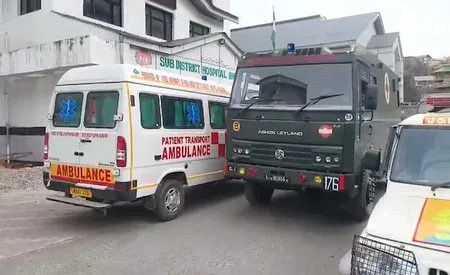
All injured parties were promptly transported to the Government Medical College in Rajouri for necessary medical care.
The victims have been identified as Naik Singh (53), son of Puran Singh, residing in Waripattan; and Mohd Yaqoob (45), son of Mohd Fazal, hailing from Saila Surankote.
The injured are Mohd Farooq, son of Mohd Fazal, from Saila Surankote; driver Mohd Sageer, son of Mohd Haneef, from Digwar Poonch; and Mohd Mushtaq, son of Fazal Hussain, from Kakora Manjakote.
“The local police station is actively investigating the incident,” stated the police.
The hilly regions of Poonch, Rajouri, Doda, Kishtwar, Ramban, and Reasi are notorious for road accidents attributed to the challenging terrain, overloading, excessive speed, road rage, and more.
To combat traffic violations in these areas, the traffic department has deployed specialized squads.
Regional Transport Officers (RTOs) routinely enforce public penalties for violators of traffic laws. For instances involving minors operating vehicles, penalties include parental imprisonment along with the cancellation of the vehicle's registration certificate.
Additionally, two-wheeled vehicles operated by riders without crash helmets frequently contribute to fatal accidents. Traffic officials conduct roadside camps aimed at educating two-wheeler operators and their passengers on the importance of wearing proper crash helmets. Fuel stations have been instructed to deny fuel to two-wheeled vehicles and passengers lacking helmets. During these sessions, traffic officials also distribute crash helmets to riders.
Point of View
It is crucial to provide our audience with timely and accurate reporting on incidents like the recent car crash in Rajouri. This tragedy highlights the urgent need for increased road safety measures in hilly regions, which are prone to accidents. We stand committed to advocating for public safety and raising awareness about the dangers of reckless driving.
NationPress
14 Sept 2026
Frequently Asked Questions
What caused the car accident in Rajouri?
The car accident was caused when a vehicle collided with a roadside parapet near Chingus, Rajouri.
How many people were affected by the accident?
Two individuals lost their lives, and three others sustained injuries in the accident.
What actions are being taken by authorities?
The local police have launched an investigation into the incident, and traffic departments are increasing safety measures.
What measures are in place to prevent such accidents?
Specialized traffic squads are deployed to monitor violations, and public penalties are enforced for traffic rule breaches.
Who were the victims of the accident?
The deceased were Naik Singh and Mohd Yaqoob, while the injured include Mohd Farooq, Mohd Sageer, and Mohd Mushtaq.