FSDC meets under Sitharaman to bolster India's financial stability amid global risks
Synopsis
With global bond yields surging and geopolitical risks multiplying, India's top financial regulators gathered under Finance Minister Sitharaman to stress-test the country's defences. The FSDC meeting was notable for its cyber security focus — including a new sector-wide strategy and a push to harden Regional Rural Banks — alongside a call to accelerate refunds of unclaimed financial assets to citizens.
Key Takeaways
The FSDC met on 23 October 2026 in New Delhi , chaired by Finance Minister Nirmala Sitharaman , to review India's macro-financial stability.
Key risks flagged: geopolitical uncertainties , the AI boom , and a steep rise in global bond yields .
The Council reviewed the Financial Sector Cyber Security Strategy (FSCSS) , covering Critical Information Infrastructure and cybersecurity of Regional Rural Banks .
Reforms discussed include KYC digitalisation , NRI and FPI digital onboarding , tokenisation of financial assets , and scaling up the Account Aggregator and ULI frameworks for MSMEs .
Sitharaman urged expedited refund of unclaimed assets — including bank deposits, shares, and pension funds — under the 'Your Money, Your Right' campaign.
Meeting attended by RBI Governor Sanjay Malhotra , SEBI chief Tuhin Kanta Pandey , and CERT-In DG Sanjay Bahl , among others.
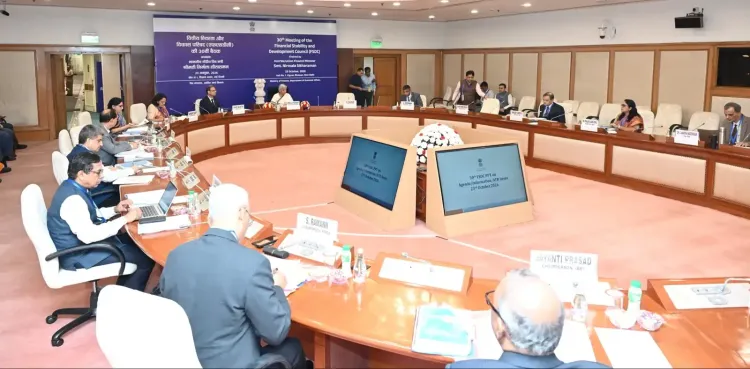
The Financial Stability and Development Council (FSDC) convened on Friday, 23 October 2026, in New Delhi under the chairmanship of Finance Minister Nirmala Sitharaman to deliberate on India's macro-financial resilience, capital flow enhancement, and deepening financial sector reforms. The high-level meeting took stock of mounting global uncertainties — including geopolitical tensions, the artificial intelligence boom, and a steep rise in global bond yields — and stressed the urgency of proactive risk mitigation.
Key Concerns on the Table
The Council acknowledged emerging trends in both domestic and global macro-financial conditions, underscoring the need for sustained vigilance. Members expressed particular concern over the interplay of ongoing geopolitical headwinds, rapid developments in artificial intelligence, and elevated global bond yields — a combination that, according to the Council, poses complex risks to financial stability.
Finance Minister Sitharaman urged the Council to hold its meetings at more frequent intervals with a pre-defined schedule, signalling a shift toward a more institutionalised monitoring posture in the face of fast-moving global risks.
Cyber Resilience and Digital Modernisation
A significant portion of the deliberations focused on cybersecurity. The Council reviewed the Financial Sector Cyber Security Strategy (FSCSS), formulated by an Inter-Ministerial Group comprising financial sector regulators and cybersecurity agencies in coordination with the Finance Ministry and the Ministry of Electronics and Information Technology (MeitY). The implementation of the FSCSS is expected to strengthen the overall resilience of the Indian financial sector.
Discussions also covered India's preparedness to protect Critical Information Infrastructure, improvements to protection systems, and enhancing cybersecurity readiness of Regional Rural Banks (RRBs) — a segment often considered the weakest link in the financial system's digital defences.
Separately, the Council discussed measures to promote innovation in the Fintech sector and explored prospects of tokenisation of financial assets and other real-world assets, reflecting growing regulatory attention to emerging asset classes.
Structural Reforms and Ecosystem Development
The FSDC took up several reform priorities aligned with recent budget announcements, including strengthening the domestic investment ecosystem and improving resource flows — notably into the GIFT-IFSC. Other items on the agenda included simplification and digitalisation of KYC processes, digital onboarding for NRIs and Foreign Portfolio Investors (FPIs), and scaling up Digital Public Infrastructure (DPI) platforms such as the Account Aggregator and Unified Lending Interface (ULI) framework, with a specific focus on MSMEs.
The Council also discussed reducing the cost of intermediation in the financial sector, improving regulatory responsiveness, and rationalising Credit Guarantee Schemes — reforms that could meaningfully expand credit access for small businesses and underserved borrowers.
Unclaimed Assets: Your Money, Your Right
Finance Minister Sitharaman urged all regulators and stakeholders to expedite the refund of unclaimed financial assets — including bank deposits, dividends, shares, post office accounts, insurance funds, and pension funds — to their rightful owners. The FSDC noted the progress achieved under the 'Your Money, Your Right' campaign at the district level and directed Ministries and Regulators to intensify efforts for timely restitution.
Who Attended the Meeting
The meeting was attended by Reserve Bank of India (RBI) Governor Sanjay Malhotra, Secretaries in the Finance Ministry, MeitY Secretary S. Krishnan, Securities and Exchange Board of India (SEBI) chief Tuhin Kanta Pandey, and Indian Computer Emergency Response Team (CERT-In) Director General Sanjay Bahl. The presence of CERT-In leadership alongside financial regulators underscores the growing convergence of cybersecurity and financial oversight at the highest policy level.
The FSDC's renewed emphasis on inter-regulatory coordination and scheduled review meetings suggests India is recalibrating its financial stability architecture ahead of what regulators view as a potentially turbulent global cycle.
Point of View
Scheduled meetings is a quiet but significant signal — it suggests regulators believe the window for reactive governance is narrowing as global risks compound. What stands out is the inclusion of CERT-In at the table alongside RBI and SEBI: cyber threats are no longer an IT department concern but a systemic financial risk. The push on unclaimed assets, while humanitarian in framing, also reflects a latent capital mobilisation opportunity worth thousands of crores. The real accountability test, however, lies in whether the FSCSS and DPI reform commitments are tracked against timelines — or quietly deferred, as past inter-regulatory coordination exercises have tended to be.
NationPress
23 Oct 2026
Frequently Asked Questions
What is the FSDC and why did it meet on 23 October 2026?
The Financial Stability and Development Council (FSDC) is India's apex body for macro-financial oversight, chaired by the Finance Minister. It met on 23 October 2026 to review domestic and global macro-financial risks — including geopolitical tensions, rising global bond yields, and AI-related disruptions — and to discuss financial sector reforms.
What is the Financial Sector Cyber Security Strategy (FSCSS)?
The FSCSS is a sector-wide cybersecurity framework formulated by an Inter-Ministerial Group comprising financial regulators and cybersecurity agencies, coordinated by the Finance Ministry and MeitY. Its implementation is intended to strengthen the resilience of India's financial sector against cyber threats, including protection of Critical Information Infrastructure and improved preparedness of Regional Rural Banks.
What is the 'Your Money, Your Right' campaign?
'Your Money, Your Right' is a government-led campaign operating at the district level to return unclaimed financial assets — such as dormant bank deposits, unpaid dividends, shares, post office accounts, and insurance or pension funds — to their rightful owners. The FSDC noted its progress and directed regulators to intensify restitution efforts.
Which financial sector reforms were discussed at the FSDC meeting?
Reforms discussed include digitalisation and simplification of KYC, digital onboarding for NRIs and Foreign Portfolio Investors, tokenisation of financial and real-world assets, scaling up the Account Aggregator and Unified Lending Interface frameworks for MSMEs, reducing intermediation costs, and rationalising Credit Guarantee Schemes.
Who attended the FSDC meeting on 23 October 2026?
The meeting was attended by RBI Governor Sanjay Malhotra, Finance Ministry Secretaries, MeitY Secretary S. Krishnan, SEBI chief Tuhin Kanta Pandey, and CERT-In Director General Sanjay Bahl, alongside Finance Minister Nirmala Sitharaman who chaired the session.