Gadkari Pays Tribute to Industrialist Dorabji Tata on Death Anniversary
Synopsis
Union Road Transport and Highways Minister Nitin Gadkari paid homage to early Indian industrialist Dorabji Tata on his death anniversary, calling him a 'great businessman'. The brief X post, accompanied by a video, marks the legacy of the Tata Sons chairman who led the founding of Tata Iron and Steel in 1907 and Tata Hydro-Electric Power.
Key Takeaways
Union Minister Nitin Gadkari posted a tribute to Dorabji Tata on 3 June 2026 , his death anniversary.
Gadkari called Dorabji Tata a 'great businessman' and shared a video with the hashtag #DorabjiTata.
Dorabji Tata chaired Tata Sons and led the founding of the Tata Iron and Steel Company in 1907 .
The Jamshedpur steel plant began production in 1912 , becoming India's first major indigenous integrated steel facility.
He also established Tata Hydro-Electric Power and endowed the Sir Dorabji Tata Trust .
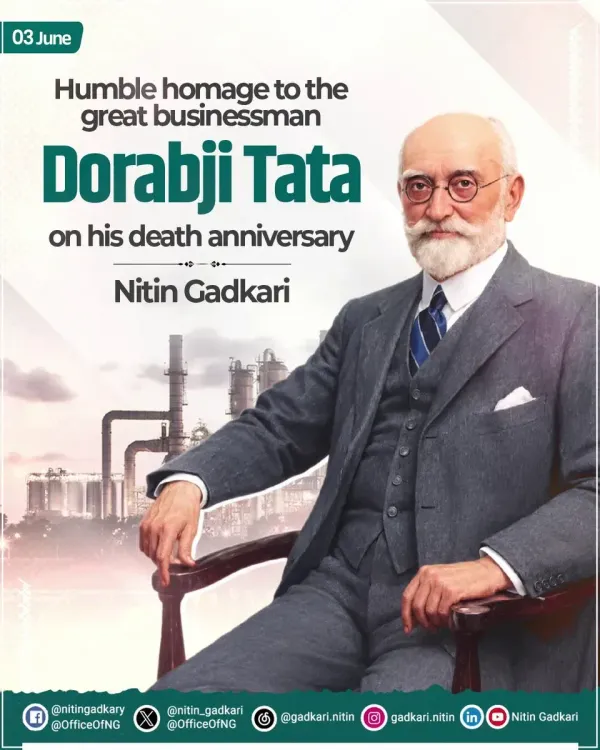
Union Road Transport and Highways Minister Nitin Gadkari on Wednesday, 3 June 2026, paid tribute to early Indian industrialist Dorabji Tata on his death anniversary, describing him as a 'great businessman' in a brief post on X. The minister accompanied the message with a short video and the hashtag #DorabjiTata.
In his post, Gadkari wrote, 'Humble homage to the great businessman Dorabji Tata on his death anniversary.' The tribute marks the anniversary of Dorabji Tata's passing on 3 June 1932, nearly a century after he helped lay the foundations of Indian heavy industry.
Context
Dorabji Tata, the eldest son of group founder Jamsetji Tata, chaired Tata Sons in the early decades of the twentieth century and steered the establishment of the Tata Iron and Steel Company in 1907. The Jamshedpur plant began production in 1912, becoming India's first major indigenous integrated steel facility at a time when the country was still under colonial rule.
He also led the creation of Tata Hydro-Electric Power, supplying electricity to industrial Bombay, and channelled a substantial part of the family fortune into the Sir Dorabji Tata Trust, which remains one of India's oldest philanthropic institutions.
Policy backdrop
Tributes from senior Union ministers to pre-independence industrialists have become a recurring feature of public commemoration, situating present-day economic priorities within a longer arc of indigenous enterprise. Steel, power and heavy engineering — the sectors pioneered by the early Tata Group — remain central to the government's stated push on manufacturing capacity and infrastructure build-out.
Gadkari, who oversees the country's largest civil works portfolio through the Ministry of Road Transport and Highways, has frequently linked highway expansion to demand for domestic steel, cement and construction equipment. His tribute to a founding figure of Indian steelmaking sits within that broader narrative of public works powered by home-grown materials.
Stakeholders and impact
For Tata Trusts and the wider Tata Group, ministerial acknowledgements of family founders reinforce the conglomerate's status as a continuity institution in Indian industry, spanning steel, automobiles, aviation, software and consumer goods. The group's philanthropic vehicles, several of which trace their origin to Dorabji Tata's bequests, continue to fund research, healthcare and higher education across the country.
For Indian industry more broadly, such observances reaffirm the political space accorded to legacy private capital, even as the government pursues newer manufacturing incentives and infrastructure tenders. Commemorative posts of this nature typically draw engagement from corporate executives, industry associations and historians of Indian business.
What's next
Gadkari's post does not announce any policy measure or programme, and is confined to the commemorative occasion. Attention will turn next to upcoming infrastructure reviews and parliamentary discussions on manufacturing, where references to early industrial pioneers and to current steel and highway capacity are likely to recur.
The tribute underlines a familiar pattern in which senior ministers use anniversaries of foundational industrialists to bridge historical enterprise with the present government's stated infrastructure and self-reliance agenda.
Point of View
The road transport minister implicitly connects highway-led demand for steel and cement to a legacy of indigenous heavy industry. The post is ceremonial rather than programmatic, but such commemorations subtly reinforce the political legitimacy of legacy private capital alongside newer self-reliance initiatives.
NationPress
25 Sept 2026
Frequently Asked Questions
Who was Dorabji Tata?
Dorabji Tata was the eldest son of Jamsetji Tata and chaired Tata Sons in the early twentieth century. He led the establishment of the Tata Iron and Steel Company in 1907 and Tata Hydro-Electric Power, and endowed the Sir Dorabji Tata Trust.
When did Dorabji Tata die?
Dorabji Tata's widely recorded death date is 3 June 1932. His death anniversary is observed each year on this date by members of the Tata Group and admirers of early Indian industry.
What did Nitin Gadkari say about Dorabji Tata?
Nitin Gadkari called Dorabji Tata a 'great businessman' and offered a 'humble homage' on his death anniversary in a brief post on X. The post was accompanied by a short video and the hashtag #DorabjiTata.
What companies did Dorabji Tata help establish?
Dorabji Tata played a central role in setting up the Tata Iron and Steel Company in 1907, which began production at Jamshedpur in 1912. He also led the founding of Tata Hydro-Electric Power, supplying electricity to industrial Bombay.
What is the Sir Dorabji Tata Trust?
The Sir Dorabji Tata Trust is one of India's oldest philanthropic institutions, funded by a substantial part of Dorabji Tata's personal fortune. It supports research, healthcare and higher education across India.