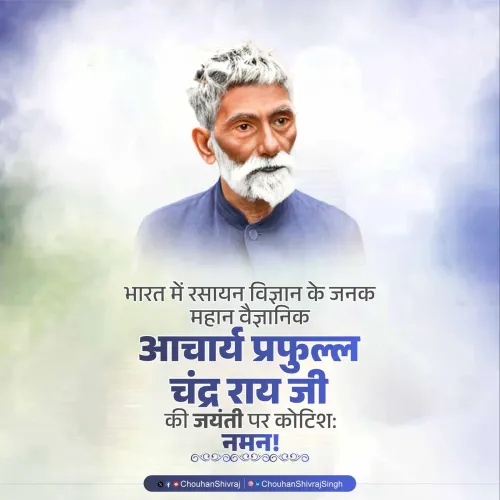
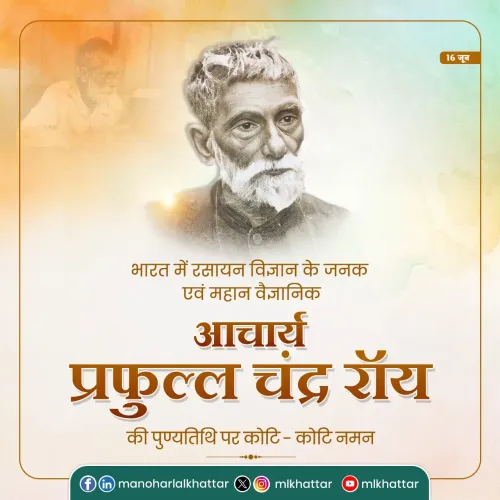
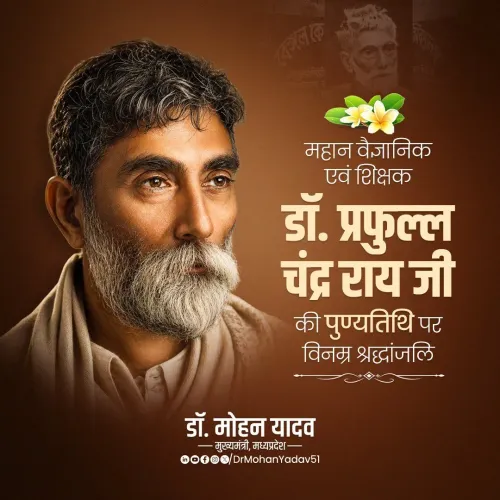
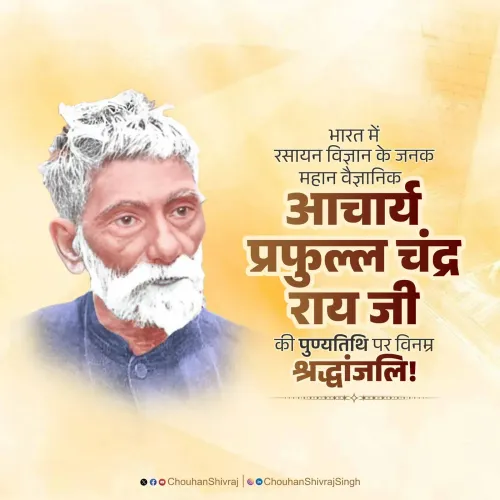
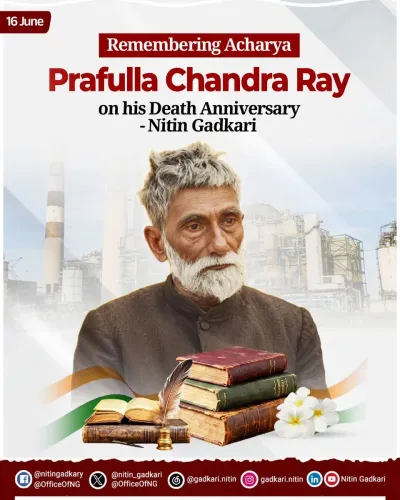
Gadkari Remembers Acharya P C Ray on Birth Anniversary
Synopsis
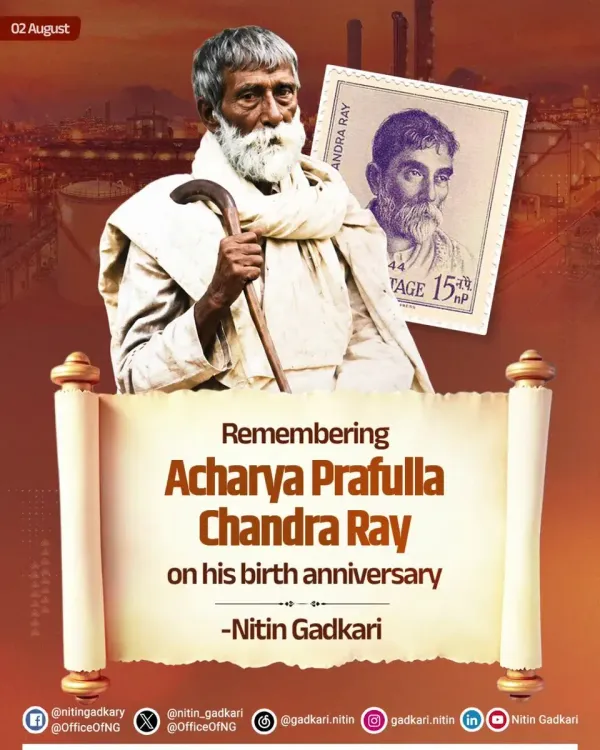
Union Minister Nitin Gadkari marked the birth anniversary of Acharya Prafulla Chandra Ray on 2 August 2026, honouring the chemist, educationalist and philanthropist credited as the father of chemical science in India and founder of Bengal Chemical and Pharmaceutical Works.
Key Takeaways
Union Minister Nitin Gadkari paid tribute to Acharya Prafulla Chandra Ray on his birth anniversary, 2 August 2026 .
Ray was born on 2 August 1861 and is widely regarded as the father of chemical science in India.
He isolated mercurous nitrite in 1896 , a landmark discovery in Indian chemistry.
Ray founded Bengal Chemical and Pharmaceutical Works in 1901 , one of India's first indigenous pharmaceutical enterprises.
He taught at Presidency College, Calcutta and authored the two-volume History of Hindu Chemistry .
Official tributes to pre-independence scientists form part of a broader pattern of commemorating India's scientific and intellectual heritage.
On the 163rd birth anniversary of Acharya Prafulla Chandra Ray, Union Road Transport and Highways Minister Nitin Gadkari paid tribute on Sunday, 2 August 2026 to the man widely regarded as the father of chemical science in India — a polymath whose legacy spans the laboratory, the lecture hall, and the ledger of modern Indian industry.
Gadkari remembered Ray as 'an eminent chemist, educationalist, historian and philanthropist,' invoking the full breadth of a life that was never confined to a single discipline. Born on 2 August 1861 in Raruli-Katipara, in what is now Bangladesh, Ray would go on to reshape Indian science from the ground up.
The chemist who built a laboratory and an industry
Ray's most enduring scientific contribution was the isolation of mercurous nitrite in 1896 — a discovery that drew international attention to Indian chemistry at a time when the colonial world barely acknowledged the subcontinent's scientific capacity. But Ray refused to let discovery stop at the journal page. In 1901, he founded Bengal Chemical and Pharmaceutical Works, one of India's earliest indigenous pharmaceutical and chemical enterprises, turning scientific knowledge directly into industrial self-reliance decades before it became a political slogan.
He taught at Presidency College, Calcutta, where his students included figures who would themselves shape Indian science. His two-volume 'History of Hindu Chemistry' was a scholarly assertion that India's chemical tradition was ancient, rigorous, and worthy of global study.
Why ministers keep returning to Ray's name
Gadkari's tribute is part of a consistent pattern of official commemoration of pre-independence scientists and intellectuals — figures whose contributions to industry, education, and national confidence sit at the intersection of heritage and aspiration. Ray represents something specific in that canon: a scientist who was equally an entrepreneur and an institution-builder, qualities that resonate with contemporary policy emphasis on indigenous manufacturing and scientific self-sufficiency.
On a birth anniversary that falls every year, it is the why of remembrance that carries weight. Ray did not just discover — he built, he taught, he wrote, and he invested his Nobel Prize prize money and personal savings back into Indian science. That full picture is what Gadkari's tribute, brief as it is, gestures toward.
A century and a half on, the father of Indian chemistry still has things to teach about what it means to turn knowledge into national capability.
Point of View
Indigenous enterprise, and institution-building maps neatly onto the current government's 'Atmanirbhar Bharat' narrative. Indian ministers have increasingly used birth anniversaries of pre-independence figures to draw implicit lines between historical achievement and present-day policy ambitions. Ray, as both a chemist and a pharmaceutical entrepreneur, is a particularly apt figure for that framing. The commemoration carries no direct policy weight, but it contributes to a sustained effort to anchor modern industrial aspiration in a longer national story.
NationPress
16 Sept 2026
Frequently Asked Questions
Who was Acharya Prafulla Chandra Ray?
Acharya Prafulla Chandra Ray (1861–1944) was an Indian chemist, educationalist, historian and philanthropist widely regarded as the father of chemical science in India. He isolated mercurous nitrite in 1896 and founded Bengal Chemical and Pharmaceutical Works in 1901.
Why is Prafulla Chandra Ray called the father of Indian chemistry?
Ray is called the father of Indian chemistry because he pioneered original chemical research in colonial India, established the country's first major indigenous pharmaceutical company, and trained generations of Indian scientists at Presidency College, Calcutta.
What did Nitin Gadkari say about Prafulla Chandra Ray?
Gadkari described Ray as 'an eminent chemist, educationalist, historian and philanthropist' and the father of chemical science in India, paying tribute on his birth anniversary on 2 August 2026.
What is Bengal Chemical and Pharmaceutical Works?
Bengal Chemical and Pharmaceutical Works is one of India's earliest indigenous pharmaceutical and chemical enterprises, founded by Prafulla Chandra Ray in 1901 in Calcutta as an effort to build Indian industrial self-reliance through science.
When is Prafulla Chandra Ray's birth anniversary?
Prafulla Chandra Ray was born on 2 August 1861, so his birth anniversary is observed every year on 2 August.