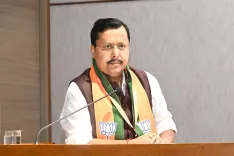
Gadkari pays tribute to Annasaheb Patil on his birth anniversary
Synopsis
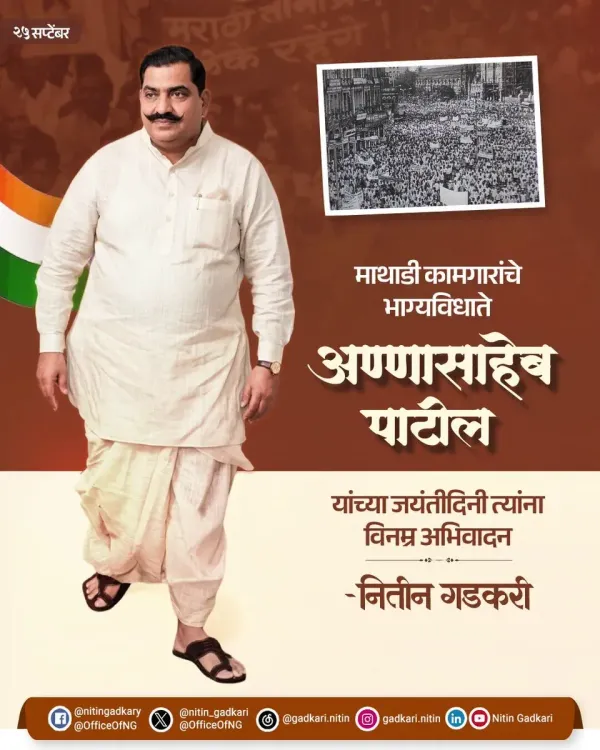
Union Minister Nitin Gadkari on September 25, 2026, honoured Maharashtra labour leader Annasaheb Patil on his birth anniversary, calling him an 'indomitable leader' who dedicated his life to Mathadi headload workers and their welfare.
Key Takeaways
Union Minister Nitin Gadkari posted a tribute to Annasaheb Patil on his birth anniversary on September 25, 2026 .
Gadkari described Patil as an 'indomitable leader' who 'dedicated his life to the welfare of Mathadi workers.' Mathadi workers are headload labourers in Maharashtra's markets and transport sectors — one of the most vulnerable segments of the unorganised workforce.
The Maharashtra Mathadi Hamal and Other Manual Workers (Regulation of Employment and Welfare) Act, 1969 created welfare boards inspired by the movement Patil championed.
Senior leaders across parties regularly mark anniversaries of Maharashtra's labour icons, reflecting the political and social weight of Mathadi unions in the state.
A quiet but pointed salute from the highest offices of government — Union Road Transport and Highways Minister Nitin Gadkari on Friday, September 25, 2026, paid homage to Annasaheb Patil, the Maharashtra labour leader who devoted his life to the welfare of Mathadi workers, on the occasion of Patil's birth anniversary.
Posting in Marathi, Gadkari wrote: 'झुंजार नेतृत्व अण्णासाहेब पाटील यांनी माथाडी कामगारांच्या कल्याणासाठी आपले आयुष्य वेचले.' — 'Indomitable leader Annasaheb Patil dedicated his life to the welfare of Mathadi workers.' He added a 'humble salute' on this birth anniversary.
The Mathadi workers Annasaheb Patil championed
Mathadi workers — headload labourers who carry goods manually in markets, warehouses, and transport yards — have long occupied one of the most physically gruelling and economically precarious corners of Maharashtra's unorganised labour force. Annasaheb Patil became a defining voice for this community, steering public and political attention toward their basic rights and social security at a time when such workers had little institutional protection. The legislative landmark of that era was the Maharashtra Mathadi Hamal and Other Manual Workers (Regulation of Employment and Welfare) Act, 1969, which established tripartite welfare boards to regulate employment and channel benefits to headload workers. The boards — funded by levies on establishments that use such labour — became a model for extending social security to workers outside the formal employment relationship. Patil's advocacy was embedded in the movement that made that framework possible.Why leaders from across parties mark the anniversary
In Maharashtra's political landscape, Mathadi unions carry both moral weight and organisational muscle. State and central leaders from across the ideological spectrum routinely issue public tributes on the birth and death anniversaries of labour figures who shaped the state's worker-welfare architecture. For a senior BJP leader like Gadkari — who also served as the party's national president — marking this anniversary signals continuity with the welfare tradition that Mathadi legislation represents, and acknowledges a constituency of manual workers whose social security depends on active board functioning. The welfare boards for unorganised-sector workers remain a live policy question: their financial health, the pace of benefit disbursal, and any potential expansion of similar protections to other categories of manual workers are areas that both state and central labour administrations revisit periodically. Annasaheb Patil's legacy, then, is not merely commemorative. It lives in the institutional machinery that hundreds of thousands of Mathadi workers rely on every day — and in the political responsibility leaders implicitly accept each time they invoke his name.Point of View
The 1969 Mathadi welfare framework. For a senior BJP leader with a national profile, such posts serve a dual purpose: affirming continuity with Maharashtra's labour-welfare history and maintaining visibility with a constituency of organised informal workers whose support matters at the state level. The timing also implicitly invites scrutiny of whether welfare boards are functioning at full capacity — a policy question that neither the post nor current reporting settles. Over time, the real test of such tributes is whether they coincide with measurable improvements in benefit disbursal and board governance for the workers Patil once championed.
NationPress
25 Sept 2026
Frequently Asked Questions
Who was Annasaheb Patil and why is he remembered?
Annasaheb Patil was a Maharashtra labour leader known for his advocacy on behalf of Mathadi (headload) workers in the state's markets and transport sectors, dedicating his life to improving their welfare and working conditions.
What are Mathadi workers?
Mathadi workers are headload labourers who manually carry goods in markets, warehouses, and transport yards. They form a significant part of Maharashtra's unorganised workforce and have long campaigned for social security protections.
What is the Maharashtra Mathadi welfare board?
The Maharashtra Mathadi Hamal and Other Manual Workers (Regulation of Employment and Welfare) Act, 1969 created tripartite welfare boards funded by levies on establishments that use headload labour, providing employment regulation and benefits to these workers.
Why did Nitin Gadkari pay tribute to Annasaheb Patil?
Gadkari paid tribute on the occasion of Annasaheb Patil's birth anniversary, honouring his lifelong contribution to Mathadi worker welfare — a tradition common among Maharashtra's political leaders across party lines.
What is the significance of Mathadi unions in Maharashtra politics?
Mathadi unions in Maharashtra carry significant moral and organisational influence. Leaders from major parties regularly acknowledge the community's labour icons, reflecting the political weight of organised informal workers in the state.