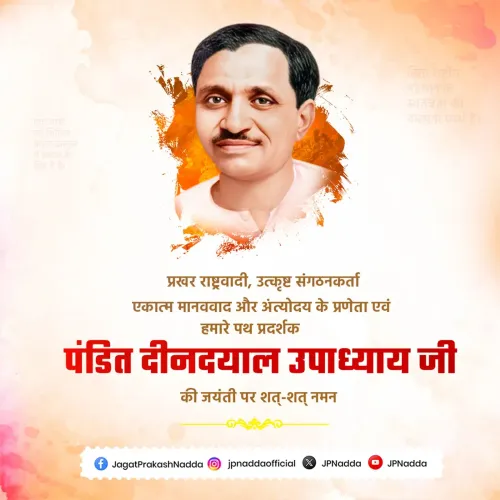
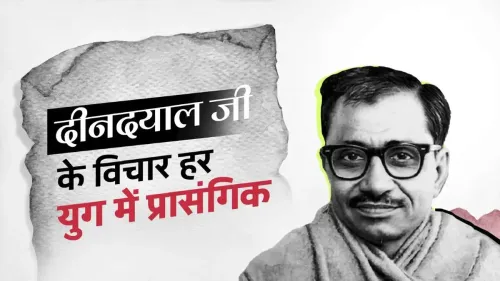
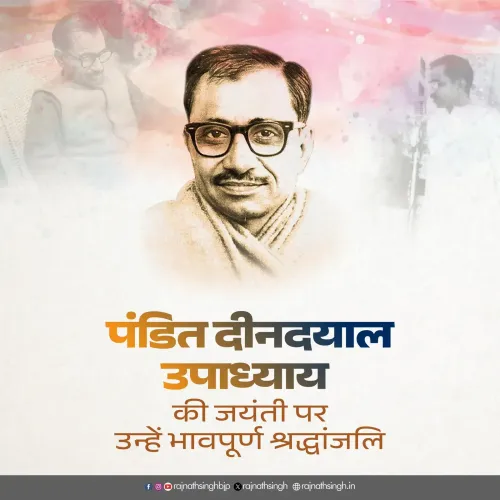
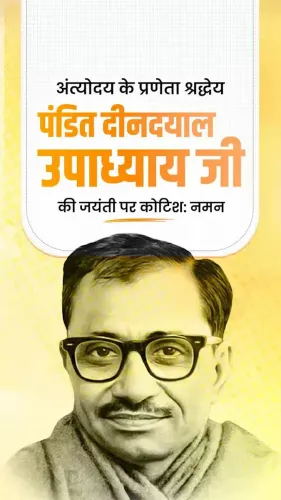
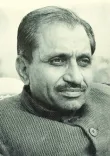
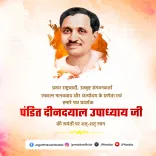
Khattar pays tribute to Deendayal Upadhyay on birth anniversary

Synopsis
Union Power Minister Manohar Lal Khattar paid tribute to Pandit Deendayal Upadhyay on his birth anniversary, honouring the BJP's ideological founder and connecting his Antyodaya philosophy to Prime Minister Modi's Viksit Bharat 2047 development vision.
Key Takeaways
Pandit Deendayal Upadhyay founded the Bharatiya Jana Sangh in 1951 and is the ideological ancestor of the BJP.
His Antyodaya philosophy centres on uplifting the last and poorest person in society.
The Antyodaya Anna Yojana (2000) is a direct policy descendant of Upadhyay's concept, extending food security to the most marginalised households.
Khattar linked Upadhyay's legacy to the BJP government's Viksit Bharat 2047 vision under PM Narendra Modi .
His Ekathman Manavvad (Integral Humanism) framework rejected both capitalism and communism in favour of an India-rooted civilisational model.
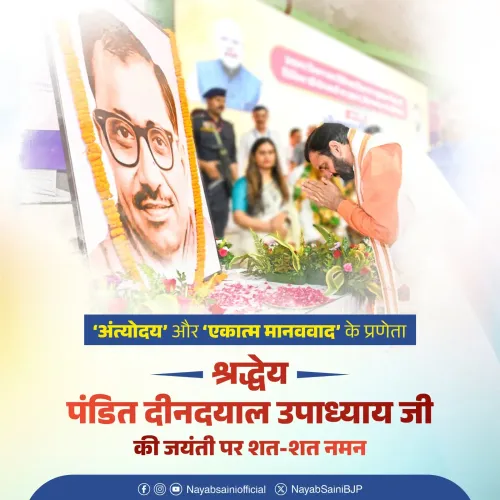
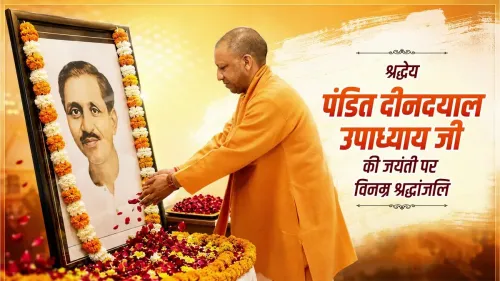
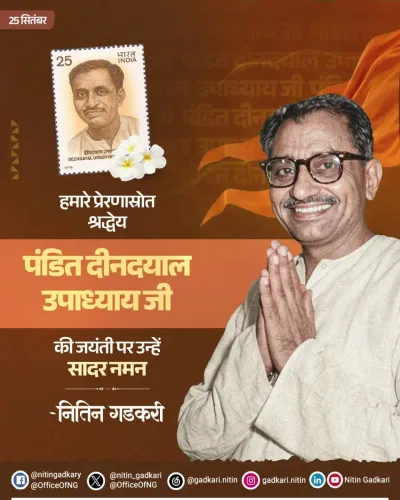
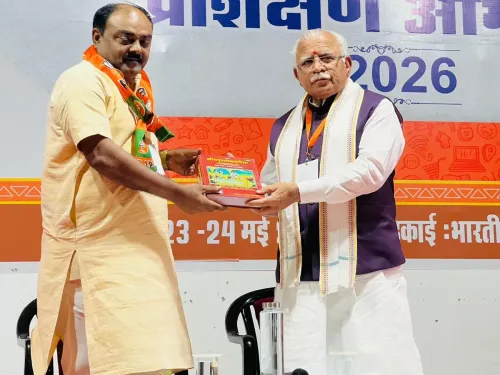
On the birth anniversary of Pandit Deendayal Upadhyay, Union Power Minister Manohar Lal Khattar honoured the ideological patriarch of the BJP, calling his life an 'unparalleled example of service, dedication, and patriotism' — and drawing a direct line from Upadhyay's Antyodaya philosophy to India's present-day development ambitions.
Khattar, posting on X on Friday, 25 September 2026, described Upadhyay as a 'great nationalist thinker, founder of Bharatiya Jana Sangh, and pioneer of Ekathman Manavvad (Integral Humanism).' He added that Upadhyay's principles would 'always inspire the people of the country to serve the public.'
The man behind Antyodaya — and why the BJP keeps invoking him
Pandit Deendayal Upadhyay founded the Bharatiya Jana Sangh in 1951 — the direct ideological ancestor of the BJP. His concept of Antyodaya — literally 'rise of the last person' — placed the welfare of the most marginalised citizen at the centre of political thought, at a time when mainstream discourse was dominated by Nehruvian socialism and Western liberalism.
His companion philosophy, Ekathman Manavvad (Integral Humanism), rejected both capitalism and communism in favour of a civilisational framework rooted in Indian cultural values. These ideas have since become the ideological bedrock on which the BJP frames its welfare outreach — from subsidised grain to rural electrification.
From philosophy to policy: Antyodaya's long journey into governance
The Antyodaya principle did not remain confined to party pamphlets. When the NDA government launched the Antyodaya Anna Yojana in 2000, it explicitly drew from Upadhyay's concept, extending food security to the poorest households in the country. The scheme became one of the most direct policy translations of a philosophical idea in post-Independence India.
Khattar's post goes further, arguing that under Prime Minister Narendra Modi, Upadhyay's 'priceless legacy of Antyodaya' is now playing 'an important role in the goal of achieving the Viksit Bharat (Developed India) resolve.' The framing is deliberate — it stitches together the party's founding ideology with its flagship Viksit Bharat 2047 vision, presenting continuity rather than departure.
For the BJP, marking Upadhyay's birth anniversary is both a ritual of ideological renewal and a public restatement of the party's roots. Senior leaders across the country use the occasion to remind workers — and voters — that the party's welfare agenda is not transactional politics but flows from a coherent philosophical tradition dating back 75 years.
The nation's poorest citizen, Upadhyay argued, must be the true measure of any government's success. That benchmark, articulated decades before 'last-mile delivery' became a policy buzzword, continues to be the standard the BJP holds itself to — at least in rhetoric. Whether the ledger balances is the question every budget cycle forces back onto the table.
Point of View
Khattar positions the Modi government's welfare agenda not as political pragmatism but as the organic fulfilment of a seven-decade philosophical tradition. This framing is strategically important: it gives the BJP's mass welfare schemes a civilisational legitimacy that transcends any single election cycle. The recurring invocation also signals to the party's rank and file that ideological grounding, not just electoral arithmetic, remains the stated organisational compass.
NationPress
25 Sept 2026
Frequently Asked Questions
Who was Pandit Deendayal Upadhyay?
Pandit Deendayal Upadhyay was a nationalist thinker who founded the Bharatiya Jana Sangh in 1951 — the party that later became the BJP. He is best known for his philosophy of Integral Humanism (Ekathman Manavvad) and the Antyodaya principle, which places the welfare of the poorest citizen at the centre of governance.
What is the Antyodaya principle?
Antyodaya, meaning 'rise of the last person,' is a philosophy articulated by Deendayal Upadhyay that measures a society's progress by how well it uplifts its most marginalised members. It directly inspired the Antyodaya Anna Yojana food security scheme launched by the NDA government in 2000.
When is Deendayal Upadhyay's birth anniversary?
Pandit Deendayal Upadhyay's birth anniversary falls on 25 September . It is observed annually by BJP leaders and workers as a day of ideological reflection and public tribute.
What is Ekathman Manavvad or Integral Humanism?
Integral Humanism is Deendayal Upadhyay's political philosophy that rejected both Western capitalism and Soviet communism, instead proposing a development model rooted in Indian civilisational and cultural values, with the individual, family, society, and nation seen as an integrated whole.
How does Antyodaya connect to Viksit Bharat 2047?
BJP leaders, including Manohar Lal Khattar, argue that Prime Minister Modi's Viksit Bharat 2047 vision — aimed at making India a developed nation by its centenary of Independence — draws its welfare philosophy directly from Upadhyay's Antyodaya concept, ensuring that development reaches the last person first.